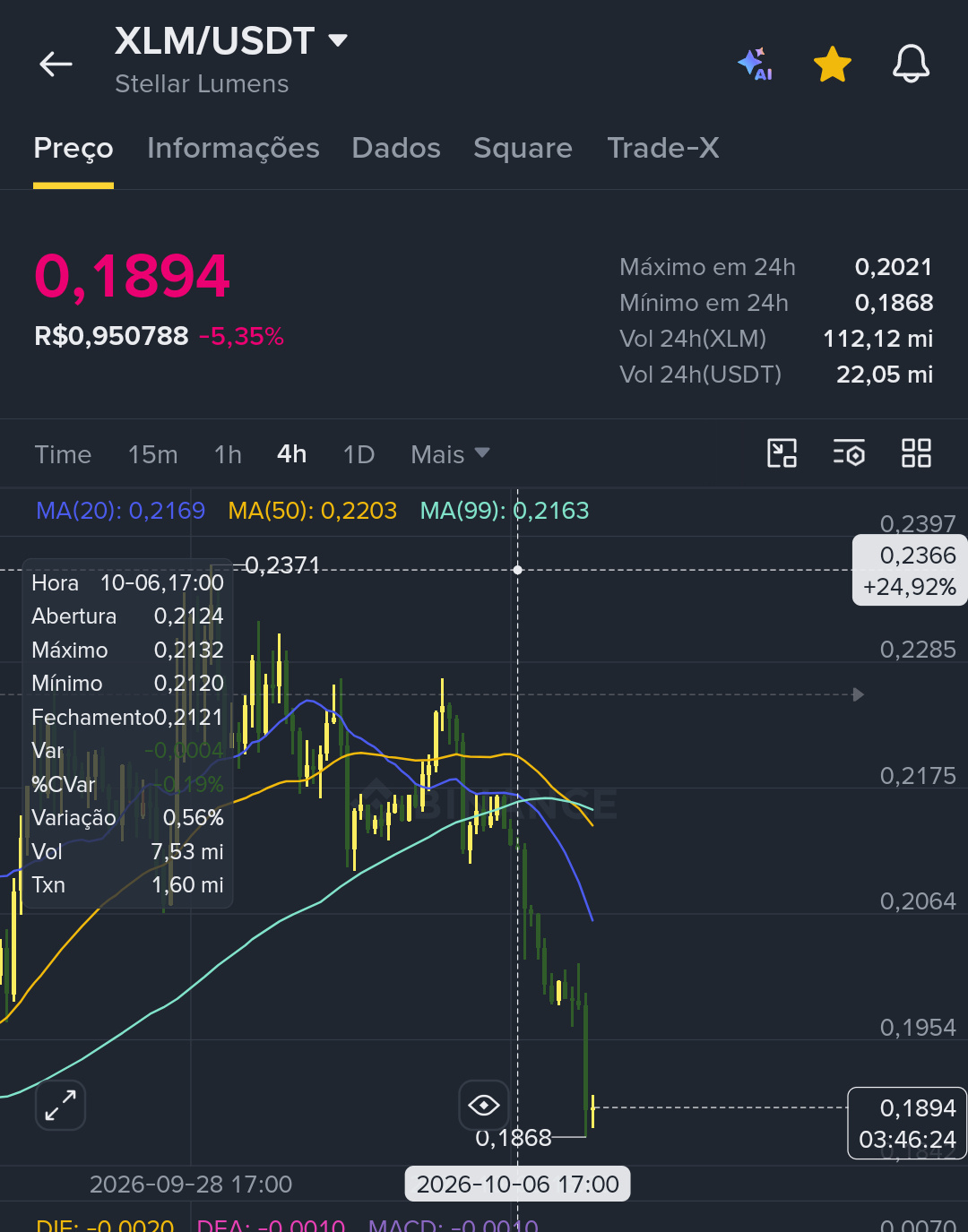

$XLM : PRICE CORRECTION FINDING AN EVER MORE INSTITUTIONAL STELLAR
XLM trades at $0.1899, after a correction of approximately 24% from the recent peak of $0.2271, recorded on October 5 on the 4-hour chart. In the past 24 hours, the XLM/USDT pair moved about $22 million on Binance, while total global volume reached approximately $215 million. Market capitalization is around $6.6 billion, placing the asset in 20th position, with about 35 billion XLM in circulation.
This drop follows the retracement of the altcoins and, so far, does not represent a specific deterioration for Stellar. Profit-taking began in early October and gained traction with the macroeconomic environment, including higher interest rates on U.S. Treasuries.
The difference is that, while the price corrects, Stellar’s infrastructure keeps moving forward.
An evolving network:
In July, Stellar activated Protocol 27, known as Zipper, introducing native authentication delegation mechanisms for smart accounts. In September, Protocol 28, called Adapter, went into effect, with improvements to consensus and features aimed at updating and migrating smart contracts. The update was activated on mainnet on September 16.
This development tracks the expansion of the Soroban ecosystem and reinforces Stellar’s strategy to act not just as a payments network, but as an infrastructure for on-chain financial applications.
Usage figures help support this evolution. In Q2 2026, tokenized real-world assets on Stellar surpassed $3 billion, while stablecoin transfers reached $11.4 billion—an all-time network record.
Institutional progress is the key point:
Another decisive factor was the American regulatory environment. In March 2026, the SEC and CFTC published a joint interpretation establishing a regulatory framework for different categories of cryptoassets. XLM is explicitly included among the assets classified as digital commodities.
That regulatory clarity strengthens the environment for institutional participation. On February 9, 2026, the CME began trading Lumens futures, creating regulated instruments for exposure and risk management involving XLM.
And institutional entry is no longer just a matter of expectation:
On September 29, the State Street Galaxy Onchain Liquidity Sweep Fund (SWEEP) went live on Stellar. The fund uses the network to provide on-chain liquidity management 24 hours a day, seven days a week, with participation from companies such as Galaxy, Anchorage, and Chainlink.
DTCC also announced the connection of its tokenization service to Stellar’s public blockchain, with expectations to make tokenized assets available on the network during the first half of 2027. This is one of the most relevant infrastructures in the U.S. financial market.
Payments, stablecoins, and tokenization:
The Stellar thesis also gained momentum with the expansion of its payments infrastructure.
MoneyGram, Figure Markets, and Range participate directly in the ecosystem, while Franklin Templeton keeps its tokenized fund, BENJI, on the network. The BVNK integration expands the stablecoin infrastructure, and the arrival of USDT0 connects Stellar to USDT’s global liquidity through a unified offering across different networks.
This is important because it places Stellar squarely in the segment where financial institutions are increasing their presence: international payments, stablecoins, settlement, and real-world assets.
However, there’s one point the investor needs to understand. Much of the network activity takes place using stablecoins, such as USDC and USDT, rather than XLM directly. Therefore, growth in Stellar usage does not automatically translate into the same proportion of demand for the token. This is one of the main issues that still needs to evolve for the XLM price to fully track the expansion of the infrastructure.
The correction creates a new entry window:
That’s exactly the combination that makes the current price relevant.
XLM is about 20% below October’s peak as Stellar accumulates protocol updates, expands tokenized assets, grows stablecoin usage, gains greater institutional access, and integrates with traditional financial infrastructure.
The CME already offers XLM futures. Regulatory classification has advanced. State Street has placed an institutional product on the network. DTCC is preparing its integration. And the use of Stellar in stablecoins and real-world assets continues to grow.
The calendar also remains relevant. Meridian 2026 takes place in Lisbon on October 28 and 29 and brings together participants from the financial sector, developers, institutions, and executives connected to digital asset infrastructure.
In this scenario, the correction stops being just a price decline and starts to represent an opportunity to accumulate ahead of new important events in the ecosystem.
#XLM is in correction, but Stellar is expanding. For anyone looking for exposure to a payments-, stablecoins-, and asset-tokenization-focused infrastructure, this is an entry point to accumulate before the next major ecosystem catalysts.
Attention is now focused on three factors: the evolution of demand for XLM itself, the progress of institutional tokenization, and the DTCC integration expected in 2027.
Buy on Binance and keep a close eye on the next phase of Stellar.
This was the opportunity I had been waiting for 🙌🏻