

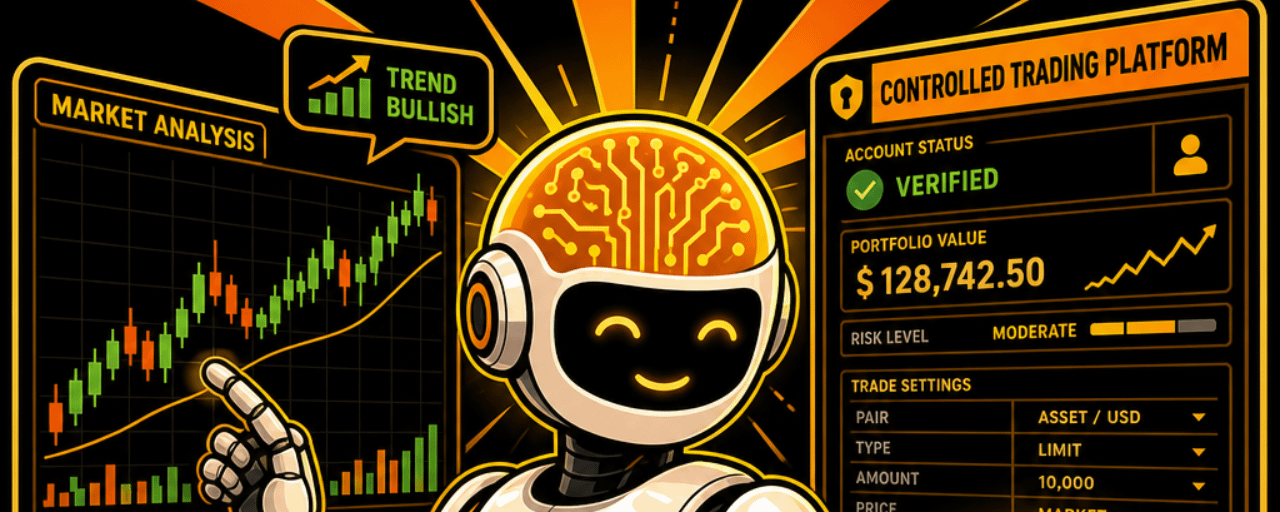

Executive Summary (TL;DR) AI agents can analyze markets and place orders when connected to a compatible platform and authorized by the user. This article explains the technical workflow, the limits of the Binance Agent OS, access controls, and the difference between an autonomous agent and a traditional trading bot.
OVERVIEW: WHAT AN AI AGENT CAN DO
Yes, an AI agent can help analyze markets and execute stock trades when connected to a platform that supports those actions, with your authorization.
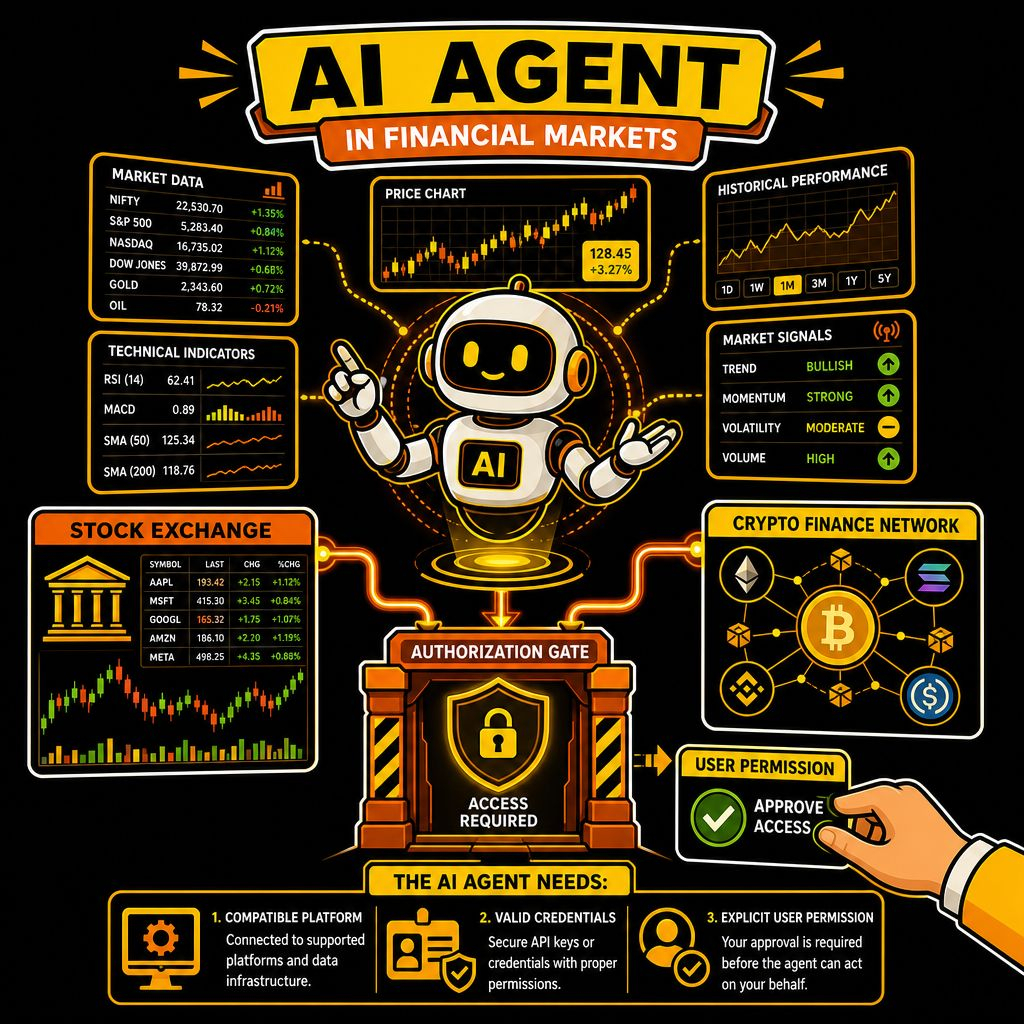
In practice, the agent interprets data, applies rules defined by the user, and calls external tools to look up information or send an order. It does not trade stocks on its own: it needs compatible infrastructure, valid credentials, and explicit permissions.
HOW DO AN AI AGENT TRADE STOCKS?
The flow starts with a request or a pre-configured rule. The agent can query prices, history, indicators, and other information provided by the platform. Then it interprets this data according to the defined objective and decides whether to only provide an analysis or to attempt executing an authorized action.
To send an order, the agent needs to call a tool connected to a broker or exchange. This tool validates the account, the asset, the order type, the quantity, and the available permissions. Execution depends on the connected infrastructure and the real market conditions, not just the model’s decision.
This design separates analysis, authorization, and execution. A model may produce an incorrect interpretation, receive incomplete data, or call a tool improperly. That’s why value limits, permitted assets, and the ability to revoke access are central parts of the system.

IS IT POSSIBLE TO USE BINANCE AGENT OS TO TRADE STOCKS?
The Binance Agent OS is presented as a layer that connects AI agents to resources in the Binance ecosystem. These resources include trading, market data, wallets, payments, and on-chain capabilities, with access controls and permissions that can be configured and revoked.
Binance also describes its ecosystem as covering cryptoassets, traditional finance, and tokenized securities. However, this does not equal a confirmation that any agent can trade traditional stocks, nor that this capability is available in all regions.
So, the technical answer is conditional: Agent OS can connect an agent to capabilities made available by Binance, but trading stocks can only be stated when there is explicit support for the asset, the account, the region, and the desired action.
HOW TO CONNECT AN AI AGENT TO BINANCE?
The connection depends on a compatible tools interface. We highlight the Model Context Protocol, or MCP, as an open standard used by AI applications to discover and call external tools. In a flow like this, the agent identifies an available function, sends the requested parameters, and receives the result from the platform.
The user or developer must define which operations will be available. One configuration may allow only reading data, while another may include creating, modifying, or canceling orders. Access should be granted deliberately, with a scope limited to what’s necessary and with the ability to revoke.
The specific documentation for your account, Agent OS, and the applicable product is essential to confirm the connection method. The provided source describes the architecture in general terms, but does not provide a complete setup procedure for stock trading.
HOW MUCH CONTROL DO YOU HAVE OVER A TRADING AGENT?
Control can be split into four layers: the data the agent can query, the tools it can call, the permitted assets and operations, and financial or operational limits. The broader the permission, the greater the execution capability—and also the larger the error surface.
Agent OS is described as compatible with configurable and revocable permissions and access controls. This makes it possible to interrupt the connection or reduce the scope when necessary. Even so, revoking an authorization does not automatically undo an order that has already been executed, and the concrete behavior depends on the connected platform.
A prudent architecture separates simulation, analysis, and real execution. Before granting operational access, it’s important to verify what the agent can do without new confirmation, which logs are made available, and how failures are handled. AI can automate decisions, but it does not eliminate the need for supervision.
FAQ: AI AGENTS AND TRADING
Can an AI agent buy and sell stocks for me? Yes, as long as it is connected to a broker or platform that offers this capability, that your account is eligible, and that you authorize the operations. The source does not confirm a universal offering of stock trading by agents.
What’s the difference between a trading agent and a bot? A bot normally executes predefined rules, such as price conditions or indicators. An agent can interpret instructions, query different tools, and decide which action to request within the permissions it receives. This flexibility also makes it essential to limit the scope and review results.
Create your account on Binance
Conclusion
AI agents can work as an analysis and execution layer, but they depend on a compatible platform, reliable data, well-defined permissions, and regional availability. Binance Agent OS provides a bridge between agents and resources in the Binance ecosystem.
Disclaimer: Purely educational/informational content, without investment advice.