

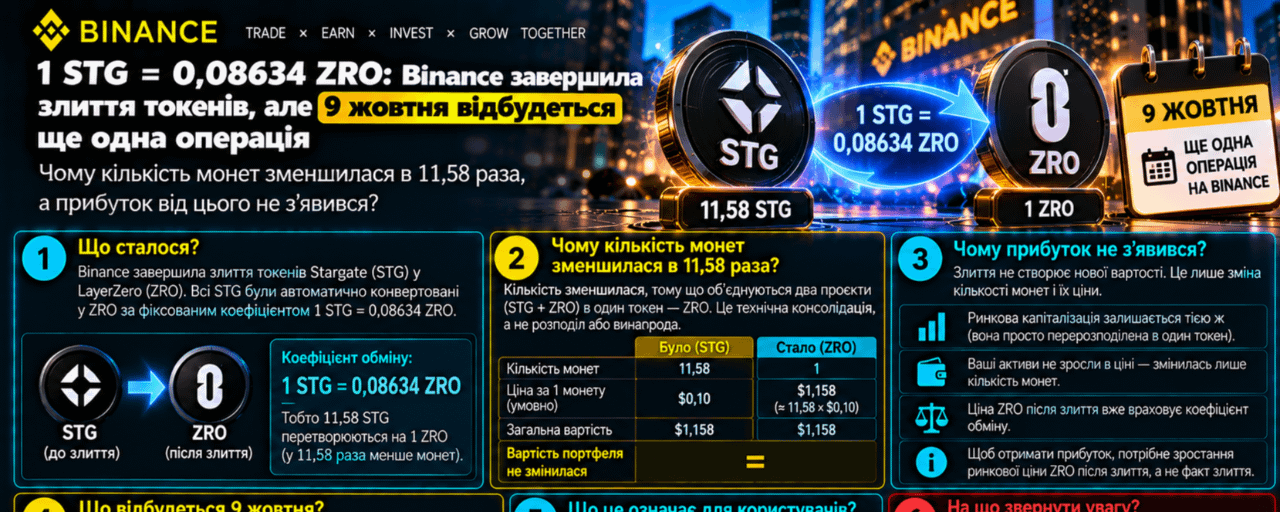

1 STG = 0.08634 ZRO: Binance completed the token merger, but another operation will take place on October 9. Why the number of coins fell by a factor of 11.58, yet no profit materialized
October 8, 2026. The crypto market continues to recover after September’s rally, but one of the most interesting events of recent days didn’t happen on the BTC or ETH chart.
On October 7, Binance officially completed the token merge of Stargate Finance (STG) and LayerZero (ZRO).
Users received ZRO using a fixed ratio:
1 STG = 0.08634 ZRO.
Old STG are no longer supported for deposits and withdrawals on Binance. The distribution of the new tokens is already complete.
At first glance, it’s a standard token swap.
But in reality, three processes happen simultaneously here:
The number of tokens in the portfolio changes. The asset changes—what the investment result depends on also changes according to its price. And on October 9, for part of the users, Binance will automatically move the received ZRO back into Simple Earn.
And there is another important date:
December 15, 2026.
After that, LayerZero will stop supporting the conversion of old STG into ZRO.
That’s why this story is much more interesting than a regular delisting.
It shows how the token migration risk works—the risk that occurs when a crypto project changes the asset that an investor owns.
What actually happened to Stargate
Stargate is a protocol for moving liquidity between blockchains that uses LayerZero infrastructure.
In 2025, LayerZero acquired Stargate.
After that, STG holders were given the opportunity to exchange the tokens for ZRO.
On September 15, 2026, the LayerZero team reported that support for conversion would end on December 15.
At the same time, Stargate infrastructure is being simplified: starting from October 1, all protocol transactions are processed via Stargate Taxi, while the Bus mode is no longer used.
That is, this is not just a ticker replacement.
LayerZero consolidates part of its ecosystem around a single token.
And this is exactly where the first question arises.
What happened to the value of STG if instead of 1,000 tokens the user received only 86.34 ZRO?
Why did the number of tokens decrease by 11.58 times
The conversion formula is very simple:
ZRO = STG × 0.08634.
So:
1,000 STG → 86.34 ZRO.
5,000 STG → 431.70 ZRO.
10,000 STG → 863.40 ZRO.
100,000 STG → 8,634 ZRO.
Mathematically, the number of units of the asset decreases by about 11.58 times.
But that doesn’t mean the investor lost 91.37% of their capital.
That’s because:
The number of tokens ≠ portfolio value.
The value depends on the price of the new asset.
How much do the former STG cost now?
As of October 8, 2026, ZRO was trading at approximately $2.11. According to CoinLore at 04:32 UTC, the daily change was about -1.81%, and the 24-hour trading volume was about $96.9 million. This is a time snapshot, not a guaranteed order execution price.
Let’s take $2.11 for the calculation.
We know that:
1 STG = 0.08634 ZRO.
So:
0.08634 × $2.11 = $0.18218.
Therefore, at such a ZRO price, the economic value of one former STG is approximately:
$0.1822.
This is the key number.
It allows you to estimate the result of the conversion even if STG is no longer traded on Binance.
Example: you had 10,000 STG
Before the merger:
10,000 STG.
After conversion:
863.4 ZRO.
At the ZRO price of $2.11:
863.4 × 2.11 =
$1,821.77.
That’s roughly how much the new portfolio costs.
But did the investor make a profit?
The answer depends on the user’s initial STG purchase price.
Scenario #1: STG were bought at $0.10
The investor spent:
10,000 × $0.10 = $1,000.
After conversion, its ZRO cost approximately:
$1,821.77.
Result:
+82.18%.
But it’s important:
This is not the profit created by the token merger.
This is the result of the difference between the historical purchase price and the current market valuation of the received asset.
Scenario #2: STG were bought at $0.25
Initial investment:
10,000 × $0.25 = $2,500.
Current ZRO value:
$1,821.77.
Result:
-27.13%.
And even though the user received a new token, their loss does not go anywhere.
This is where a common psychological mistake often occurs.
After the migration, the exchange shows a different asset, a different number of tokens, and a different price.
But:
Replacing the token does not reset historical PnL.
How to correctly calculate the new break-even price
Let’s assume you bought STG at $0.25.
To determine the ZRO price at which the investment becomes profitable again, you need to:
$0.25 / 0.08634 = $2.8955.
So your new break-even is:
ZRO ≈ $2.90.
If STG were bought at $0.15:
break-even ZRO ≈ $1.74.
What if at $0.30?
break-even ZRO ≈ $3.47.
If at $0.50:
break-even ZRO ≈ $5.79.
This is significantly more useful than simply looking at the new average ZRO price in the app.
That’s because the economic history of the investment did not start on October 7.
It started when you bought STG.
But there is another important detail: a fixed ratio does not mean a fixed value
Ratio:
0.08634
remains unchanged.
And the ZRO price is:
changes constantly.
So the former 10,000 STG may have completely different value.
If ZRO = $1.50:
portfolio = $1,295.10.
If ZRO = $2:
portfolio = $1,726.80.
If ZRO = $2.50:
portfolio = $2,158.50.
If ZRO = $3:
portfolio = $2,590.20.
If ZRO = $4:
portfolio = $3,453.60.
So after conversion, the investor already depends on:
ZRO market dynamics.
And not from a separate STG price.
Why this changes the investment strategy
Before the merger, you could have two independent positions:
STG is a bet on Stargate.
ZRO is a bet on LayerZero.
Now the former STG position has turned into ZRO.
If the investor already held ZRO, an automatic increase in concentration in a single asset occurred.
For example:
before migration:
$5,000 ZRO;
$3 000 STG.
Together:
$8,000.
If after the conversion STG kept an equivalent market value, the structure becomes:
$8,000 ZRO.
Previously, there were two tokens.
Now one.
And even though they belonged to related ecosystems, after the conversion the portfolio already depends entirely on a single market asset.
This is called:
Concentration Risk.
And here is the most interesting event in the coming hours
Binance completed the ZRO distribution on October 7.
But for some users, the process is not yet finished.
In Binance’s official announcement it is stated:
After October 9, 2026, at 08:00 UTC, Binance Simple Earn will re-place the received ZRO into Flexible Products for the users affected by this operation.
In Kyiv time, that is:
after 11:00 on October 9.
Why is this important?
Because not all STG were on Spot before migration.
Some users held them in:
Simple Earn Flexible.
What Binance did with old STG in Earn
On September 30, Binance stopped supporting STG Flexible Products.
The remaining STG positions along with accumulated rewards were automatically redeemed and returned to Spot.
After that, the conversion happened:
STG → ZRO.
And now for the relevant Binance users, the received ZRO will be re-placed into Flexible Products.
So for such balances, the route looks approximately like this:
STG Simple Earn → STG Spot → ZRO Spot → ZRO Simple Earn.
This is not four separate investment decisions by the user.
This is a sequence of operations related to migration.
Why this is important for trading bots
Let’s imagine:
the user had 5,000 STG in Simple Earn.
After the conversion, they received:
431.7 ZRO.
On October 8, it checks Spot and sees the new tokens.
Plans to use them for Spot Grid or another strategy.
But after October 9, the relevant balance may be re-placed in Simple Earn according to the migration rules.
If the strategy assumes that ZRO will constantly remain on Spot, then a risk arises:
Available Balance Mismatch.
So the asset belongs to the user.
But it is not located where the trading algorithm expects it to be.
This is especially important for API strategies that check only Spot free balance.
And what happens to the accumulated rewards?
Binance reports that STG Flexible Products were redeemed together with accumulated rewards.
But after migration, you should not automatically assume that ZRO will receive the same yield.
This is already a different asset.
Another Flexible Product.
The current APR needs to be checked separately.
Therefore:
STG Earn APR ≠ ZRO Earn APR.
Even if the transition between them happened automatically.
Another date you can’t miss: December 15
Here it is necessary to clearly distinguish between two scenarios.
First—STG were on Binance.
The exchange has already completed their conversion.
On October 7, Binance confirmed the distribution of ZRO at a ratio of 0.08634.
Second—STG are in their own wallet.
Here the situation is different.
LayerZero officially announced that support for STG → ZRO redemption would end:
December 15, 2026.
After this date, conversion will no longer be supported.
This is no longer a market forecast.
This is an operational deadline.
Why you shouldn’t delay the conversion until the last day
Imagine the user has old STG in a self-custody wallet.
It sees that the tokens are still in the wallet.
The balance is reflected.
Smart contract exists.
And it raises the thought:
If the token doesn’t go anywhere, I’ll be able to swap it later.
But:
The existence of a token on the blockchain does not guarantee the existence of a redemption mechanism for it.
After the redemption window is completed, the old token may remain in your wallet.
However, the conversion mechanism supported by the team will already be unavailable.
This is fundamentally a different risk than a price drop.
You can call it:
Redemption Expiry Risk.
Why you don’t need to send old STG to Binance
After the migration was completed, Binance directly stated:
Deposits and withdrawals of old STG are no longer supported.
Therefore, trying to simply send old tokens to the exchange hoping for an automatic swap is the wrong approach.
For self-custody, use only the up-to-date official LayerZero instructions.
And especially carefully check the website address and the smart contract address.
Therefore, migration events create an obvious opportunity for phishing.
Now let’s return to the ZRO price
On October 8, ZRO was trading at approximately:
$2.11.
According to CoinLore, during the day the asset opened at about $2.20, reached approximately $2.26, but didn’t hold that level.
For short-term observation, interesting zones are:
$2.02 — the closest technical support based on the provided market statistics.
$2.26 — a local resistance zone.
$2.55 — the next reference point if growth continues more strongly.
Below $2.02 is the next historical zone worth checking, located at approximately $1.74.
But after the token merger, there is another factor that can affect the market.
Does migration create additional sell pressure?
Automatic conversion by itself does not mean automatic selling of ZRO.
But after receiving the new tokens, some former STG holders may decide to:
close the position;
to lock in profit;
reduce the loss;
reallocate the portfolio.
This creates a potential:
Post-Migration Sell Pressure.
However, it’s important not to confuse the possibility with a confirmed fact.
This specific Binance announcement does not prove that STG holders are massively selling ZRO.
To reach this conclusion, you need to see the actual token flows on the exchange, the sell volumes, and the liquidity structure.
What does conversion mean for future ZRO
There are two opposite effects.
Positive: the ecosystem receives a more consolidated token structure. Instead of two separate assets, investors focus on ZRO.
Negative: holders of the former STG can create additional supply of ZRO on the secondary market.
So the event itself is neither clearly bullish nor bearish.
Its result depends on:
new demand for ZRO versus the supply of received tokens.
And it is this balance that will determine the future market dynamics.
What STG holders should check now
After the migration is completed, it’s important to make sure that the number of received ZRO matches the formula:
STG × 0.08634.
For investment accounting, it’s necessary to keep the initial acquisition value of STG and the transaction date. Tax accounting for such a conversion depends on the jurisdiction, so it should not automatically be considered a non-taxable event.
If earlier STG were in Simple Earn, you should check your balance after the planned re-placement on October 9.
If old STG remained in your wallet, you need to account for the December 15 deadline.
And finally, if there were already ZRO in the portfolio, it’s necessary to recalculate the total concentration after combining the positions.
Main takeaway
The merger of STG into ZRO shows a very important feature of the crypto market.
An investor can buy a token, correctly assess the technology prospects, and even wait for the ecosystem to develop.
But during the investment horizon it may change:
the instrument itself that they own.
In the case of Stargate:
On October 6, Binance stopped Spot trading of STG.
On October 7, it completed the ZRO distribution.
After October 9, they plan to re-place the corresponding ZRO balances in Simple Earn.
And on December 15, LayerZero will complete STG redemption support.
That is, one migration event covers:
trading, custody, Earn, tokenomics, portfolio accounting, and self-custody.
And most importantly:
1 STG = 0.08634 ZRO — this is the conversion ratio, not a guarantee of value.
A user who had 10,000 STG now has 863.4 ZRO.
But its real financial outcome is determined not by the number of new tokens.
It is determined by:
STG purchase price and the current ZRO price.
That’s why after any token merger it’s necessary to recalculate not only the balance.
It’s necessary to recalculate:
break-even, PnL, concentration, and operational risks.
Because a new ticker does not mean a new investment history.
It means continuing the old story in a different asset.
Disclaimer: The material is for educational purposes and is not financial advice. Market prices change, and the calculations provided do not account for trading commissions, spreads, taxes, and individual user expenses. Before converting tokens in your own wallet, check the project’s official instructions and supported networks.
#BinanceSquare #LayerZero #TokenMigration #CryptoInvesting #CryptoAnalysis