


We hear a lot about Web3, wallets, DeFi, DApps, and tokens.
But behind all of this lies a fundamental technology:
The blockchain.
Without it, much of the Web3 ecosystem would not be able to function in the same way.
So, in practical terms, what is a blockchain and how does it work?
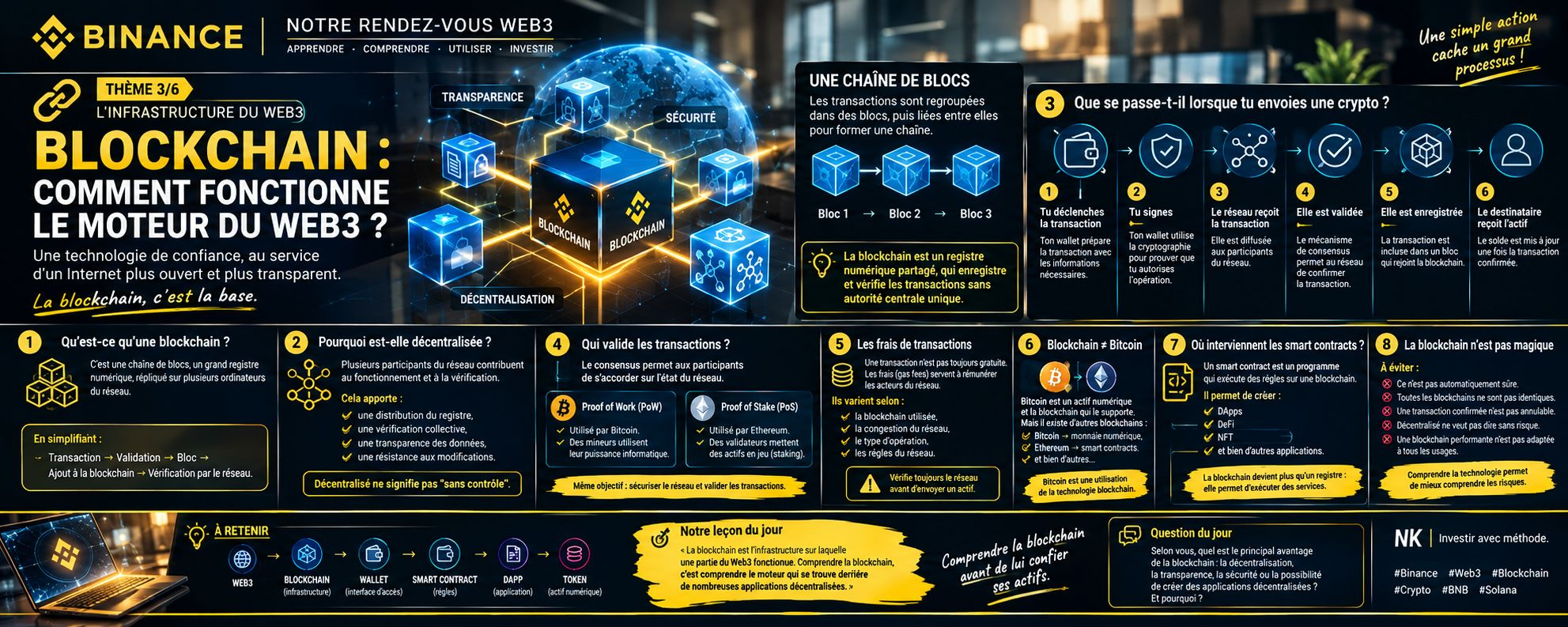
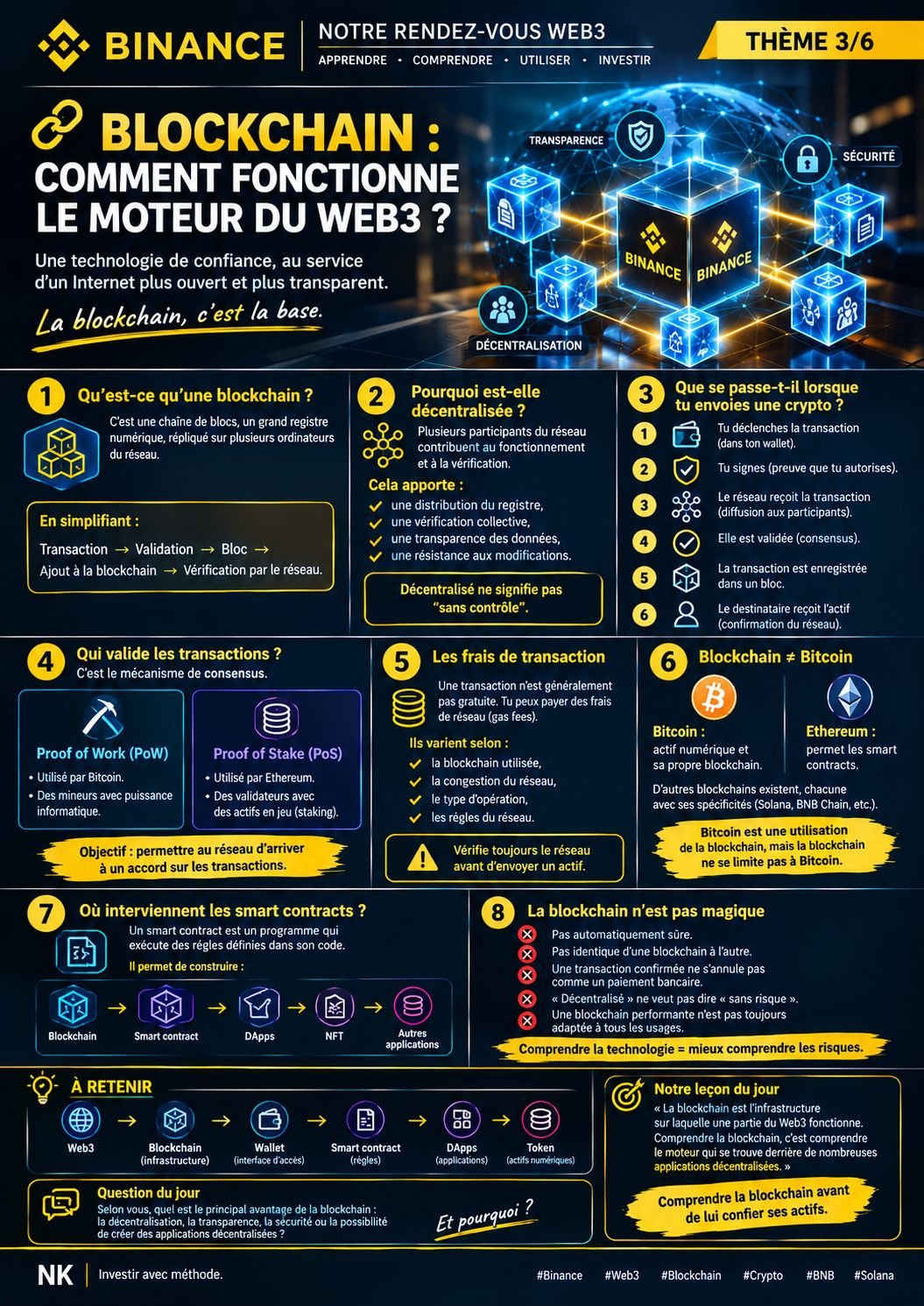
1-What is a blockchain?
The word blockchain literally means “chain of blocks.”
Imagine a large digital ledger in which transactions are recorded.
Instead of this ledger being held by a single company or computer, it can be replicated and verified by many network participants.
Transactions are grouped into blocks, and these blocks are linked together to form a chain.
To simplify:
Transaction → Validation → Block → Added to the blockchain → Verified by the network
This architecture allows the blockchain to record and verify operations without necessarily relying on a single central authority.
2-Why do we say that blockchain is decentralized?
In a traditional system, a company or institution can control the main ledger.
With a decentralized blockchain, multiple network participants contribute to the system's operation and verification.
This provides, among other things:
🔹 distribution of the ledger;
🔹 collective verification;
🔹 transparency of public data through the blockchain;
🔹 increased resistance to arbitrary changes to historical records.
Note: decentralized does not mean “no one controls anything.”
Each blockchain has its own rules, validation mechanisms, and levels of decentralization.
3-What happens when you send crypto?
Let's take a very simple example.
You want to send a digital asset to someone.
Step 1 — You initiate the transaction
Your wallet prepares a transaction with the necessary information.
Step 2 — You sign
Your wallet uses the appropriate cryptographic mechanisms to prove that you authorize the operation.
Step 3 — The network receives the transaction
The transaction is broadcast to network participants.
Step 4 — It is validated
The blockchain's consensus mechanism allows the network to determine which transactions can be included.
Step 5 — The transaction is recorded
It is included in a block that becomes part of the blockchain's history.
Step 6 — The recipient receives the asset
Once the transaction is confirmed according to the network's rules, the corresponding balance is updated.
This entire process takes place behind a simple click on “Send.”
4-Who validates transactions?
This is where consensus comes in.
A blockchain must have a mechanism that allows participants to agree on the state of the network.
Two particularly well-known mechanisms are:
Proof of Work — PoW
Used notably by Bitcoin.
Miners use computing power to help secure and validate the network.
Proof of Stake — PoS
Used notably by Ethereum.
Validators stake assets to help operate and secure the network.
The general principle is different, but the goal remains essential:
enable the network to reach agreement on transactions.
5-And transaction fees?
A blockchain transaction is generally not free.
You may have to pay network fees, often called gas fees on some blockchains.
These fees are used, among other things, to reward those who contribute to the network's operation and process transactions.
The amount may vary depending on:
the blockchain used;
network congestion;
the type of operation;
the rules specific to the network.
Common mistake
Sending an asset over the wrong network can result in a loss or make the funds difficult to recover.
Before any transaction:
Always check the network used by the sender AND the one accepted by the recipient.
6-Blockchain ≠ Bitcoin
This is a fundamental distinction.
Bitcoin is a digital asset and also the network/blockchain that supports it.
But there are many other blockchains.
For example:
Bitcoin → primarily designed around digital currency and securing its network;
Ethereum → enables, among other things, the execution of smart contracts;
other blockchains offer different architectures, performance levels, and features.
So:
Bitcoin is one use of blockchain technology; blockchain is not limited to Bitcoin.
7-Where do smart contracts come in?
This is where our journey becomes even more interesting.
A blockchain can record transactions.
But some blockchains also allow smart contracts to be executed.
A smart contract is essentially a program deployed on a blockchain that executes rules defined in its code.
This makes it possible to build:
Blockchain → Smart contracts → DApps → DeFi → NFTs → other Web3 applications
Blockchain then becomes much more than a simple transaction ledger.
8-Blockchain isn't magic
You should also avoid certain misconceptions.
❌ A blockchain isn't automatically secure just because it's a blockchain.
❌ Not all blockchains are the same.
❌ A confirmed transaction generally can't simply be reversed like a traditional bank payment.
❌ “Decentralized” does not mean “risk-free.”
❌ A high-performance blockchain isn't necessarily suitable for every use case.
Understanding the technology helps you better understand the risks.
KEY TAKEAWAYS
Our journey is now very clear:
🌐 WEB3
⬇️
🔗 BLOCKCHAIN — the infrastructure
⬇️
👛 WALLET — your access interface
⬇️
📜 SMART CONTRACT — rules executed on the blockchain
⬇️
📱 DApps — applications
⬇️
💰 TOKENS — digital assets
Today's lesson
“The blockchain is the infrastructure on which part of Web3 operates. Understanding blockchain means understanding the engine behind many decentralized applications.” NK
And above all:
Understand blockchain before entrusting it with your assets.
Question of the day
In your opinion, what is the main advantage of blockchain: decentralization, transparency, security, or the ability to create decentralized applications?
NK | Invest methodically.
#Binance #Web3 #Blockchain #Crypto #BNB #Solana