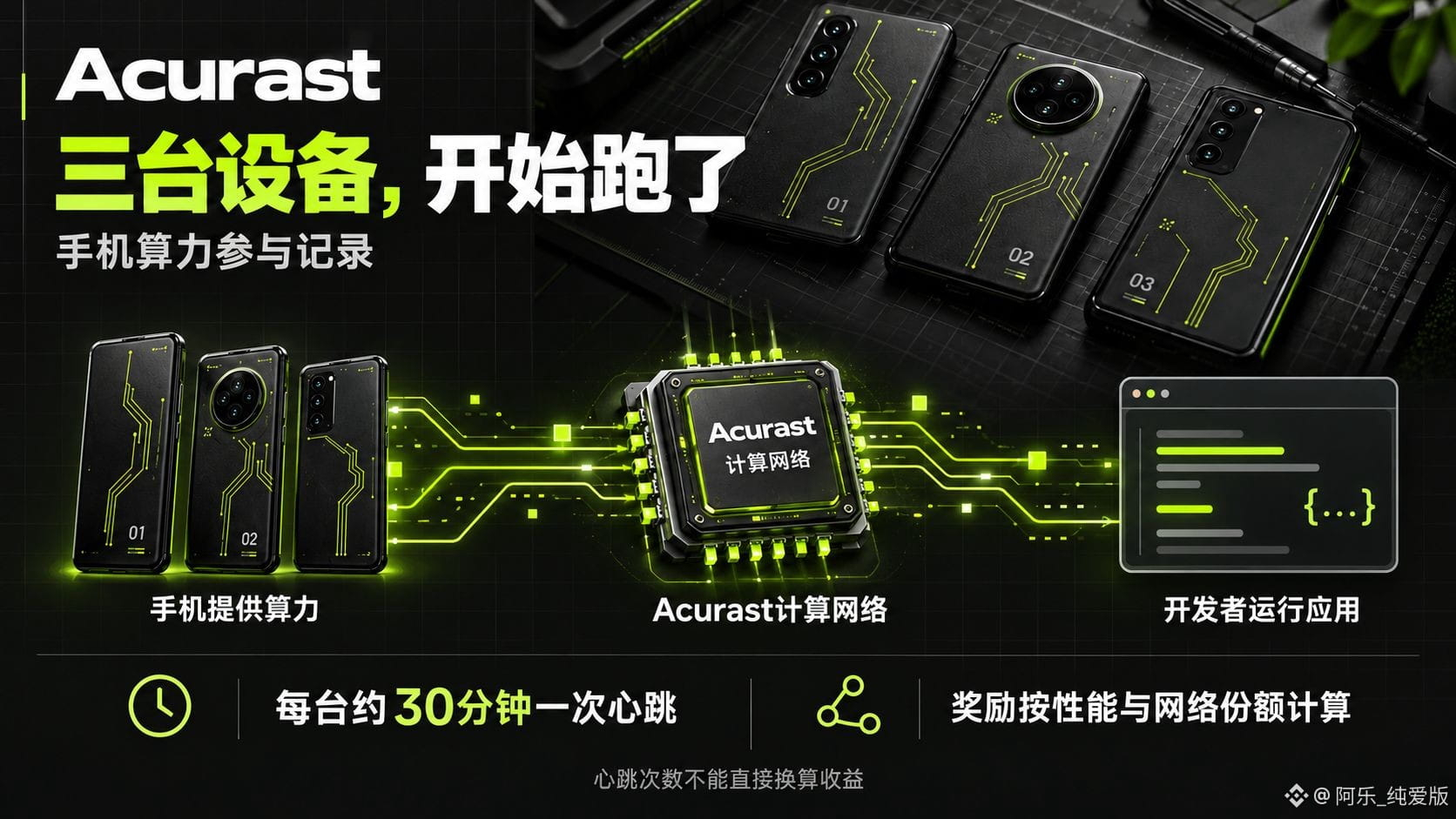
I’ve been tinkering with @Acurast lately and have connected three devices so far. I’ve gone through installation, checking heartbeats, and looking at Gas several times, so I wanted to share what I’ve learned with anyone who’s thinking of joining.
Acurast is a mobile computing network. After installing Processor on a phone, developers can deploy programs to run on eligible devices. The devices provide computing resources and earn rewards according to the network’s rules.
When I first checked the Hub, all three devices showed 0.5 next to the star, and I thought it might be related to heartbeat frequency. I looked it up and found out that it’s the device reputation score, which defaults to 0.5 for new devices.
Heartbeats usually happen about once every 30 minutes, so three devices should theoretically send six heartbeats per hour. But you can’t work out rewards by simply multiplying the number of heartbeats by a set rate. Base rewards depend on test results for CPU, memory, storage, and other factors, as well as the device’s share of the network reward pool. Different configurations can earn different rewards.
Base rewards come from token issuance. A phone earning rewards while online doesn’t mean a developer has paid to use that device. You’ll need to check separately whether it’s handling actual tasks.
There are already some real use cases you can try out. The recently released official Laya demo has an AI model on your phone sort emails, moderate chats, and even decide where the snake should go next in Snake.
These tasks are easy to understand, and you can see what your phone is actually processing.
If you want to join, you can add a device through Acurast Hub, then follow the prompts to install Processor and link your device. Android currently requires version 12 or later, no root access, and a locked bootloader. Once it’s connected, check the heartbeat and authentication status first—there’s no need to rush into adding more devices.
Also, make sure you know which network you’re using: mainnet rewards are in $ACU, while Canary shows cACU; MIST is a separate campaign points system. On-chain actions such as heartbeats also incur a small fee.
My three devices are still being monitored, so I don’t want to throw out unreliable earnings figures just yet. Once I have a complete operating record, I’ll work out the rewards and costs together.
If you’d like to join in, you can use my invitation link to enter Cloud Rebellion, connect your phone, then add the device in Hub: