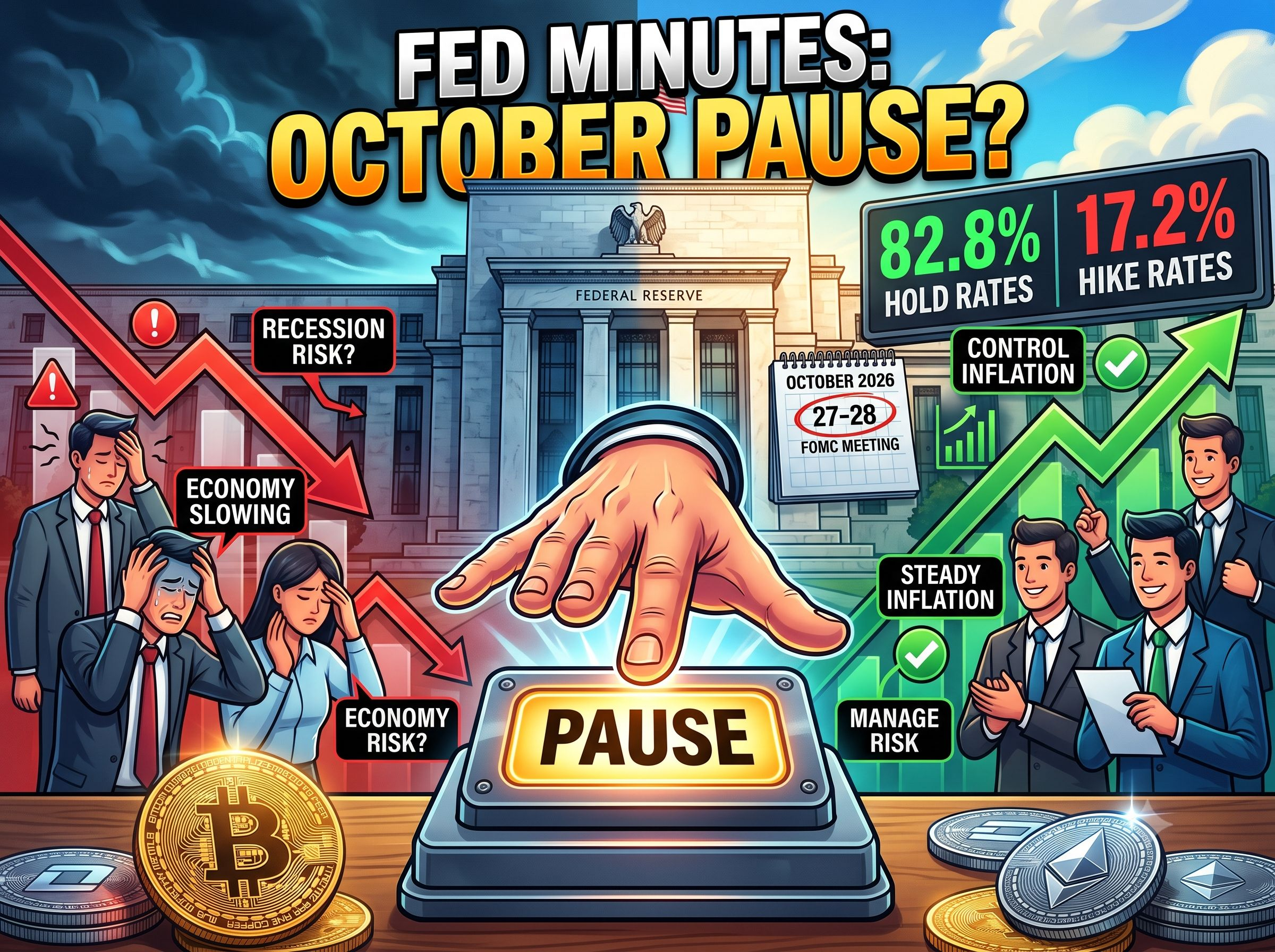

The latest Federal Reserve minutes, released on October 7, 2026, have changed the conversation around the Fed’s next move. The key message is not simply pause or hike. The minutes show a divided policy outlook: most officials still saw another rate increase as appropriate by year-end, but they also stressed that future decisions would depend on incoming data.
The current Fed setup
At its September 15–16, 2026 meeting, the FOMC unanimously raised the federal funds target range by 25 basis points to 3.75%–4.00%. The vote was 12–0.
The October meeting is scheduled for October 27–28, 2026.
But markets have moved sharply toward an October pause.
Recent CME Fed Watch pricing put the probability of an October hold around 82.8%, versus roughly 17.2% for another 25-basis-point hike. These probabilities can change as new inflation, employment and financial-market data arrive.
The key takeaway is that Bitcoin has received a potentially supportive October Fed setup, but the broader macro environment is still restrictive.
The Real Fed vs Bitcoin Setup
Factor Current Signal Bitcoin Impact October Fed hike odds~17%
🟢 Positive October Fed hold odds~83%
🟢 Positive Fed minutes Hawkish underneath
🔴 Negative Inflation Still above target
🔴 Negative Treasury yields Elevated
🔴 Negative U.S. dollar Strong
🔴 Negative Labor market More balanced
🟢/⚪October pause Increasingly expected
🟢December hike risk Still significant
🔴BTC around $83KCritical area⚠️
What did the Fed minutes actually say?
This is where the story becomes more interesting.
The minutes said most participants believed another rate increase would likely be appropriate by the end of 2026. However, officials also emphasized that they would approach each meeting with an open mind and would respond to incoming economic data.
So the minutes are not a confirmation of an October hike.
In fact, the market interpretation has shifted toward:
October = possible pause
December = more important hike risk
That distinction matters for crypto traders.
Why is the Fed still worried about inflation?
The Fed's concern has not disappeared.
At the September meeting, officials continued to see inflation as elevated and noted several potential upside risks, including:
Higher energy prices
Geopolitical disruptions
AI-related investment and demand
Tariff-related price pressures
Persistent inflation in some services
The possibility that businesses could pass higher costs to consumers
The minutes also said inflation risks were generally tilted to the upside.
At the time of the September meeting, the staff estimated August headline PCE inflation at 3.8% and core PCE inflation at 3.4% under the then-current methodology.
That is still well above the Fed's 2% inflation objective.
But the labor market gives the Fed room to pause
This is the other side of the equation.
Fed officials generally described labor-market risks as more balanced. The minutes noted stable employment conditions, while some participants argued that wage growth was moderate and consistent with inflation eventually moving toward 2%.
That creates a difficult policy trade-off:
Raise rates → fight inflation but risk weakening growth and employment.
Pause → give the economy time to adjust but risk allowing inflation to remain elevated.
This is why the October meeting is so important.
What Does the October Pause Mean for Bitcoin?
For Bitcoin, the word “pause” is potentially bullish—but only if financial conditions also become easier.
A Fed pause can reduce expectations for additional monetary tightening. That can eventually support:
Lower rate expectations → lower pressure on yields → potentially weaker dollar → better liquidity conditions → stronger appetite for risk assets → potential Bitcoin support
But there is an important catch.
A pause caused by falling inflation and controlled economic growth is very different from a pause caused by economic stress.
Bitcoin generally responds much better to the first scenario.
Current Bitcoin situation
Bitcoin has been under pressure around the latest Fed-minutes release.
On October 7, Bitcoin fell below $84,000, while rising Treasury yields and a stronger U.S. dollar created additional pressure on risk assets.
Current market data on October 8 puts BTC around the $80,000–$83,000 area, depending on the exchange and timestamp.
This is important because it shows that:
A higher probability of an October Fed pause does not automatically mean Bitcoin immediately rallies.
Right now, other macro forces are competing with the Fed-pause narrative.
The Bigger Problem: Treasury Yields and the Dollar
This may actually be more important for Bitcoin in the short term.
The October 7 market reaction showed a combination of:
Higher Treasury yields
A stronger U.S. dollar
Elevated oil prices
Persistent inflation concerns
Falling crypto prices
The 10-year Treasury yield moved above 5.2%, while the dollar index was around 102.
That creates a difficult environment for Bitcoin.
Why?
Because when safe dollar-denominated yields become attractive, investors have less incentive to aggressively chase higher-risk assets.
Therefore, Bitcoin traders should not look at the Fed's October probability alone.
They should watch:
Fed → Treasury yields → DXY → liquidity → ETF flows → Bitcoin
That is the more complete macro chain.
Fed Pause: Bullish or Bearish for Bitcoin?
🟢 Bullish scenario
If the Fed pauses in October because:
inflation continues cooling,
employment weakens gradually,
Treasury yields stabilize,
the dollar weakens,
liquidity improves,
then Bitcoin could benefit.
The market could begin pricing a softer monetary-policy path, potentially improving risk appetite.
🔴 Bearish scenario
But if the Fed pauses while saying:
“We are simply waiting before hiking again.”
then the market may not treat the pause as genuinely dovish.
This is exactly why the December meeting could become more important.
The September minutes already showed that most officials saw another hike as potentially appropriate before the end of the year.
The Most Important Bitcoin Levels Now
From a market-structure perspective, Bitcoin's recent trading action makes the $83,000 area important.
Recent market commentary identified approximately:
$83,000: important downside/support zone
$86,500–$87,000: important recovery/resistance area
Below $83,000: risk of another move toward the $80,000 area
Above $86,500–$87,000: would improve the short-term technical picture
These are market reference levels, not guaranteed support or resistance.
What Should Crypto Traders Watch Next?
The next major catalyst is not just the October FOMC meeting.
Traders will be watching the economic data that arrives before October 27–28, particularly inflation and labor-market information.
The next FOMC meeting will ultimately depend on whether incoming data validates a pause or revives the case for another hike.
That makes the current setup extremely interesting:
Fed minutes = hawkish underneath
Market pricing = dovish for October
Inflation = still too high
Labor market = less threatening
Treasury yields = elevated
Bitcoin = under pressure
My View
The simplest interpretation—“Fed pause = Bitcoin bullish”—is too shallow.
The more accurate interpretation is:
An October pause could remove one immediate source of monetary tightening, but Bitcoin needs falling yields, a softer dollar and improving liquidity to turn that pause into a durable bullish catalyst.
The September minutes actually make the situation more complicated because most Fed officials still saw another hike as appropriate by year-end.
Therefore, the market may be shifting from an October-hike story to an October-pause/December-hike story, rather than moving directly into a new easing cycle.
For Bitcoin, that distinction could be crucial.
This is not a signal to blindly buy or sell BTC. It is a macro framework for understanding why Bitcoin may remain volatile around the October FOMC meeting.
Data and market probabilities referenced above are based on information available on October 8, 2026; Fed Watch probabilities can change continuously. Also Visit https://zenvestai.com