💵 Cash, card, or Bitcoin: how to build a system instead of looking for a single place to keep your money
DVA ANALYTICS • FACT → MECHANISM → RISK → DECISION
For years, you saved money for a “rainy day.” Then that day came—not just for you, but for the whole country.
And a simple question arose: where should you keep your savings during a war—in cash, in a bank, or in Bitcoin?
But it’s better to ask a different question:
what is each part of your money meant for?
Because cash, a bank, and Bitcoin solve different problems.
FACT—what is known
Cash remains necessary for emergencies. But economists Serhiy Furса and Taras Kozak point out the risks of storing large sums of cash.
You can lose it, have it stolen, or physically destroy it. In addition, hryvnia cash generates no income and gradually loses purchasing power due to inflation.
The banking system has a different risk model. The account doesn’t disappear when a physical branch goes offline, and banks use backup power and alternative operating channels. At the same time, during large-scale blackouts, problems with terminals, communications, or ATMs are possible.
During martial law, the deposit guarantee system provides expanded protection: for deposits covered by the legislation governing the Deposit Guarantee Fund (FGVFO), full reimbursement applies under the established rules and exceptions. The limit of UAH 600,000 during martial law does not apply; it must be restored three months after martial law is terminated or canceled.
Bitcoin solves a different problem.
In a self-custody format, control over the asset can remain directly with the owner, without being tied to a specific bank. This can matter for capital mobility and access to it across different jurisdictions.
But Bitcoin is a volatile asset. Its market price can change significantly over a short period.
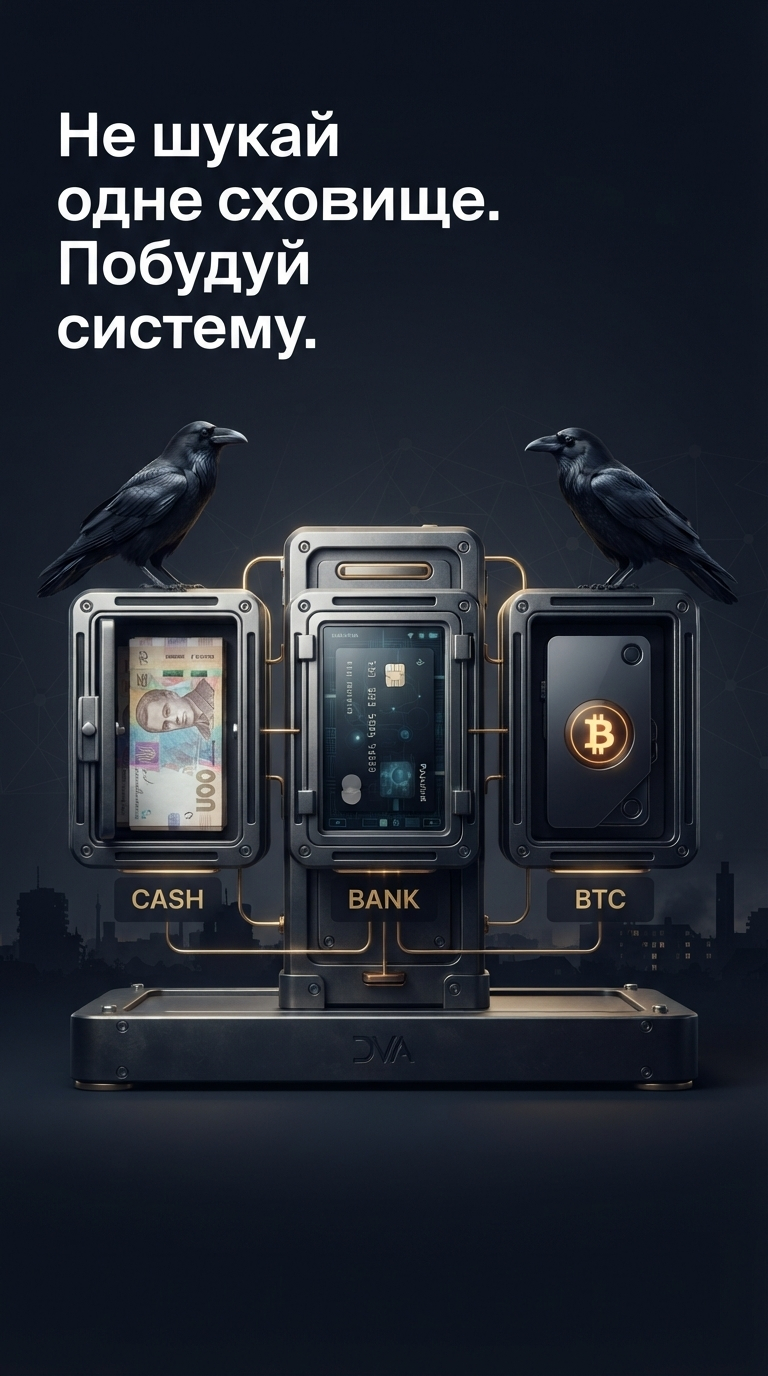
Three instruments—three different functions:
💵 Cash—emergency access.
🏦 The bank is operating money and part of savings.
₿ Bitcoin is a long-term digital asset and a potential tool for capital mobility.
MECHANISM—why one format doesn’t solve everything
Cash provides something a card can’t guarantee: physical access to money without electricity, a terminal, or a banking app.
But you pay for that with other risks: theft, loss, damage, and lack of income.
The bank works the other way around.
Money is easier to use for everyday payments, and a deposit can generate interest income. However, access to funds depends on the functioning of banking and telecommunications infrastructure.
So a card isn’t a separate type of asset.
A card is only a way to access money in an account.
Bitcoin has a different architecture.
In self-custody, the owner controls the private keys independently. This reduces dependence on a banking intermediary but shifts responsibility onto the owner.
Losing a seed phrase, phishing, a fake wallet, an error during a transaction, or key compromise can all mean losing access to the asset.
So Bitcoin doesn’t replace emergency cash, and cash doesn’t replace long-term capital.
RISK—where the real problem arises
Risk #1—keeping everything in cash.
You control the banknotes directly, but at the same time you take on all physical risks.
Large sums kept at home are effectively a lack of backup.
Risk #2—keeping everything in one bank or on one card.
The banking system is much more resilient than it may seem during panic, but local disruptions are possible.
One account, one bank, one access method—this concentrates risk.
Risk #3—treating Bitcoin as “digital cash for a rainy day.”
Bitcoin can be a useful asset for long-term storage and transferring capital.
But its price isn’t stable.
If money might be needed in a week or a month, BTC volatility can create a problem exactly when you need liquidity.
Risk #4—the currency illusion.
Currency can reduce the risk of hryvnia devaluation, but it isn’t itself risk-free.
The rate can move in both directions. And if a foreign currency is kept physically, the same risks of loss, theft, or destruction return.
Risk #5—confusing accessibility with value preservation.
Money you can access quickly doesn’t necessarily preserve purchasing power best.
And vice versa: an asset that could potentially be better for long-term capital storage may be unsuitable for paying for products tomorrow.
These are different functions.
DECISION—an actionable model
Don’t look for one perfect place to store it.
Build a system with multiple layers.
1. Operating money—bank/card
An amount for everyday expenses, utility bills, groceries, medicines, and other current needs.
Practically, having access to more than just one card or one bank.
2. Emergency reserve—cash
An amount for a few days of basic expenses.
Cash is needed specifically for this scenario:
“Banking infrastructure is temporarily unavailable.”
This is reserve capital, not the main place to store capital.
3. Reserve capital—deposits and other instruments
Funds that aren’t needed every day can work instead of just sitting at home.
Before placing money, you need to check current interest rates, early withdrawal terms, taxation, and guarantees.
4. Currency diversification
You can keep part of your savings in foreign currency if that matches your future expenses and currency risks.
Fixed “30%” or “35%” for everyone is not a universal rule.
5. Bitcoin—only for the long term
If you understand the technology, volatility, and self-custody, BTC can be a separate part of your capital.
But you shouldn’t keep in Bitcoin money that you may need soon.
A simple DVA test
Before placing money, ask yourself four questions:
Do I need this money today?
→ a liquid reserve.
What if the card doesn’t work for two days?
→ a small cash reserve.
What if one bank is temporarily unavailable?
→ another access channel.
What if Bitcoin drops by 30–50% exactly when I need the money?
→ BTC shouldn’t be money for short-term needs.
Conclusion
During wartime, the question isn’t “cash, bank, or Bitcoin?”
It’s more correct to ask:
What function do my funds perform—access, reserve, or long-term capital preservation?
Cash provides autonomy.
The bank provides liquidity and infrastructure.
A deposit is potential income.
Currency provides diversification.
Bitcoin is digital self-custody and capital mobility.
The biggest risk isn’t a specific instrument.
The biggest risk is when all savings depend on a single scenario.
FACT → MECHANISM → RISK → DECISION
DVA—facts without hype.
Not financial advice. DYOR.