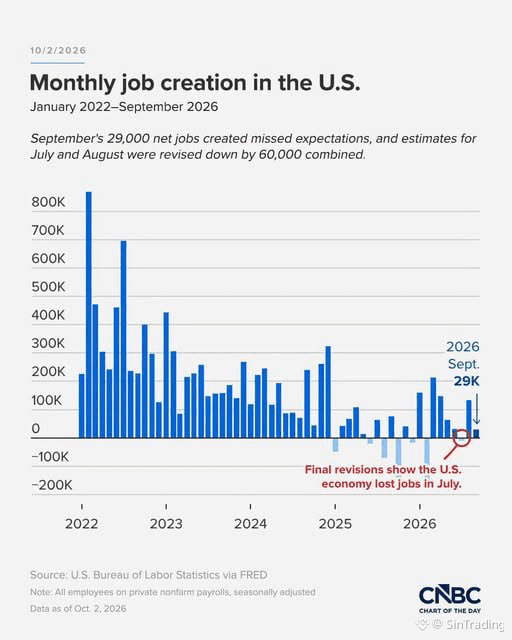
When the U.S. labor market creates fewer jobs than expected (for example, a weak Nonfarm Payrolls report), this signals that the economy is cooling. This triggers a chain reaction across financial markets, particularly interest rates and the bond market.
1. Interest Rate Expectations (Fed Scenario)
The labor market and inflation are the two main pillars guiding the monetary policy of the U.S. Federal Reserve (Fed).
* Pressure to cut rates (or pause hikes): Weakening job growth raises concerns about the risk of an economic recession. To support businesses and the economy, the Fed will face pressure to ease monetary policy by cutting interest rates or halting further rate hikes.
* Market pricing: Investors in the futures market (FedWatch) will immediately raise the probability of Fed rate cuts at upcoming meetings.
2. Impact on the Bond Market
In finance, bond prices and yields always move in opposite directions.
Weak job growth
↓
Expectations of Fed rate cuts
↓
BOND YIELDS FALL ←— (Opposite direction) —→ BOND PRICES RISE
* U.S. Treasury yields fall sharply:
* Short-term bonds (2-year): These are the most sensitive to expectations about the Fed's policy rate. When employment is weak, 2-year yields typically fall the most as investors bet that the Fed will soon cut rates.
1. Interest Rate Expectations (Fed Scenario)
The labor market and inflation are the two main pillars guiding the monetary policy of the U.S. Federal Reserve (Fed).
* Pressure to cut rates (or pause hikes): Weakening job growth raises concerns about the risk of an economic recession. To support businesses and the economy, the Fed will face pressure to ease monetary policy by cutting interest rates or halting further rate hikes.
* Market pricing: Investors in the futures market (FedWatch) will immediately raise the probability of Fed rate cuts at upcoming meetings.
2. Impact on the Bond Market
In finance, bond prices and yields always move in opposite directions.
Weak job growth
↓
Expectations of Fed rate cuts
↓
BOND YIELDS FALL ←— (Opposite direction) —→ BOND PRICES RISE
* U.S. Treasury yields fall sharply:
* Short-term bonds (2-year): These are the most sensitive to expectations about the Fed's policy rate. When employment is weak, 2-year yields typically fall the most as investors bet that the Fed will soon cut rates.