

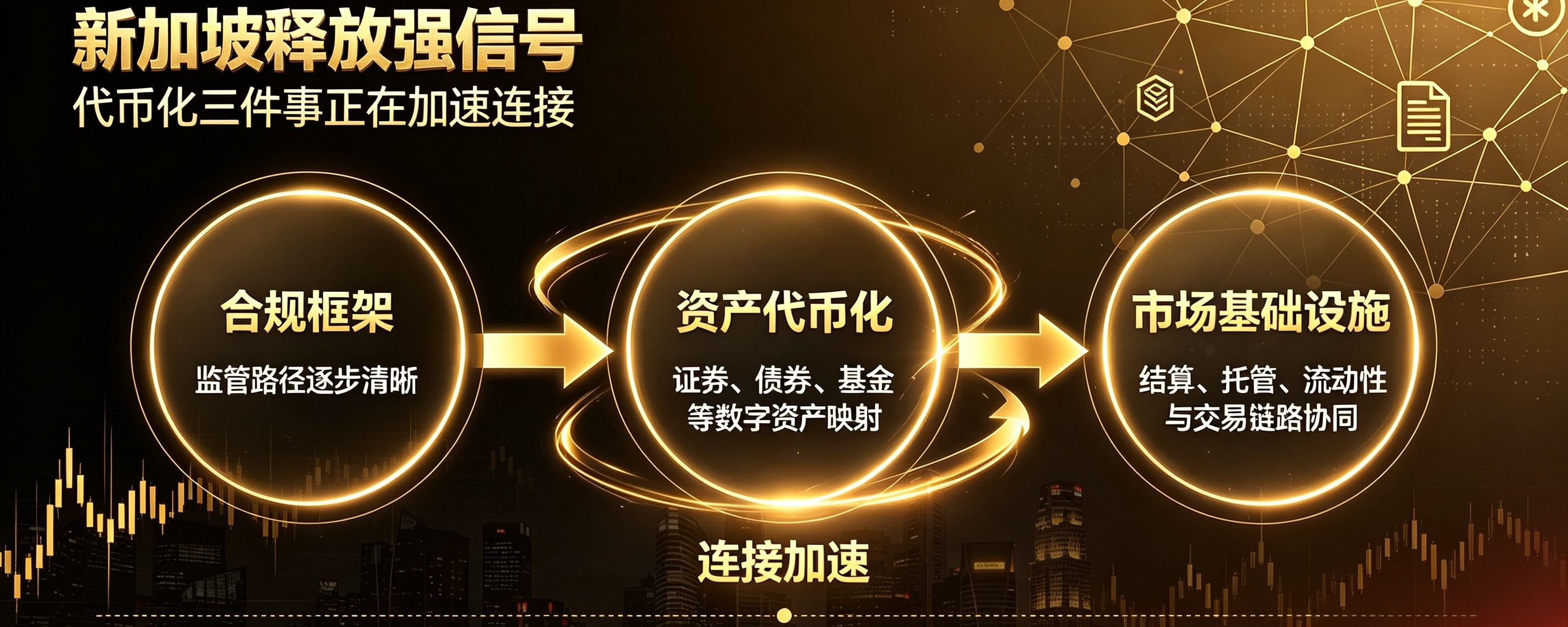

From October 6 to 7, three signals emerged in Singapore that are worth looking at together.
On October 6, Digital Assets Summit 2026 was held at the Singapore Exchange Centre. The focus of discussion had shifted from “Can assets be tokenized?” to “Can tokenization create real markets?”
On the same day, Singapore-licensed digital asset platform DigiFT launched tokenized interests in a U.S. Treasury money market fund managed by Fidelity Investments.
On October 7, TOKEN 2049 Singapore opened, with traditional financial institutions such as Nasdaq, BlackRock, Morgan Stanley, Fidelity, and ICE taking part directly in the agenda. Discussions covered how institutional finance can move on-chain, how tokenized assets can achieve global liquidity, and how on-chain settlement can enter traditional capital markets.
Taken together, the three developments raise the question Singapore is discussing: “How can tokenized assets truly enter the systems for trading, collateral, clearing, and settlement?”
First shift: Putting assets on-chain is no longer the hardest problem
At the Digital Assets Summit on October 6, Danny Chong, Co-Chair of the Digital Assets Association, raised a crucial question: “We know we can tokenise an asset. The harder question is whether we can build a functioning market around it.” “We already know that assets can be tokenized. The harder question is whether we can build a truly functioning market around them.”
He then broke the question down further: Can trading be scaled? Is there enough liquidity? What assets will be used for settlement? How will risk be managed?
This already makes the bottlenecks facing the tokenization of global assets today very clear. Putting assets on-chain is only the first step.
Second shift: Traditional funds are becoming “usable assets” on-chain. On the same day, DigiFT announced the launch of tokenized interests in a U.S. Treasury money market fund managed by Fidelity.
What’s most worth paying attention to this time isn’t that “Fidelity has put another fund on-chain.” It’s how Fidelity describes the value of tokenization.
Cynthia Lo Bessette, Head of Digital Asset Management at Fidelity, said: “Tokenization has the potential to expand access to investment products while enabling new forms of liquidity, collateral utility, and investment innovation…”
“Tokenization can expand access to investment products while creating new forms of liquidity, collateral utility, and investment innovation.” The key point here is: collateral utility.
This means that once money market funds go on-chain, further questions need to be considered: Can they be used as collateral? Can they serve as margin? Can they enter on-chain trading and liquidity systems?
Tokenized U.S. Treasury products have now reached a total market size of about $14.8 billion. Circle’s USYC, Ondo’s USDY, and BlackRock’s BUIDL have each reached a market size of around $2.2–2.4 billion. This shows that competition in the market is also changing.
Third shift: Wall Street is starting to discuss directly how to put financial markets on-chain
Today, TOKEN 2049 Singapore officially opens. This year, organizers expect around 25,000 attendees, and traditional financial institutions such as Nasdaq, Franklin Templeton, BlackRock, Morgan Stanley, and Goldman Sachs are all part of the conference program.
A panel this afternoon that is especially worth watching is titled: Tokenized Markets: How Institutional Finance Moves Onchain.
Participants include Chainlink, Ripple Prime, and FalconX, while the moderator is Roland Chai, Head of Nasdaq’s Digital Liquidity Network.
There’s another session tomorrow that’s even more worth watching: Tokenization: The Next Investment Revolution. Participating institutions include Fidelity Investments, BlackRock, Morgan Stanley, ICE, and Bitwise.
Taken together, these institutions make the significance clear. BlackRock represents global asset management; Morgan Stanley represents investment banking and wealth management; ICE owns the New York Stock Exchange; Nasdaq is itself a core piece of global trading infrastructure; and Fidelity is directly involved in tokenized fund products.
So the discussion now is about which parts of future asset, trading, liquidity, collateral, and settlement systems should move on-chain.
What’s truly worth watching in Singapore these days is that three developments are beginning to connect
The Digital Assets Summit on October 6 focused on how markets take shape.
DigiFT × Fidelity shows how assets can move on-chain and become usable financial instruments.
TOKEN 2049 is discussing how institutional finance can move on-chain as a whole.
Put the three developments together, and the sequence is: assets go on-chain → liquidity forms → they become collateral → enter trading → clearing and settlement are completed.
It is beginning to approach a new capital market structure.
Tokenization is entering its second phase
Over the past few years, tokenization has mostly been a concept for product innovation.
The questions that determine whether it can become financial market infrastructure come next: Is there liquidity? Can it trade 24/7? Can it serve as collateral? Who is responsible for clearing? What is used for settlement? Who bears the risk under stressed conditions?
Ivan Tan, Chief Risk Officer of the Singapore Exchange, put it plainly at the summit: “It provides confidence, discipline and safeguards that turn a promising idea into something institutions can use at scale.” “Risk management provides the confidence, discipline, and safeguards that turn a promising idea into something institutions can use at scale.”
Singapore is becoming a very important place to watch
The three developments taking place in Singapore these days point to a clear trend: digital assets are moving from “digitizing assets” to “digitizing capital markets.”
The focus used to be on “how to put assets on-chain.” Now the focus is shifting to “how to put the entire financial market on-chain.”
The fact that traditional financial institutions like Nasdaq, BlackRock, Fidelity, Morgan Stanley, and ICE are all entering this discussion signals that tokenization has become an issue for global capital markets themselves.
This is a sign that asset tokenization is beginning to scale.#比特币跌破8.4万美元

