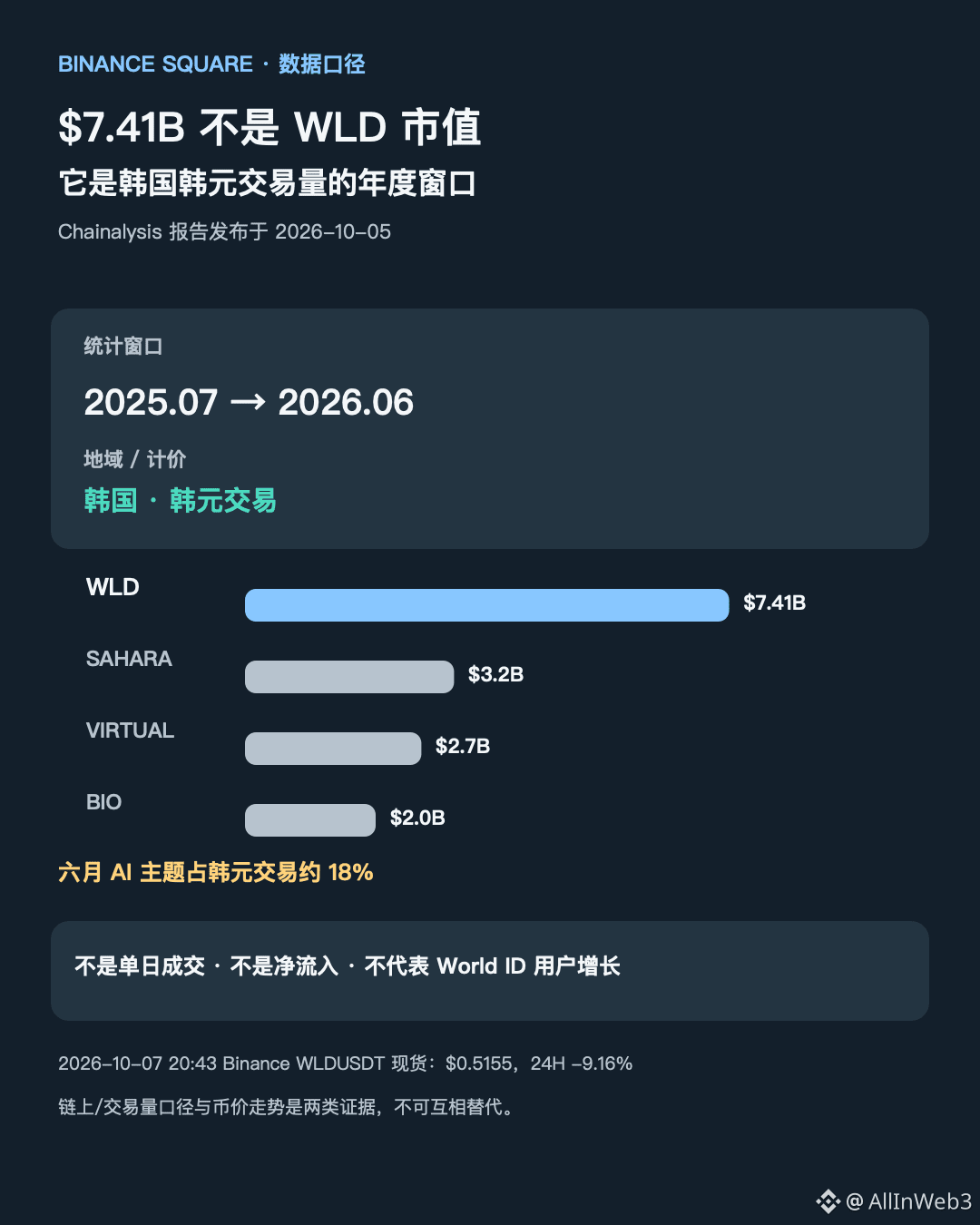
#South Korea’s AI-themed crypto trading and Worldcoin: The “$7.41 billion” in the trending headline is neither WLD’s market cap nor today’s inflow. The current No. 6 item on Binance Square refers to an East Asia crypto economy report published by Chainalysis on October 5. Its data covers a period ending in June 2026, so it is an annual overview, not a transaction that just happened.
The report’s figures show that, among AI-themed crypto assets traded in South Korean won, Worldcoin (WLD) recorded a cumulative trading volume of $7.41 billion, ahead of SAHARA at $3.2 billion, VIRTUAL at $2.7 billion, and BIO at $2 billion. These figures represent the nominal value of trades matched between buyers and sellers repeatedly over a period of time. They should not be treated as new net purchases, dollar inflows into WLD, or the token’s market capitalization. The report also says that AI-themed assets accounted for about 18% of won-denominated trading volume in June 2026. This describes the theme’s share of local trading activity; it does not mean that 18% of South Korean investors hold AI coins.
What these figures actually reveal is trading preference: Chainalysis defines AI-related coins as tokens from AI projects or assets associated with AI infrastructure, and observed that South Korea’s market was driven by retail trading. The report notes that WLD and SAHARA replaced VIRTUAL and KAITO as the main trading targets during this period. This supports the view that “AI coins are attracting heavy trading in South Korea,” but it does not prove growth in World ID users, product adoption, or long-term demand. High trading volume may also reflect faster rotation between themes.
Now consider the market context: A Binance WLDUSDT spot snapshot at 20:43 Beijing time showed a price of about $0.5155, down approximately 9.16% over the rolling 24 hours. This quote and the report’s trading volume through June cover different time windows, so they cannot be combined into a cause-and-effect narrative. When reading this trending item, keep the reporting period, won-denominated trading figures, token price, and actual product usage separate; $7.41 billion does not mean that “the market cap was pushed to $7.41 billion.”
The report also explicitly states that activity in South Korea is driven mainly by the retail market, while financial institutions are still in the preparatory stages of participation. This statistic is therefore better understood as traders’ activity around a particular theme, rather than the proportion of institutional allocations. The rotation among tokens also shows that a single token leading during one annual window does not mean it will hold the same ranking the following year.
The report’s figures show that, among AI-themed crypto assets traded in South Korean won, Worldcoin (WLD) recorded a cumulative trading volume of $7.41 billion, ahead of SAHARA at $3.2 billion, VIRTUAL at $2.7 billion, and BIO at $2 billion. These figures represent the nominal value of trades matched between buyers and sellers repeatedly over a period of time. They should not be treated as new net purchases, dollar inflows into WLD, or the token’s market capitalization. The report also says that AI-themed assets accounted for about 18% of won-denominated trading volume in June 2026. This describes the theme’s share of local trading activity; it does not mean that 18% of South Korean investors hold AI coins.
What these figures actually reveal is trading preference: Chainalysis defines AI-related coins as tokens from AI projects or assets associated with AI infrastructure, and observed that South Korea’s market was driven by retail trading. The report notes that WLD and SAHARA replaced VIRTUAL and KAITO as the main trading targets during this period. This supports the view that “AI coins are attracting heavy trading in South Korea,” but it does not prove growth in World ID users, product adoption, or long-term demand. High trading volume may also reflect faster rotation between themes.
Now consider the market context: A Binance WLDUSDT spot snapshot at 20:43 Beijing time showed a price of about $0.5155, down approximately 9.16% over the rolling 24 hours. This quote and the report’s trading volume through June cover different time windows, so they cannot be combined into a cause-and-effect narrative. When reading this trending item, keep the reporting period, won-denominated trading figures, token price, and actual product usage separate; $7.41 billion does not mean that “the market cap was pushed to $7.41 billion.”
The report also explicitly states that activity in South Korea is driven mainly by the retail market, while financial institutions are still in the preparatory stages of participation. This statistic is therefore better understood as traders’ activity around a particular theme, rather than the proportion of institutional allocations. The rotation among tokens also shows that a single token leading during one annual window does not mean it will hold the same ranking the following year.