



You don’t need to know how to code to turn your trading ideas over to a machine to execute—that’s what excites me most about Binance Intelligence.
But as I listened to last night’s AMA, one question kept coming to mind as an SMC strategy trader: If everyone has AI to help analyze the market, track smart money, and generate strategies, then who will make money in this market—and who will lose?
As tools get smarter, will it become harder and harder to make money in the market?
Before discussing that question, let’s first understand what Binance is doing this time.
On October 5, 2026, Binance launched Binance Intelligence. The Chinese-language AMA on the evening of October 6 was hosted by Sisi, with He Yi, Jeff Li, and Jackson introducing the product’s direction. This recap draws on official launch materials and the Chinese AMA. The first half covers the product, and the second half shares my observations on trading.
💡 What exactly can Binance Intelligence do?
The product suite includes three offerings, which can be understood by their use cases:
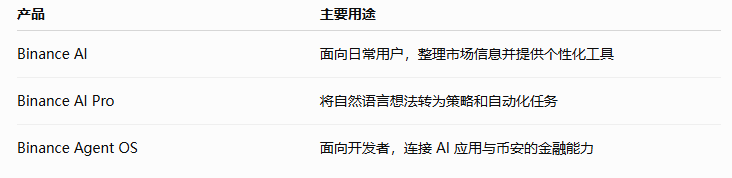
For traders, these three layers correspond to gathering information, expressing rules, and executing trades.
In the past, we might have started by browsing the news, then looked at on-chain wallets, opened a chart, and finally put the conditions into a script. Binance hopes to connect these steps so that people who can’t code can also use more sophisticated tools.
According to Binance’s official announcement dated October 5, free Binance AI features are beginning to roll out gradually; the new AI Pro experience is planned to roll out in the second half of October. The premium plan is priced at 19.99 USDC per month and includes features such as paper trading and deployment of live strategies. Strategies use separate sub-accounts, which users fund manually.
These are the arrangements announced at launch. What’s actually available will still depend on what has been enabled for each account.
💡 The key points I’m watching in the Chinese AMA
He Yi summed up the long-term direction as “All in AI,” with the goal of lowering the barriers to financial knowledge and using tools.
At the product level, Binance AI will provide personalized content based on authorized information such as holdings and watchlists. The AI Pro upgrade is planned for mid-to-late October, with more data interfaces, gradually expanded backtesting support, and strategies that can run continuously in the cloud.
At the execution level, users need to review the visualized strategy and confirm permissions and capital limits; expanding authorization requires confirmation again. The longer-term roadmap includes connecting spot, futures, Earn, wallets, and Web3.
These features are at different stages: launch plans, experiences currently being tested, and future plans. They shouldn’t all be treated as features available today.
I’m following this AMA because it could change how traders interact with tools.
Someone with a strategy idea but no coding skills used to get stuck at “I can’t build it.” If natural language can generate rules, that barrier may be lowered.
Next, the question becomes more specific: have you actually spelled out the rules clearly?
“Buy a little after a big drop” sounds intuitive, but it’s hard to execute. How much of a drop? Which time frame? Which price are you using as the reference? How much do you buy? Under what conditions do you stay out?
Only when conditions are testable can we discuss whether a strategy works. For example, you could define an observation period, a trigger threshold, a capital limit, and conditions for stopping. These are just examples; writing conditions precisely doesn’t automatically turn them into a profitable strategy.
A machine can help expose what’s unclear. That process is valuable in itself: you may discover that what you previously called a “strategy” still leaves plenty of room for on-the-spot interpretation.
💡 And then we’re back to the question: if everyone has AI, whose money are we making?
Let’s first clear up a common misconception: giving everyone better tools doesn’t mean everyone can keep making money.
And “making money” also depends on which kind of return we mean.
When spot prices rise, many holders can show paper gains at the same time. The fact that the coin you bought has gone up doesn’t mean the person who sold it to you lost the same amount. They may have bought earlier and already sold at a profit.
Asset repricing can increase paper wealth. But market capitalization on paper doesn’t mean there’s an equal amount of cash sitting in the market. If everyone sells at once, they may not all be able to cash out at the last traded price.
Price gains and losses on a contract work differently. For the same contract, a long’s price gain corresponds to a short’s price loss, and vice versa. Fees are then deducted from traders’ overall returns.
AI can help a trader reduce mistakes and improve execution, but it can’t make both sides of the same contract earn positive price returns at the same time.
We also need to distinguish absolute returns from excess returns: if the market rises, you make money. Whether you outperform the market and whether you took on too much risk are two separate questions that need to be calculated.
💡 A useful strategy can be changed by the people who use it
Suppose there’s a brief price gap between two markets. Once a few people spot it, they can buy on the cheaper side and sell on the more expensive side.
AI lowers the barriers to spotting and executing a trade. If more people make the same trade at once, buying pushes up the cheaper side and selling pushes down the more expensive side, so the price gap may disappear faster.
This helps make the market more efficient, but it also means thinner profit margins for traders who enter later.
A public strategy can undergo a similar change: more people enter early, worsening execution prices; more people exit at the same time, raising the cost of getting out.
That’s why strategies have a capacity limit. A small amount of capital running smoothly doesn’t mean the strategy will perform just as well when copied with a much larger amount.
That’s why I’m skeptical of the idea of “giving everyone a strategy that makes money.” A strategy’s returns depend on how its participants behave. When the users change, the market conditions behind its historical performance may change too.
Of course, AI won’t necessarily make everyone place the same order. Users’ goals, data, parameters, and models may all differ. What we need to watch is whether similar tools cause certain trades to become increasingly concentrated, and how returns and risks change as a result.
💡 The moves of smart money are often only part of the picture
When you see a large wallet buying, the easiest thought to have is: “They know more than I do, so I’ll follow them.”
The problem is that what you see is the buying action, not necessarily the complete strategy.
It might hedge by shorting in another market, execute arbitrage, or have different costs, holding periods, and exit conditions.
Even if it ends up making money, your copy trade could still lose. You may not be able to withstand the drawdown it can tolerate, especially if you’re using leverage; it may have finished buying before you receive the signal, and it may start exiting while you’re still waiting for prices to rise.
AI can make it easier to organize clues from wallets, but the gaps in those clues remain. A public address doesn’t reveal a trader’s full assets, liabilities, or intentions.
And there’s competition among smart-money players too. Market making, arbitrage, trend trading, and long-term holding have different goals, and their positions may point in opposite directions.
💡 AI improves execution, but may also amplify mistakes
For individuals, I’m most hopeful that it can help organize information, check rules, monitor things continuously, and reduce missed or duplicate actions.
These capabilities can improve efficiency. But there’s still a whole process of validation between efficiency and strategy returns.
Did the backtest accidentally use future information? Were the parameters overfit to historical data? Did it account for fees, slippage, funding rates, and execution constraints? Do the results still hold up in a different market environment?
Even a clearly written rule may have no edge. Once automated, it can lose money faster and more frequently than a person.
Likewise, a separate sub-account can help limit capital exposure, but it cannot improve a strategy’s expected returns. Even a very small position can keep losing money; a rule with no effective exit conditions doesn’t become sound just because it has been authorized.
I’ll also be watching for the risk of strategies becoming crowded: if many strategies use similar signals and reduce their positions under similar conditions, a concentrated exit could amplify short-term volatility.
This is a scenario that needs to be tested. We can’t conclude that “AI will collectively pile into the same trade” just because a product has been announced.
💡 Finally, where might the advantage shift?
My view is that information curation and simple rules that are easy to replicate will find it increasingly difficult to provide an advantage on their own.
Traders need to answer: Why might this strategy work? In what conditions does it work? Can its returns cover its costs? What evidence would show that it’s no longer working?
AI can help answer questions, but its explanations also need to be tested. Human intuition needs testing too; years of trading don’t automatically make someone’s judgment in the moment better than a machine’s.
For the platform, easier-to-use tools may attract more users and trading activity. For traders, what matters in the end is returns after fees and the drawdowns they had to endure to achieve them.
More trades, more strategies, and more analysis reports cannot substitute for these two results.
I’m optimistic about Binance Intelligence because it may help more people with ideas turn them into rules, put them into practice, and test them.
But I wouldn’t take “can execute automatically” to mean “has already found a way to make money.” If all the data points to a bullish outlook but the price keeps weakening, you need to re-examine the signal, the market environment, and your own assumptions. After all, if you don’t know how to make money trading, the strategy you write or choose will most likely just lose money.
Even after AI becomes widespread, the market will still reward sound judgment and effective execution, and mistakes will still come at a cost. The tools are more powerful, so we need to be even clearer about what we ask them to do—and when to stop.
If an AI recommendation conflicts with the price action you’re observing, which side would you check first?
Information verified as of October 7, 2026. Product information is based on official materials; discussion of strategy crowding, changing advantages, and platform effects is this article’s analysis.