
#币安推出BinanceIntelligence
When AI truly enters an exchange, what changes may not be “how we analyze,” but “how we trade.”
Honestly, I’ve seen too many trading tools over the past few years: AI that watches the markets, summarizes news, and analyzes candlestick charts. At first, they seemed pretty novel. But after using them for a while, I realized that many of them still just “tell you what happened.”
But this time, Binance’s launch of Binance Intelligence feels a little different to me.
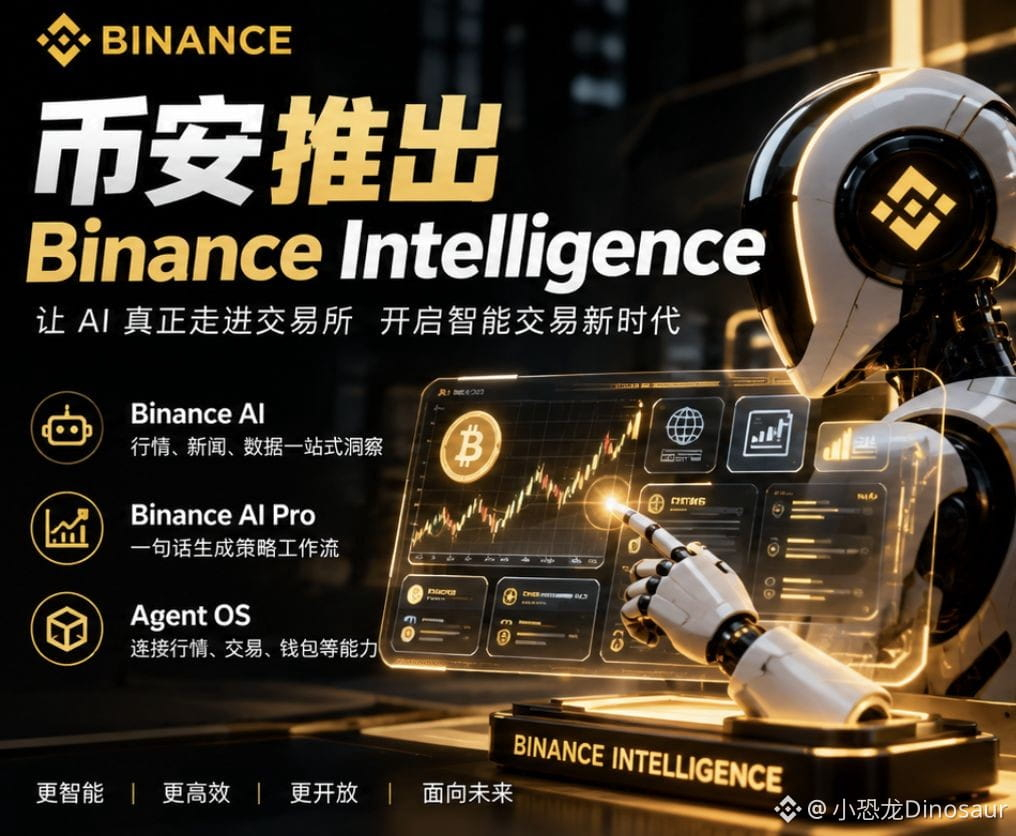
It’s not just a chatbot bolted on by itself. Instead, it’s made up of three layers: Binance AI, Binance AI Pro, and Agent OS. Everyday users can use AI to organize market trends, news, and other market information. Taking it a step further, AI Pro can turn a plain-language request into a strategy workflow. Developers, meanwhile, can use Agent OS to connect to market data, trading, wallets, and other capabilities.Binance
That means that in the past, putting together a strategy might have involved finding data → reading the news → writing the logic → backtesting → monitoring the market → executing trades. In the future, there’s a chance these steps will gradually be condensed into a single AI interface.
I think this is where things get really interesting: the barrier to trading may shift from “Do you know how to use the tools?” to “Can you ask the right questions?”
Of course, don’t take this to mean that in the future you can just say, “Make me money,” and sit back counting your cash. AI can improve the efficiency of information processing and execution, but it can’t fix poor judgment. In fact, if everyone uses similar models and similar data, strategies could become even more alike.
So what’s really worth watching about Binance Intelligence isn’t how smart the AI is, but whether it can change the way people have interacted with exchanges for decades.
In the past, we opened an exchange and searched for the features we needed.
In the future, we may simply tell AI what we want to do.
To me, that’s far more interesting than just adding another AI feature.
When AI truly enters an exchange, what changes may not be “how we analyze,” but “how we trade.”
Honestly, I’ve seen too many trading tools over the past few years: AI that watches the markets, summarizes news, and analyzes candlestick charts. At first, they seemed pretty novel. But after using them for a while, I realized that many of them still just “tell you what happened.”
But this time, Binance’s launch of Binance Intelligence feels a little different to me.
It’s not just a chatbot bolted on by itself. Instead, it’s made up of three layers: Binance AI, Binance AI Pro, and Agent OS. Everyday users can use AI to organize market trends, news, and other market information. Taking it a step further, AI Pro can turn a plain-language request into a strategy workflow. Developers, meanwhile, can use Agent OS to connect to market data, trading, wallets, and other capabilities.Binance
That means that in the past, putting together a strategy might have involved finding data → reading the news → writing the logic → backtesting → monitoring the market → executing trades. In the future, there’s a chance these steps will gradually be condensed into a single AI interface.
I think this is where things get really interesting: the barrier to trading may shift from “Do you know how to use the tools?” to “Can you ask the right questions?”
Of course, don’t take this to mean that in the future you can just say, “Make me money,” and sit back counting your cash. AI can improve the efficiency of information processing and execution, but it can’t fix poor judgment. In fact, if everyone uses similar models and similar data, strategies could become even more alike.
So what’s really worth watching about Binance Intelligence isn’t how smart the AI is, but whether it can change the way people have interacted with exchanges for decades.
In the past, we opened an exchange and searched for the features we needed.
In the future, we may simply tell AI what we want to do.
To me, that’s far more interesting than just adding another AI feature.