NMR at $16—are you still willing to chase it?
First, the surface picture: BTC is falling, while NMR is rising on its own.
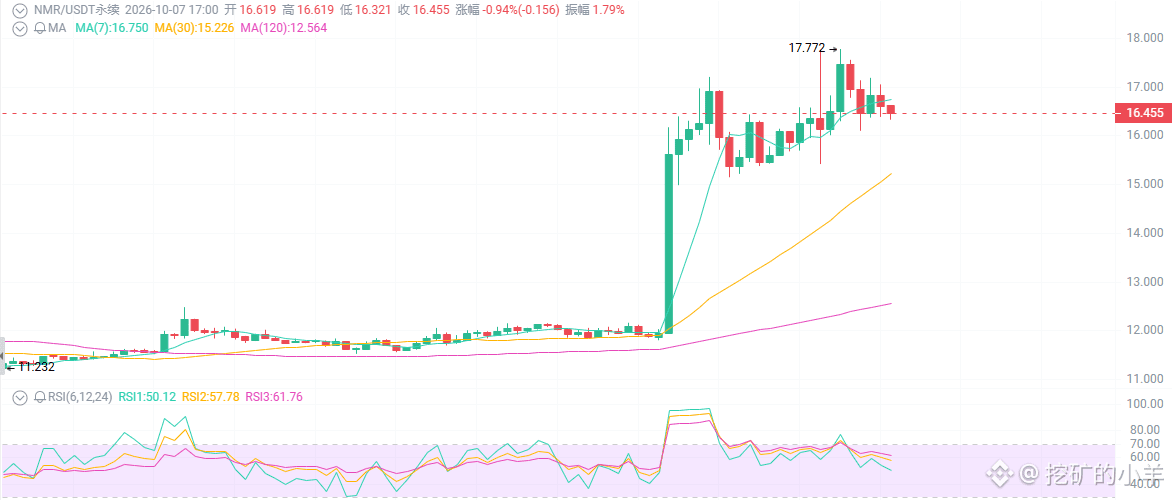
On Wednesday, BTC plunged from 86,600 to 83,560. Oil prices and the dollar hammered risk assets, liquidating long positions. But NMR? It defied the market with a massive 67% green candle.
First point: Upbit added KRW trading pairs—but is that bullish, or an exit opportunity?
On October 6, Upbit officially listed NMR/KRW and NMR/USDT. Everyone in crypto knows how much buying power Korean retail traders have—and how Upbit listings have historically been “all downhill after the opening bell.”
What’s the pattern? The announcement brings the biggest move, the listing comes next, and then the market starts digesting it the following day.
BTC and ETH are both down today, while NMR is rising on its own. That means this isn’t a broad market rally—it’s a venue-liquidity trade. The Korean money brought in by Upbit comes fast and leaves even faster.
Second point: The Numerai fund narrative is old news.
Numerai had around $700 million in AUM this July, and in November 2025 it raised $30 million in a Series C at a $500 million valuation. Sounds impressive?
But JPMorgan’s $500 million is an available credit line, not money that’s already flowed into the market. And buybacks? Just $3.2 million in total from July 2025 to July 2026.
A $3.2 million buyback won’t even make a ripple against a $120 million market cap. It can’t support a $16 price.
Third point: The chart says $16 is halfway up the mountain, not the bottom.
The first daily RSI spike already hit 85, and now we’re seeing a pullback after a second overbought spike. Volume is more than ten times what it was a few days ago—this isn’t a healthy rally; it’s an emotional blow-off.
$16 sits right in the middle of the $15.3–$19.75 range. If $15.3 holds, you could view it as a retest; if it can’t reclaim $17.5, any bounce is an opportunity to reduce your position.
The middle of the mountain is the most dangerous place—$20 to the upside is wishful thinking; $12 to the downside is reality.
Trading strategies
Aggressive:
Opening a long at $16 isn’t recommended. If you really can’t resist, enter only a tiny position if it stabilizes at $15.3–$15.6, with a stop-loss at $14.6 and a target of $17.2. Take profit at $17—don’t get greedy.
Conservative (recommended for most people):
Wait for $12.5–$13.5 before considering an entry, with a stop-loss at $11.5. If it doesn’t get there, stay out. Money from an exchange-listing spike isn’t your money.
Breakout traders:
Only consider chasing if it holds above $18 on strong volume and then retests $16.5 without breaking below it. Target $19.5. Don’t use $19.75 as your target.
Bears:
If it struggles to push higher in the $17.2–$18 range, you could take a tiny short position for a pullback, with a stop-loss at $18.6 and targets at $15.3 and $14.
It can go from $12 to $20 in a day—and give it all back from $20 to $15 just as fast. Can you handle that?
First, the surface picture: BTC is falling, while NMR is rising on its own.
On Wednesday, BTC plunged from 86,600 to 83,560. Oil prices and the dollar hammered risk assets, liquidating long positions. But NMR? It defied the market with a massive 67% green candle.
First point: Upbit added KRW trading pairs—but is that bullish, or an exit opportunity?
On October 6, Upbit officially listed NMR/KRW and NMR/USDT. Everyone in crypto knows how much buying power Korean retail traders have—and how Upbit listings have historically been “all downhill after the opening bell.”
What’s the pattern? The announcement brings the biggest move, the listing comes next, and then the market starts digesting it the following day.
BTC and ETH are both down today, while NMR is rising on its own. That means this isn’t a broad market rally—it’s a venue-liquidity trade. The Korean money brought in by Upbit comes fast and leaves even faster.
Second point: The Numerai fund narrative is old news.
Numerai had around $700 million in AUM this July, and in November 2025 it raised $30 million in a Series C at a $500 million valuation. Sounds impressive?
But JPMorgan’s $500 million is an available credit line, not money that’s already flowed into the market. And buybacks? Just $3.2 million in total from July 2025 to July 2026.
A $3.2 million buyback won’t even make a ripple against a $120 million market cap. It can’t support a $16 price.
Third point: The chart says $16 is halfway up the mountain, not the bottom.
The first daily RSI spike already hit 85, and now we’re seeing a pullback after a second overbought spike. Volume is more than ten times what it was a few days ago—this isn’t a healthy rally; it’s an emotional blow-off.
$16 sits right in the middle of the $15.3–$19.75 range. If $15.3 holds, you could view it as a retest; if it can’t reclaim $17.5, any bounce is an opportunity to reduce your position.
The middle of the mountain is the most dangerous place—$20 to the upside is wishful thinking; $12 to the downside is reality.
Trading strategies
Aggressive:
Opening a long at $16 isn’t recommended. If you really can’t resist, enter only a tiny position if it stabilizes at $15.3–$15.6, with a stop-loss at $14.6 and a target of $17.2. Take profit at $17—don’t get greedy.
Conservative (recommended for most people):
Wait for $12.5–$13.5 before considering an entry, with a stop-loss at $11.5. If it doesn’t get there, stay out. Money from an exchange-listing spike isn’t your money.
Breakout traders:
Only consider chasing if it holds above $18 on strong volume and then retests $16.5 without breaking below it. Target $19.5. Don’t use $19.75 as your target.
Bears:
If it struggles to push higher in the $17.2–$18 range, you could take a tiny short position for a pullback, with a stop-loss at $18.6 and targets at $15.3 and $14.
It can go from $12 to $20 in a day—and give it all back from $20 to $15 just as fast. Can you handle that?