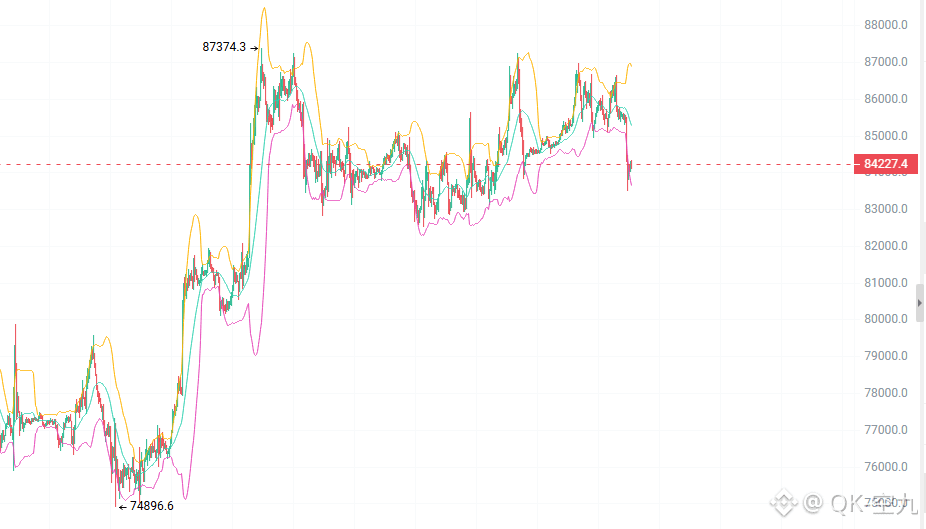
In this flash crash, $400 million worth of long positions were wiped out within minutes. At its core, this wasn’t a sell-off triggered by bad news—the market was simply overloaded with high-leverage positions.
The longer the price stays range-bound at elevated levels, the more leverage piles up. At this level of leverage, it doesn’t take any real bad news—a single wick is enough. Liquidations trigger a chain reaction that drives prices down on its own, with one forced liquidation triggering the next.
Rather than saying the market was slammed down, it’s more accurate to say that leverage squeezed itself to the breaking point. The market was overdue for this kind of leverage flush.
Here’s how I see things unfolding from here: a sharp drop → sideways consolidation → another sharp drop → more sideways consolidation.
Each sharp drop wipes out a batch of leveraged longs. Each sideways stretch convinces new people that “the bottom is in” and that it’s time to buy the dip—only for another batch to get trapped.
This will repeat until no one dares to go long: the long-short ratio falls, funding rates turn negative, and nobody in the community is calling for a dip-buy anymore. That’s when the shakeout will truly be over. A bottom is never formed by grinding down to some particular price level; it’s formed when prices fall so far that nobody dares to buy.
The key area right now is still 82–826. As long as this level isn’t decisively broken to the downside (judge by candle-body closes, not wicks), the structure remains a pullback within a high-level consolidation.
This is not a trend reversal. If the level is decisively broken, the situation changes, and we’ll need to reassess the downside potential. #币安推出BinanceIntelligence #比特币跌破8.4万美元
The longer the price stays range-bound at elevated levels, the more leverage piles up. At this level of leverage, it doesn’t take any real bad news—a single wick is enough. Liquidations trigger a chain reaction that drives prices down on its own, with one forced liquidation triggering the next.
Rather than saying the market was slammed down, it’s more accurate to say that leverage squeezed itself to the breaking point. The market was overdue for this kind of leverage flush.
Here’s how I see things unfolding from here: a sharp drop → sideways consolidation → another sharp drop → more sideways consolidation.
Each sharp drop wipes out a batch of leveraged longs. Each sideways stretch convinces new people that “the bottom is in” and that it’s time to buy the dip—only for another batch to get trapped.
This will repeat until no one dares to go long: the long-short ratio falls, funding rates turn negative, and nobody in the community is calling for a dip-buy anymore. That’s when the shakeout will truly be over. A bottom is never formed by grinding down to some particular price level; it’s formed when prices fall so far that nobody dares to buy.
The key area right now is still 82–826. As long as this level isn’t decisively broken to the downside (judge by candle-body closes, not wicks), the structure remains a pullback within a high-level consolidation.
This is not a trend reversal. If the level is decisively broken, the situation changes, and we’ll need to reassess the downside potential. #币安推出BinanceIntelligence #比特币跌破8.4万美元