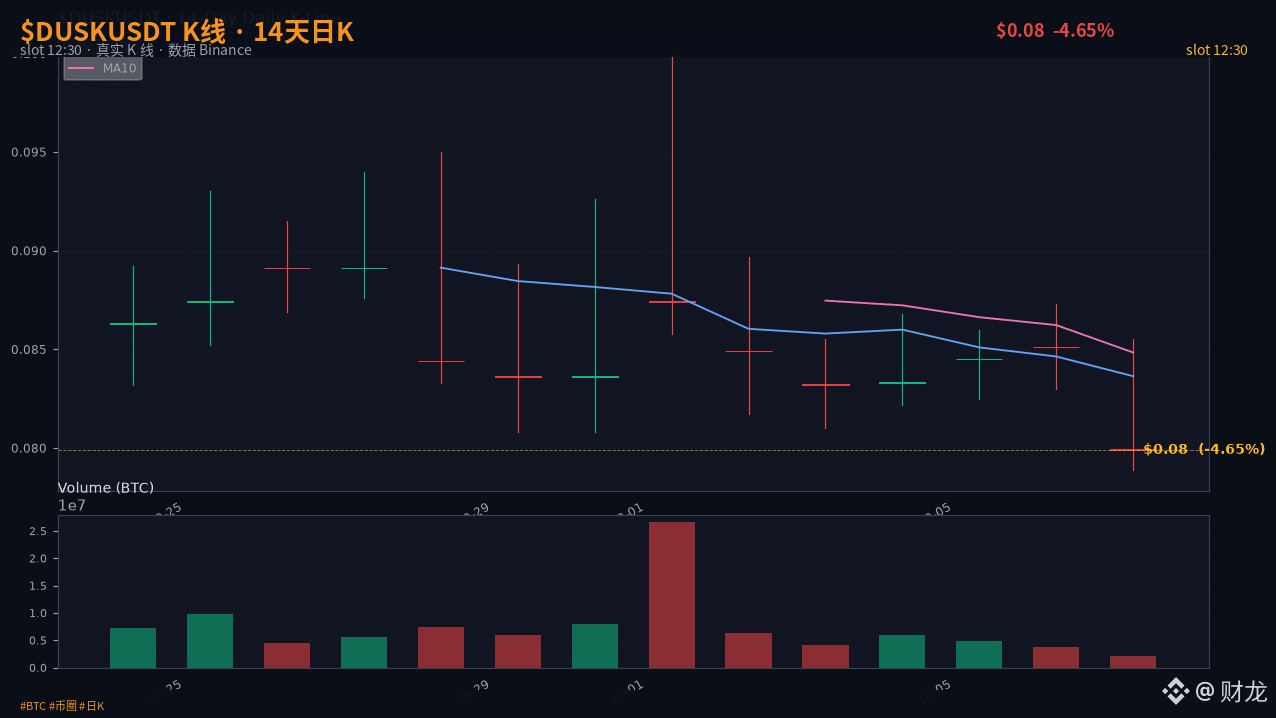

$DUSK 24 Hours down 4.3%, slipping from $0.0839 to $0.0801. Intraday high: $0.0873; low: $0.0789. Trading volume: $440K. The price action is dead.
But this week, @Dusk did something in its documentation that nobody noticed—the team put a “6-step workflow” on the market infrastructure layer page (issuer configuration → investor onboarding → transfer control → matching and distribution → settlement → ongoing disclosures). The final sentence loops right back: “If you want to understand the product layer, start with that application track.”
That sentence is positioning in itself. The application track isn’t a standalone product; it’s the official route from “market infrastructure” to “product entry point” in the documentation system. The first 10 installments discussed these topics separately—the foundational stack, 6 asset classes, user entry points, the simulator, 7 real questions, and the 4-piece foundation—but this week’s documentation connected those separate threads with a single sentence.
The stack view listed on the application track’s details page (settlement layer / contract layer / identity layer / wallet discovery / browser wallet) is the same thing as the “6 capabilities vs. 6 categories of needs” comparison table, just from a different perspective: foundational protocol level vs. application product level. The documentation itself makes that connection clear.
So this time, the point isn’t what else has been added to the application track. It’s that the team has anchored it, at the documentation level, as the executable side of the foundation. The frontend wasn’t added out of nowhere; it’s a product wrapper built out of the 6-step pipeline on the backend.
The official documentation site itself is the project’s biggest product manual.
@Dusk
#dusk #DuskTrade #DocumentationSystem
But this week, @Dusk did something in its documentation that nobody noticed—the team put a “6-step workflow” on the market infrastructure layer page (issuer configuration → investor onboarding → transfer control → matching and distribution → settlement → ongoing disclosures). The final sentence loops right back: “If you want to understand the product layer, start with that application track.”
That sentence is positioning in itself. The application track isn’t a standalone product; it’s the official route from “market infrastructure” to “product entry point” in the documentation system. The first 10 installments discussed these topics separately—the foundational stack, 6 asset classes, user entry points, the simulator, 7 real questions, and the 4-piece foundation—but this week’s documentation connected those separate threads with a single sentence.
The stack view listed on the application track’s details page (settlement layer / contract layer / identity layer / wallet discovery / browser wallet) is the same thing as the “6 capabilities vs. 6 categories of needs” comparison table, just from a different perspective: foundational protocol level vs. application product level. The documentation itself makes that connection clear.
So this time, the point isn’t what else has been added to the application track. It’s that the team has anchored it, at the documentation level, as the executable side of the foundation. The frontend wasn’t added out of nowhere; it’s a product wrapper built out of the 6-step pipeline on the backend.
The official documentation site itself is the project’s biggest product manual.
@Dusk
#dusk #DuskTrade #DocumentationSystem