
$DOT: Navigating Conflicting Signals
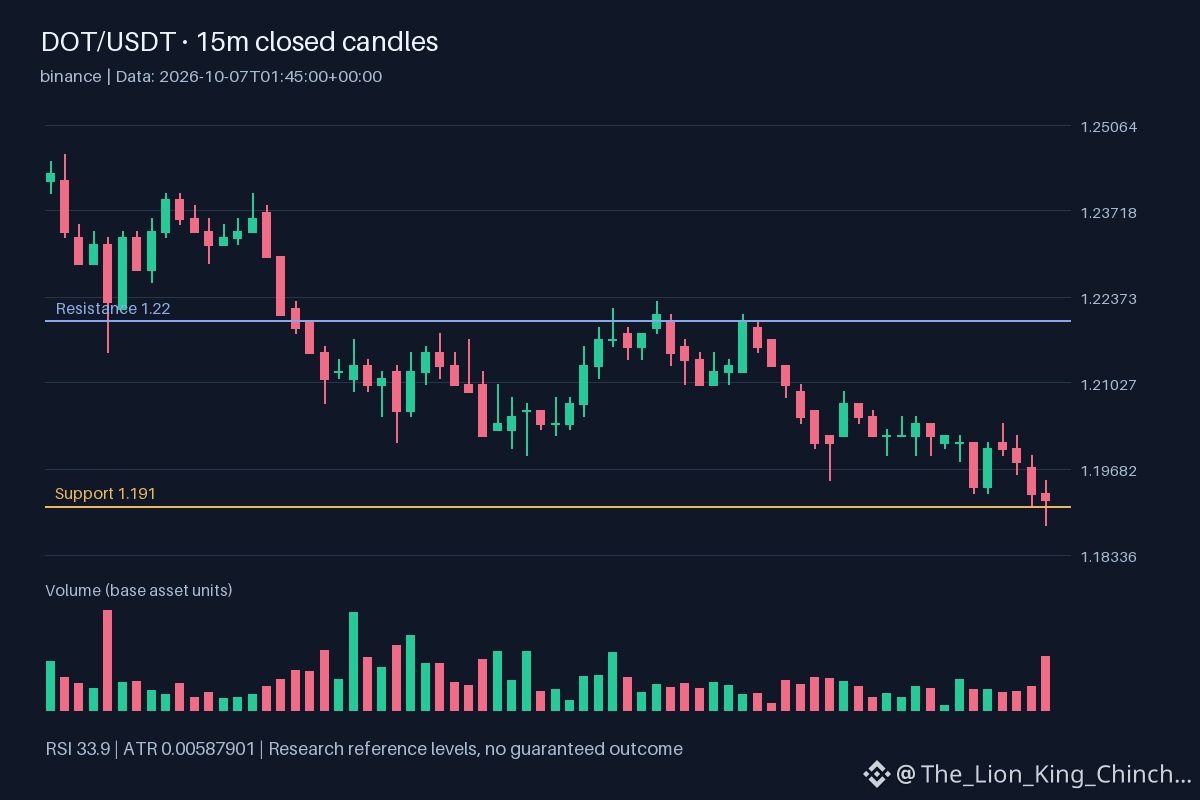
In the crypto space, we often encounter a dilemma: how much certainty should a content creator convey when sharing a thesis? When looking at $DOT, which shows volume above baseline alongside a downward hourly trend, the temptation to offer a firm prediction is high. However, relying on social proof or overly confident captions can mask the underlying uncertainty. Write to Earn platforms often incentivize this certainty, as high-conviction posts tend to gather more visibility than nuanced ones. This creates an incentive structure where the best content is not necessarily the most accurate, but the most persuasive. 🧠 Reasonable readers often disagree here. Some argue that a creator should act as a guide, providing clear targets to simplify complex data. Others believe that providing a conclusion without explaining the invalidation criteria is a disservice. Evidence-based analysis requires separating the market observation from the narrative. When observing $DOT , note the price 1.192 relative to the support 1.191 and resistance 1.22. If the RSI 33.8606 or the MACD -0.00433908 signals deviate from expected patterns, the original thesis might weaken. A transparent way to discuss uncertainty is to openly list the conditions that would prove the analysis wrong. Before you trust a chart, ask yourself if the author has considered what would invalidate their idea. If they cannot define their failure state, they are likely selling a story rather than providing an analysis. Always prioritize the evidence, like the relative volume 2.60294 and vwap 1.21863, over the tone of the caption.
Probabilistic market research, not a recommendation or guaranteed return.
Should a creator explain what could invalidate the idea before sharing a target?
#DOT #CryptoCommunity #CryptoLearning
In the crypto space, we often encounter a dilemma: how much certainty should a content creator convey when sharing a thesis? When looking at $DOT, which shows volume above baseline alongside a downward hourly trend, the temptation to offer a firm prediction is high. However, relying on social proof or overly confident captions can mask the underlying uncertainty. Write to Earn platforms often incentivize this certainty, as high-conviction posts tend to gather more visibility than nuanced ones. This creates an incentive structure where the best content is not necessarily the most accurate, but the most persuasive. 🧠 Reasonable readers often disagree here. Some argue that a creator should act as a guide, providing clear targets to simplify complex data. Others believe that providing a conclusion without explaining the invalidation criteria is a disservice. Evidence-based analysis requires separating the market observation from the narrative. When observing $DOT , note the price 1.192 relative to the support 1.191 and resistance 1.22. If the RSI 33.8606 or the MACD -0.00433908 signals deviate from expected patterns, the original thesis might weaken. A transparent way to discuss uncertainty is to openly list the conditions that would prove the analysis wrong. Before you trust a chart, ask yourself if the author has considered what would invalidate their idea. If they cannot define their failure state, they are likely selling a story rather than providing an analysis. Always prioritize the evidence, like the relative volume 2.60294 and vwap 1.21863, over the tone of the caption.
Probabilistic market research, not a recommendation or guaranteed return.
Should a creator explain what could invalidate the idea before sharing a target?
#DOT #CryptoCommunity #CryptoLearning