

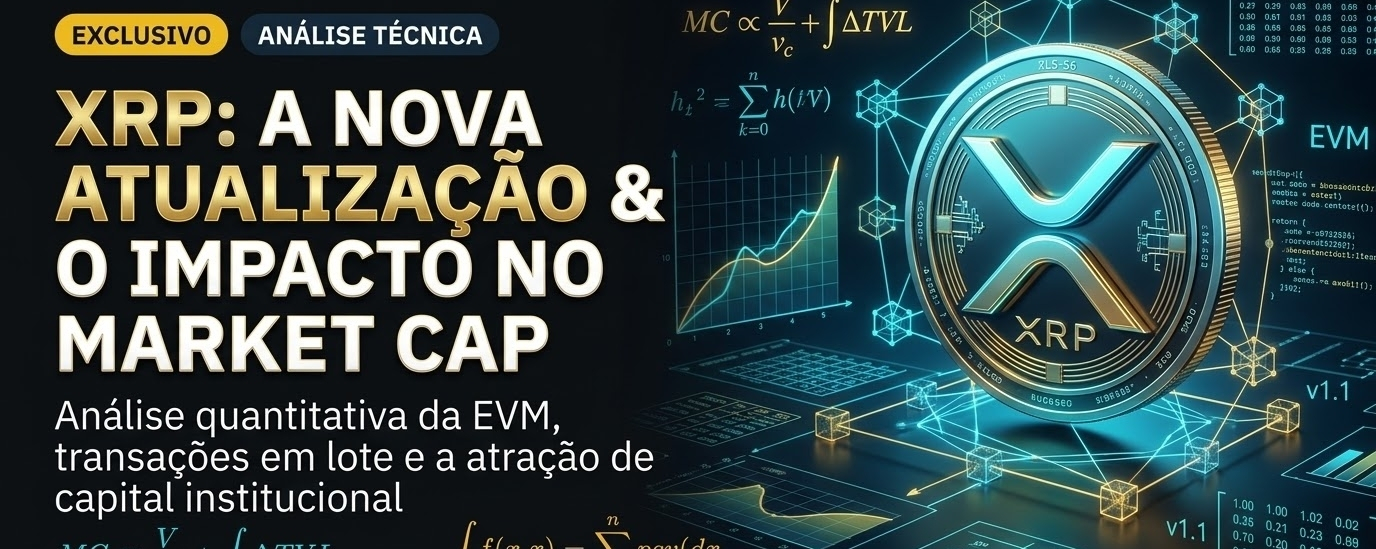

The market value of a Layer 1 utility asset is determined by the balance between circulation velocity and the density of capital retained within its ecosystem. As the XRP Ledger (XRPL) upgrade roadmap advances, notably with the Permission Delegation v1.1 amendments and atomic batch transactions, the network is undergoing a state transition. The ecosystem is evolving from a mere international payments and settlement rail into an integrated financial environment supporting multiple smart contracts, changing the key variables that determine XRP’s market capitalization.
The Utility and Capital Retention Equation
A network’s valuation dynamics can be estimated using quantitative models that relate transaction volume to retained value (Total Value Locked, or TVL) and utility. By introducing robust smart contracts through the EVM Sidechain and new lending and institutional DeFi protocols based on XLS-66 and XLS-56, XRP gains greater economic density.
The equilibrium market capitalization (MC) for networks with smart contract utility can be represented as:
Where V_{transactions} is the total transaction volume, v_c is the token’s velocity of circulation (turnover rate), and the integral of \Delta TVL represents the progressive accumulation of utility assets removed from active circulation to generate yield, create pools, or subsidize operations, reducing the available net supply (liquid supply squeeze).
When utility shifts from simple transactions to complex batch operations and institutional-compliance custody:
* Reduction in v_c: Utility tokens are locked as collateral in smart contracts and liquidity pools, creating a retention effect.
* Growth in V_{transactions}: Scalability through atomic batch transactions reduces the aggregate computational cost of arbitrage and complex settlements, increasing the frequency and volume density of high-frequency activity that cumulatively consumes burn fees.
Permission Delegation (v1.1) and RLUSD: Institutional Volume Leverage
From a practical infrastructure compliance standpoint, the recent activation of Permission Delegation v1_1 is a critical factor in attracting institutional capital. This amendment enables entities to natively delegate specific operations and actions to secondary accounts on the network, mitigating security risks and facilitating treasury governance.
The impact of this upgrade falls directly on the expansion of RLUSD (Ripple’s stablecoin, which reached a market capitalization of US$2.37 billion). With functions natively separated and compliance and operational teams guaranteed on-chain, large issuers and corporate players have a direct incentive to migrate most of their financial volume to the XRPL. Increasing the volume of regulated RWA tokens and stablecoins on the XRPL increases interactions involving the native currency, XRP, as an asset for providing liquidity and as network fuel (gas).
If we analyze this through the Modified Metcalfe’s Law, which weights a network’s value by the square of its activity and secure interconnections among users, the entry of corporate bridges and decentralized issuers has a multiplicative effect:
The ability to delegate control without exposing master credentials decisively expands N_{Institutions}, accelerating global utility.
EVM Sidechain and XLS-66 Integration: Reducing Friction Costs
With the EVM Sidechain live for deploying Solidity-based dApps, combined with native L1 features (such as native AMMs and the XLS-66 lending protocol proposal), the network resolves the classic frictions and latency of cross-chain activity.
* L1-L2 Synergy: Developers connect low-latency features (3- to 5-second blocks on the XRPL) to advanced programmability. Every interaction and routing through decentralized bridges using Axelar-based bridges and other oracles generates continuous burning and consumption on the sidechain.
* Utility Token Behavior: Assets operated on a sidechain require custodians or bridges that lock up native collateral. XRP is consumed as gas on the sidechain, generating an additional source of consumption.
From a purely mathematical perspective, market cap growth on networks following interoperability and automation upgrades reaches exponential scales once the compliance barrier (resolved here through permission delegation) is overcome. The technical and operational ability to natively process traditional capital flows drives retention and, consequently, the ecosystem’s intrinsic value.
Disclaimer (DYOR - Do Your Own Research): This content is strictly analytical and informational and does not constitute an investment suggestion or recommendation. Digital assets and financial markets carry a high risk of loss, technical complexity, and extreme volatility. Always conduct your own thorough research and consult qualified professionals before making financial decisions.