
Risk warning: This article is for informational purposes only and does not constitute investment advice. All asset classes carry extremely high volatility risks. Please view market information rationally.
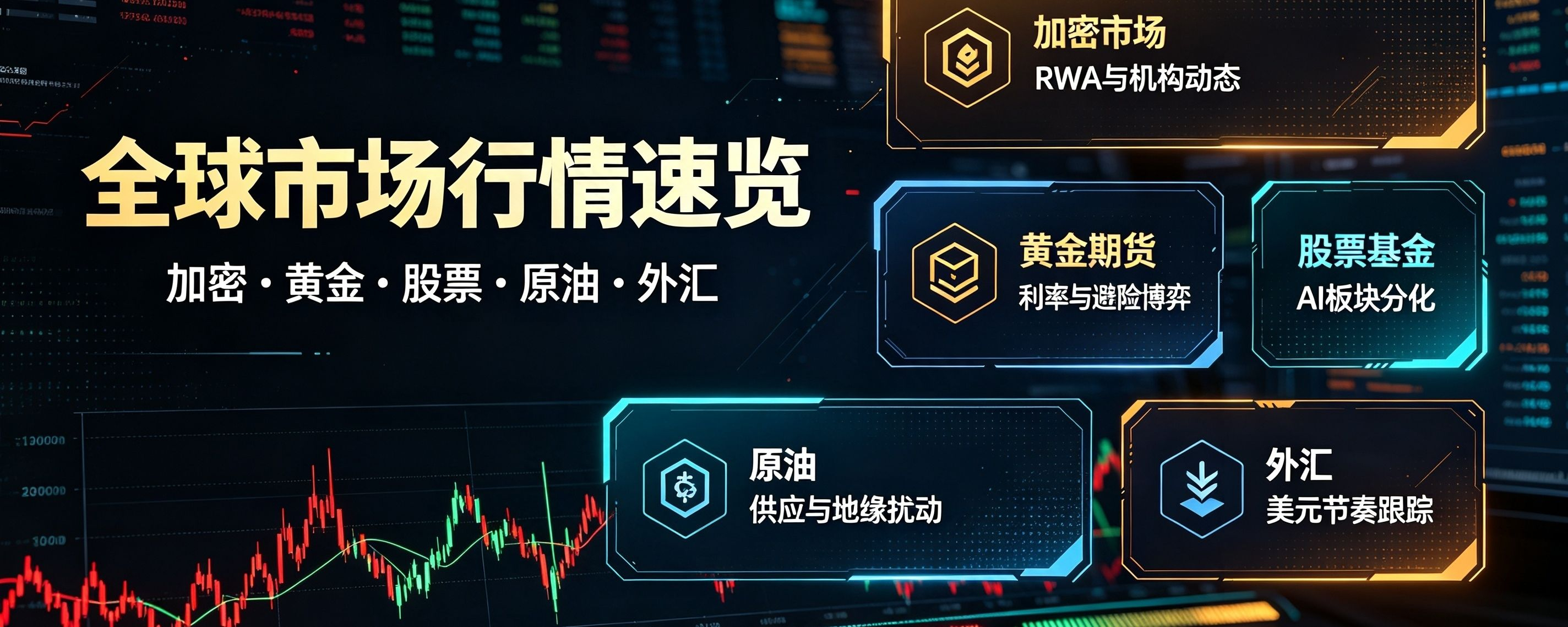
Global financial markets are entering a period of mixed bullish and bearish forces. Expectations for Federal Reserve policy, geopolitical conflicts, and institutional fund flows are simultaneously stirring activity across cryptocurrencies, precious metals, equities, crude oil, and foreign exchange. The links between different asset classes are becoming increasingly clear, and news in one market often quickly spills over into another. Below is a roundup of the key developments and signals across major sectors as of October 6.
🔐 Cryptocurrency Markets: The RWA narrative continues to gain momentum, with institutions making frequent moves
The biggest theme in crypto remains the tokenization of real-world assets (RWA). Ondo Finance has officially launched Ondo Private Markets, turning assets in AI-focused, pre-IPO private companies into tokenized notes. The product will later expand to private companies in robotics, cybersecurity, biotechnology, and other sectors. Built on infrastructure with $3.7 billion in TVL and over 1 million holders, it opens up a new path to private markets on-chain. These products do not represent direct ownership of company equity; instead, they capture economic returns from liquidity events such as IPOs and mergers and acquisitions. The tokens can be transferred on-chain and combined with the DeFi ecosystem, making this one of the most talked-about innovations in the crypto community recently.
At the institutional level, Michael Saylor’s Strategy continues to add to its BTC holdings, repeatedly setting new records for corporate Bitcoin ownership. The ongoing inflow of tens of billions of dollars is providing a strong signal to market sentiment.
On-chain data shows increased volatility in liquidations across derivatives markets, intensifying the battle between bulls and bears. Meanwhile, industry summits are taking place in quick succession. The AGENTIC MONEY Summit is underway in Singapore, where numerous institutions are discussing AI and tokenization, as well as the integration of traditional finance with the crypto ecosystem. The RWA + AI narrative continues to gather momentum.
🥇 Gold Futures: Institutions raise price targets as interest rate dynamics shape gold’s direction
International gold has recently traded in a volatile range near its highs. An LBMA survey of institutions forecasts that gold could reach $5,013 per ounce over the next year, giving bulls room to dream.
Gold prices remain primarily driven by expectations for Federal Reserve policy. Weak U.S. employment data would dampen expectations of rate hikes and support gold; a renewed rise in Treasury yields, however, would weigh on non-yielding gold.
Recurring geopolitical tensions have become a short-term source of volatility for gold prices. The market is currently in a tug-of-war driven by strong expectations, with a major split between bulls and bears. Investors need to be alert both to sudden surges driven by safe-haven demand and to sharp pullbacks triggered by a reversal in interest rates.
📈 Stocks & Funds: U.S. stocks hit new highs, while AI stocks showed clear divergence
Overnight, the S&P 500 and Nasdaq Composite once again hit record highs during intraday trading. AI computing and chip stocks led the market, with Nvidia, Marvell Technology, and others posting strong gains. Nuclear energy stocks also surged after Google signed a major nuclear power purchase deal. Real demand for the enormous amounts of electricity required by AI is boosting clean energy-related stocks.
Market dynamics have changed. The AI rally has moved past broad-based gains and officially entered a period of divergence: upstream computing hardware companies have full order books and are attracting a concentration of capital, while some cloud software companies are under sustained valuation pressure from massive capital expenditures.
For fund investors, October marks the start of the third-quarter earnings season. The ability to deliver earnings is replacing pure valuation speculation as the primary criterion for stock selection. Institutional allocation strategies are splitting into two camps: on the offensive side, focusing on tech growth; on the defensive side, allocating to high-dividend assets to hedge against volatility. European stocks also rose broadly, as global risk appetite staged a temporary recovery. However, elevated long-term U.S. Treasury yields remain a potential source of pressure hanging over equity markets.
⛽ Crude Oil & FX: Supply concerns ease, oil prices retreat sharply, and the dollar enters a volatile tug-of-war
Crude oil prices plunged sharply, with Brent and WTI futures down more than 3% at one point during intraday trading. The main catalyst was the completion of repairs to a Saudi oil pipeline, restoring daily throughput to 5.8 million barrels. Fears of a crude supply disruption quickly faded, leading to a substantial unwinding of the geopolitical risk premium.
The biggest short-term variable for oil prices remains the situation in the Middle East. Any development in the Strait of Hormuz can immediately trigger sharp price swings. Institutions broadly believe the current market is being driven by events: easing geopolitical tensions could weaken oil prices, while an escalation in conflict could spark a rapid rebound. The outlook remains highly uncertain.
In foreign exchange, the U.S. dollar index has been volatile. Resilience in the U.S. economy is supporting the dollar, but a sustained weakening in employment data could fuel expectations of rate cuts and weigh on the currency. The dollar’s strength or weakness also has a reciprocal influence on nearly all major asset classes, including gold, commodities, and cryptocurrencies, making it a key indicator that all traders must monitor closely.
📝 Overall Summary: The Three Key Variables Driving Markets Right Now
1. Federal Reserve policy path: Employment and inflation data directly affect Treasury yields, influencing stocks, gold, and crypto—all risk assets.
2. Middle East geopolitics: Shapes expectations for crude oil supply and indirectly influences global inflation expectations.
3. Evolving industry narratives: AI stocks are diverging, crypto’s RWA + AI narrative is gaining momentum, and innovative institutional products continue to launch.
Cross-market linkages are growing stronger, making it difficult for any single sector to rally on its own.
Question for discussion: Which asset class are you most optimistic about next—gold, U.S. tech stocks, or the crypto RWA sector? Share your views in the comments.