【Bitcoin ETFs see their first net outflow in October, at $90 million—but BlackRock is still buying 😱💰】
Join Mr. X’s fan chat from the homepage 🔥
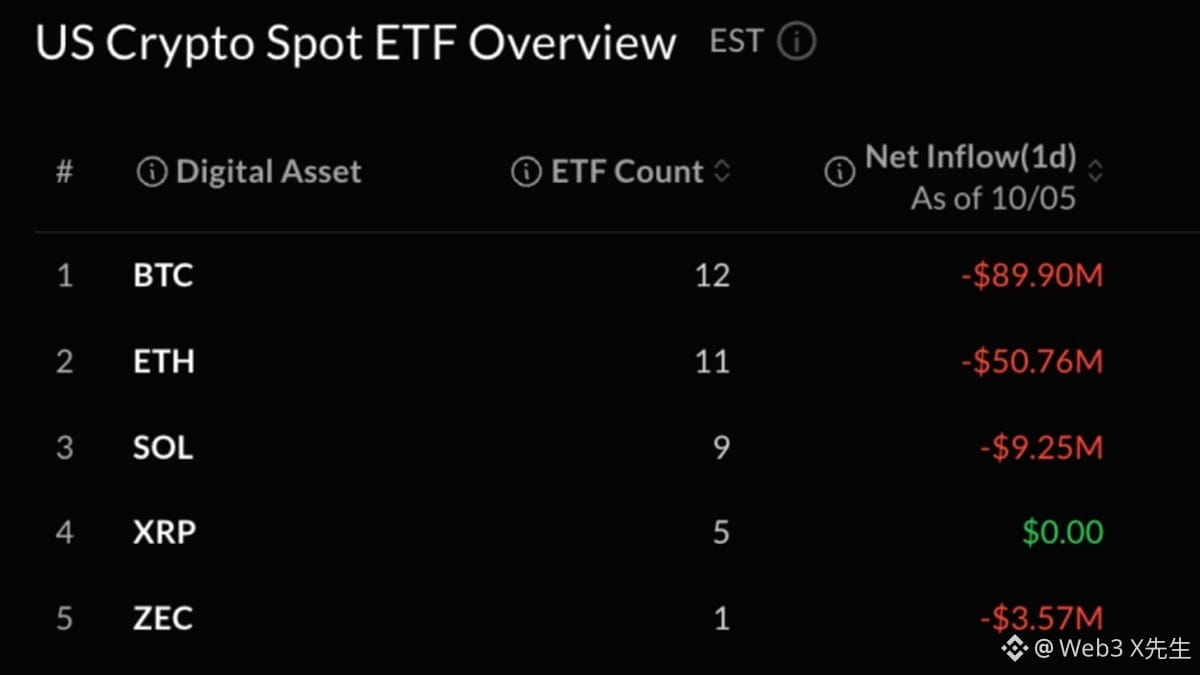
The market looked a little off right from the opening bell on Monday. U.S. spot Bitcoin ETFs saw $89.9 million in net outflows. It was the first time this month that money had pulled out. Last week, they were still logging net inflows for three weeks straight. The tide turned faster than expected. 📉
So who’s heading for the exits? ARK’s fund saw $85.21 million pulled out in a single day. Fidelity’s fund followed with $74.55 million in outflows. Those two were enough to turn the overall numbers negative. But here’s the interesting part: BlackRock didn’t follow suit. Its IBIT actually saw $69.85 million in net inflows. 💸
Ethereum ETFs looked even worse. ETH ETFs have now seen net outflows for five trading days in a row. On Monday alone, another $50.76 million flowed out. BlackRock’s ETHA saw $31.88 million withdrawn, while Fidelity’s FETH lost $18.88 million. Five full days, without a single meaningful wave of buying to catch the fall. 🥶
Smaller-coin ETFs weren’t spared either. Funds tied to SOL saw $9.25 million in outflows. ZEC products lost $3.57 million, and HYPE funds shed $2.71 million. ZEC’s net assets slid from above $1 billion to $780 million. The tide is going out faster than anywhere else. 📦
The only asset attracting inflows across the board was NEAR. Its ETF saw $539,000 in net inflows on Monday. Not a huge number, but the direction really stands out. Everyone else is pulling out, while it’s the only one seeing money come in. That kind of isolated buying often says the most. 👀
Still, there’s no need to rush to conclusions. Total assets in Bitcoin ETFs remain at $110.7 billion. Monday’s trading volume came to $2.18 billion. The money hasn’t left the market—it’s just become more selective. Buying is increasingly concentrated in the largest fund. The rest are left watching their liquidity drain away. 💡
📌 The money hasn’t all run off—it’s gone from “buying a basket” to “buying only the leader.”
Is this outflow just short-term repositioning, or have investors really changed direction? Let’s talk in the comments.
Join Mr. X’s fan chat from the homepage 🔥
The market looked a little off right from the opening bell on Monday. U.S. spot Bitcoin ETFs saw $89.9 million in net outflows. It was the first time this month that money had pulled out. Last week, they were still logging net inflows for three weeks straight. The tide turned faster than expected. 📉
So who’s heading for the exits? ARK’s fund saw $85.21 million pulled out in a single day. Fidelity’s fund followed with $74.55 million in outflows. Those two were enough to turn the overall numbers negative. But here’s the interesting part: BlackRock didn’t follow suit. Its IBIT actually saw $69.85 million in net inflows. 💸
Ethereum ETFs looked even worse. ETH ETFs have now seen net outflows for five trading days in a row. On Monday alone, another $50.76 million flowed out. BlackRock’s ETHA saw $31.88 million withdrawn, while Fidelity’s FETH lost $18.88 million. Five full days, without a single meaningful wave of buying to catch the fall. 🥶
Smaller-coin ETFs weren’t spared either. Funds tied to SOL saw $9.25 million in outflows. ZEC products lost $3.57 million, and HYPE funds shed $2.71 million. ZEC’s net assets slid from above $1 billion to $780 million. The tide is going out faster than anywhere else. 📦
The only asset attracting inflows across the board was NEAR. Its ETF saw $539,000 in net inflows on Monday. Not a huge number, but the direction really stands out. Everyone else is pulling out, while it’s the only one seeing money come in. That kind of isolated buying often says the most. 👀
Still, there’s no need to rush to conclusions. Total assets in Bitcoin ETFs remain at $110.7 billion. Monday’s trading volume came to $2.18 billion. The money hasn’t left the market—it’s just become more selective. Buying is increasingly concentrated in the largest fund. The rest are left watching their liquidity drain away. 💡
📌 The money hasn’t all run off—it’s gone from “buying a basket” to “buying only the leader.”
Is this outflow just short-term repositioning, or have investors really changed direction? Let’s talk in the comments.