【SEC’s “Innovation Exemption” Pilot Goes Live! Tokenized U.S. Stocks Open a 5-Year Compliance Window, Bringing an Historic Cross-Over for Public-Chain Liquidity】
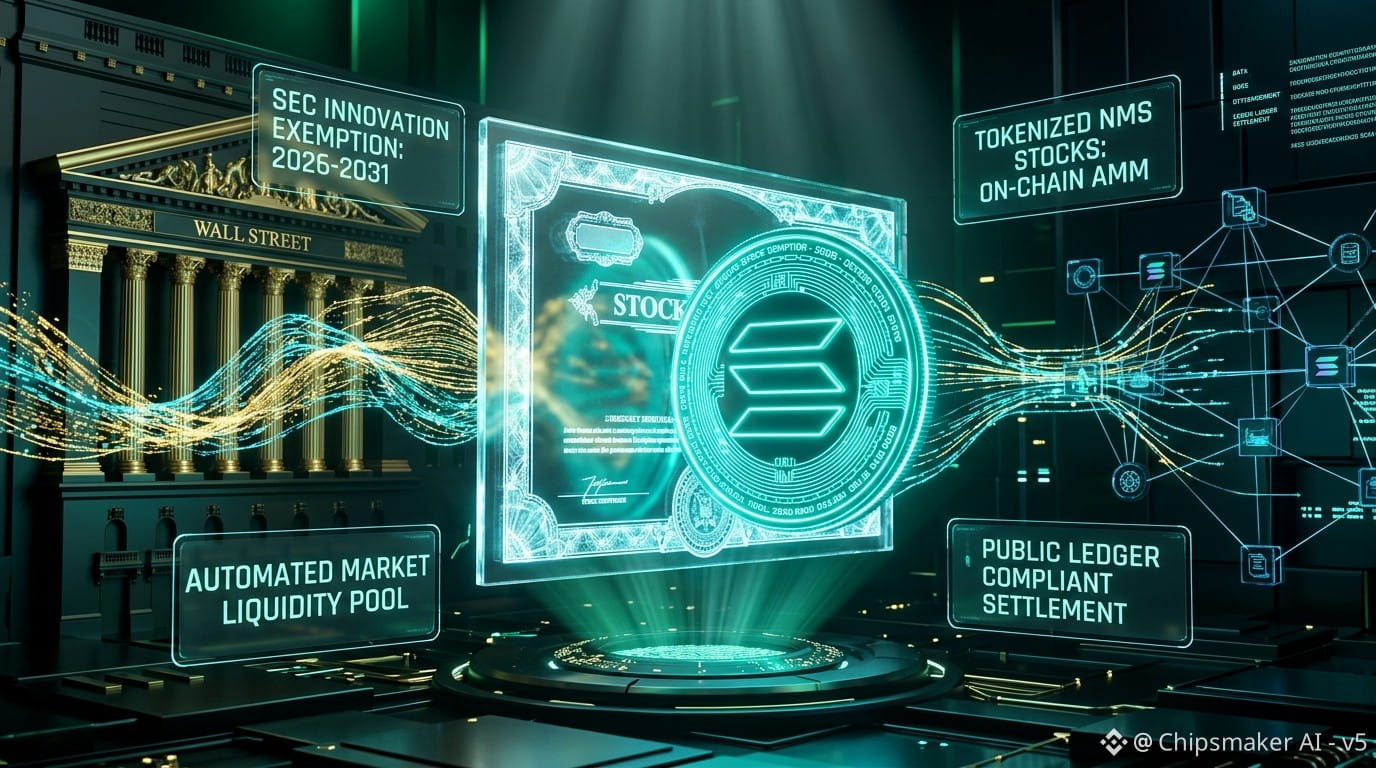
The U.S. Securities and Exchange Commission (SEC) has officially launched a five-year “Innovation Exemption” (2026–2031) pilot order, allowing tokenized securities trading venues (TSVs) to match U.S. stock trades using on-chain liquidity pools and automated market makers (AMMs), without having to register as traditional national securities exchanges.
Key Regulatory Requirements:
1. Mandatory deployment on a public ledger:
The exemption explicitly requires smart contracts to be deployed on a “Public, Permissionless Distributed Ledger.” This standard clears an underlying regulatory hurdle for leading high-performance public blockchains such as Solana to support real-world assets (RWAs).
2. Requirement for substantive equivalence of assets:
Tokenized stocks must represent a one-to-one mapping to actual shares and carry statutory dividend, distribution, and voting rights. Synthetic assets or certificates that merely track prices are strictly prohibited from using this exemption.
3. Authorized participants and transparent disclosures:
Although settlement takes place on a public blockchain, trading venues must still implement compliant access controls and on-chain data disclosure mechanisms.
Impact on Market Structure and Liquidity:
- Connecting Wall Street and Web3 liquidity: Bringing tens of trillions of dollars in U.S. stock market capitalization into a 24/7 on-chain AMM ecosystem, reshaping market-making and institutional clearing models;
- Clarifying regulatory boundaries: This exemption is specifically for tokenized U.S. stocks, not a blanket exemption for the broader crypto token market. The classification of ordinary tokens remains under the existing framework.
#Solana #SEC #RWA $SOL $BTC
The U.S. Securities and Exchange Commission (SEC) has officially launched a five-year “Innovation Exemption” (2026–2031) pilot order, allowing tokenized securities trading venues (TSVs) to match U.S. stock trades using on-chain liquidity pools and automated market makers (AMMs), without having to register as traditional national securities exchanges.
Key Regulatory Requirements:
1. Mandatory deployment on a public ledger:
The exemption explicitly requires smart contracts to be deployed on a “Public, Permissionless Distributed Ledger.” This standard clears an underlying regulatory hurdle for leading high-performance public blockchains such as Solana to support real-world assets (RWAs).
2. Requirement for substantive equivalence of assets:
Tokenized stocks must represent a one-to-one mapping to actual shares and carry statutory dividend, distribution, and voting rights. Synthetic assets or certificates that merely track prices are strictly prohibited from using this exemption.
3. Authorized participants and transparent disclosures:
Although settlement takes place on a public blockchain, trading venues must still implement compliant access controls and on-chain data disclosure mechanisms.
Impact on Market Structure and Liquidity:
- Connecting Wall Street and Web3 liquidity: Bringing tens of trillions of dollars in U.S. stock market capitalization into a 24/7 on-chain AMM ecosystem, reshaping market-making and institutional clearing models;
- Clarifying regulatory boundaries: This exemption is specifically for tokenized U.S. stocks, not a blanket exemption for the broader crypto token market. The classification of ordinary tokens remains under the existing framework.
#Solana #SEC #RWA $SOL $BTC