



“All Quiet on the Western Front”: A Choppy Stalemate Amid Fierce Bull-Bear Disagreement
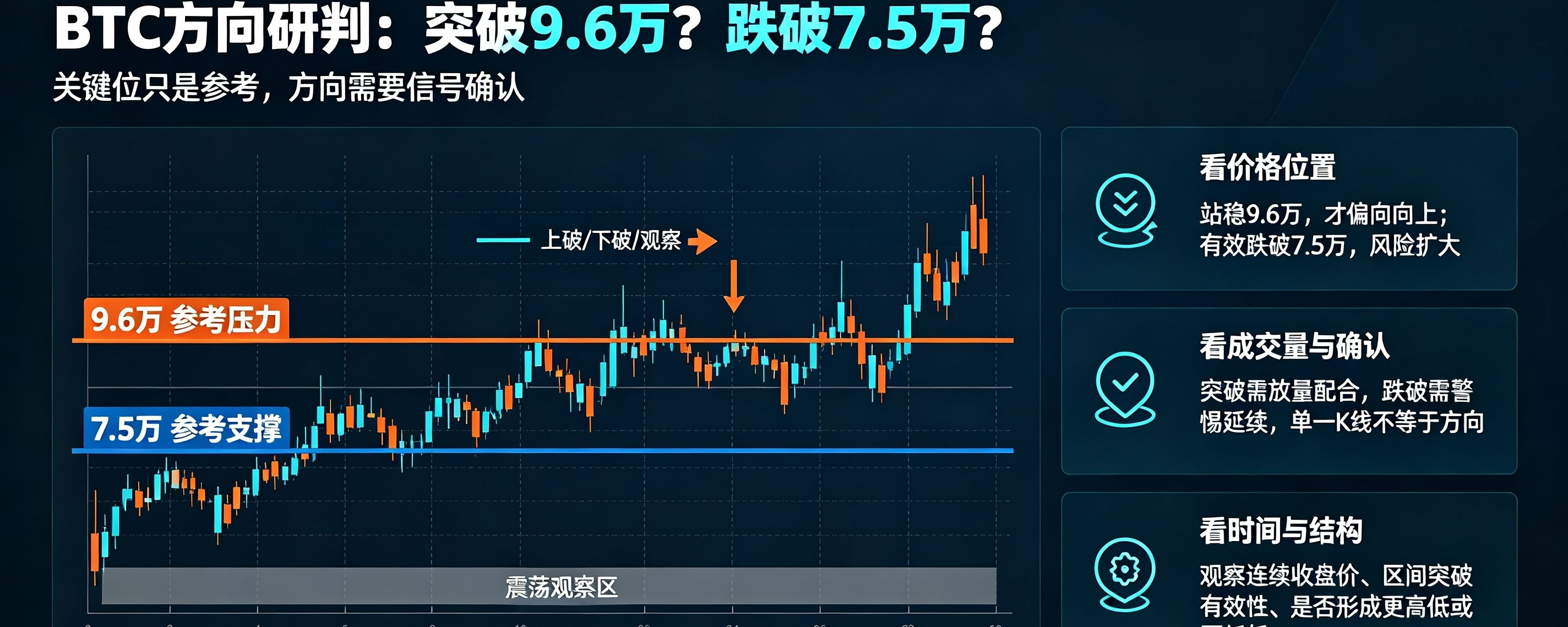
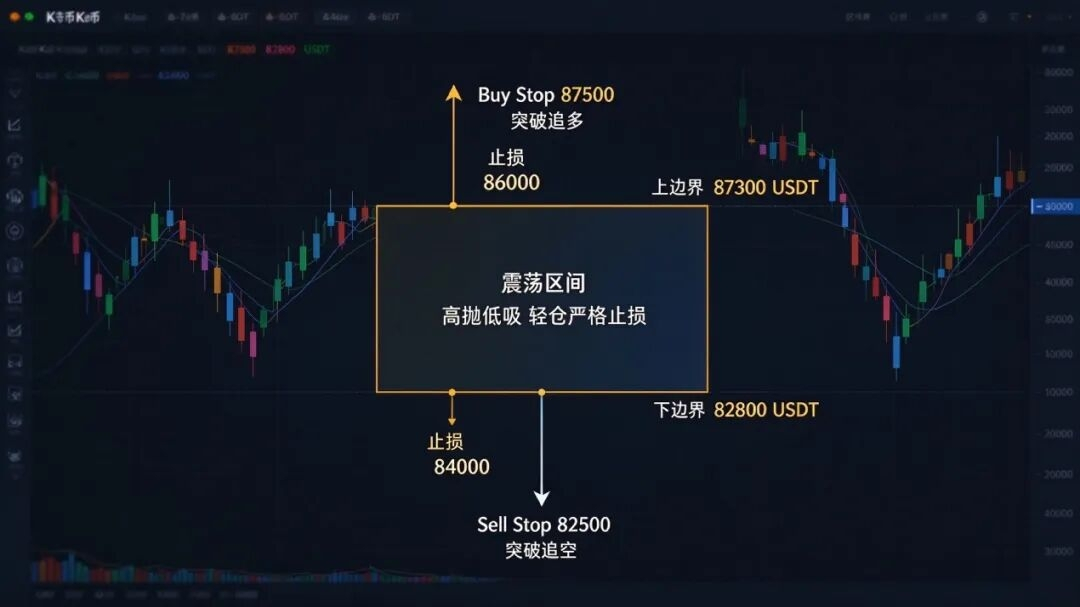
For nearly three weeks, Bitcoin has repeatedly swept through and battled back and forth within the $82,800–$87,300 range, leaving the market direction extremely unclear.
On the weekly chart, last week saw a small bullish candle with a long upper wick and relatively low volume. This suggests that after breaking above the previous structural high, price failed to launch into a powerful one-way rally. Instead, it offered an opportunity for a deeper pullback to support and a retest.
Looking at the daily and lower-timeframe structures, disagreement between bulls and bears has reached a peak. From the bears’ perspective, price has repeatedly tested the $82,800 support zone, and a bearish MACD divergence has appeared on the daily chart, signaling a risk of a pullback. However, on lower timeframes such as the 1-hour and 4-hour charts, the lows keep rising, forming an ascending rectangle or bull flag. Buyers have also stepped in repeatedly at key support-resistance flip levels, pushing price back up quickly after sharp wicks. Whenever price nears the upper boundary of the range, trading volume shows signs of fading. This state of confusion—unable to break higher, yet struggling to break decisively lower—is like the Western Front during World War I, locked in a war of attrition in the trenches.
A “War of Attrition” Through the Lens of Game Theory: Why Has the Market Been Unable to Decide a Winner?
The nature of the current market can be explained using the “reward and cost model” from game theory, also known as the War of Attrition.
The rules of this game can be simplified as follows: two people compete for a prize, and whoever lets go first loses, leaving the prize to the other. If neither lets go, each passing second costs both players energy and time. The contest continues until one side decides that the cost of holding on has exceeded the value of the prize itself and chooses to give up.
In the current Bitcoin market, the bulls’ prize is to break through resistance at $87,300, completely liquidate short positions, and capture the gains of a major rally. The bears’ prize is to break below support at $82,800 and open the door to a deeper downturn. There is no single “market maker” today who can freely dictate the market’s course. Instead, this is a multipolar contest involving institutions, trust families, government holdings, exchange market makers, miners, and other major players. Until one side gains an overwhelming advantage, this balance between bulls and bears makes short-term market direction mathematically unpredictable. How long it lasts depends on each side’s psychological tolerance and the limits of its financial resources.
This war of attrition is much like what happened when World War I broke out in 1914. The German army hoped to capture Paris within six weeks using the Schlieffen Plan, which had been ten years in the making. The French, too, optimistically believed the fighting would be over in a few months. Instead, the conflict devolved into years of trench warfare along the Marne and at Verdun. In the 1916 Battle of Verdun, two million German and French troops fought for 302 days. Positions changed hands more than 15 times, yet the front line advanced by only a few kilometers. Each successive assault involved more troops but gained less ground—a classic example of diminishing marginal returns in a war of attrition. The market is much the same. The area around $87,300 is not simply a resistance wall; it is a minefield of underwater positions, take-profit orders, and stop-loss orders. Neither bulls nor bears are likely to establish a clear trend until one side has exhausted its ammunition.

Don’t Be the “Cannon Fodder” in the Final Minute: Restraint and Wisdom for Speculators
How should ordinary investors respond to a war of attrition riddled with pitfalls? The strategies of savvy players in World War I offer valuable lessons:
Control your pace and conserve your strength: In the early stages of World War I, the British Expeditionary Force did not rush into a decisive battle in response to the German army’s rapid advance. Instead, it advanced cautiously, preserved its strength, and waited for the French army to regroup. This ultimately allowed it to play a key role at the Battle of Mons and in the counteroffensive at the Marne. When the trend is unclear, restraint and patience are not signs of weakness—they are hallmarks of sophisticated trading wisdom.
Wait for certainty and enter on confirmation: The United States remained neutral for the first three years after World War I broke out. It entered the war in 1917, when the Central Powers were visibly weakening and the balance of victory had clearly shifted. This allowed it to reap the greatest strategic benefits at minimal cost. Investors need not worry about others saying they “entered too late.” Entering when risk is manageable and the trend is clear is what mature investors do.
The film All Quiet on the Western Front portrays a brutal reality: before the armistice took effect at 11 a.m. on November 11, 1918, the protagonist Paul and many other soldiers fell in one last, senseless charge at 10:59 a.m., becoming casualties for no reason. In trading, blindly jumping into the fray midway through a market range and opening positions too frequently can easily drain your capital and confidence as prices spike in both directions—leaving you defeated on the eve of a genuine trend breakout.
End the Needless Fighting: Current Trading Strategies and Their Practical Application in the Community Amid the Ongoing War of Attrition
We need to establish strict yet measured trading discipline:
First, avoid trading blindly in the middle of the range (the POC area). Trading volume has not yet contracted to an extreme, which suggests that both bulls and bears are still firing heavily and that the time for a market reversal has not yet arrived. A genuine precursor to a reversal is often an extreme drop in volume and very quiet market activity. Until then, chasing rallies or selling off in the middle of the range is no different from becoming needless cannon fodder.
Second, stick to range-trading discipline. If trading within a range, wait for price to reach its upper or lower boundaries (such as around $82,800 or $87,300), then look for a reclaim after a false breakout or breakdown before entering, and set a clear stop-loss. When complex patterns appear on lower time frames, standing aside is the most cost-effective choice. In earlier program forecasts and analyses, the market showed signs of a potential reversal on several occasions, and some outlooks optimistically predicted an “immediate breakout” or a “sudden plunge.” However, in our public community and previews, we promptly revised our views, clearly identifying a range-bound market where “the highs won’t break higher and the lows won’t fall lower.” We pointed out heavy selling pressure overhead and exhausted buying support, and urged everyone to stay patient, watch the market, and wait for a clear signal.
Market competition is a marathon; staying rational and disciplined is the key to lasting success. Follow our social media channel for more in-depth analysis of market dynamics and real-time trading insights. You can also contact us through the details page and join our Fortune Community, where you can join many rational investors in identifying genuine breakout opportunities.#币安推出BinanceIntelligence #BTC走势分析
