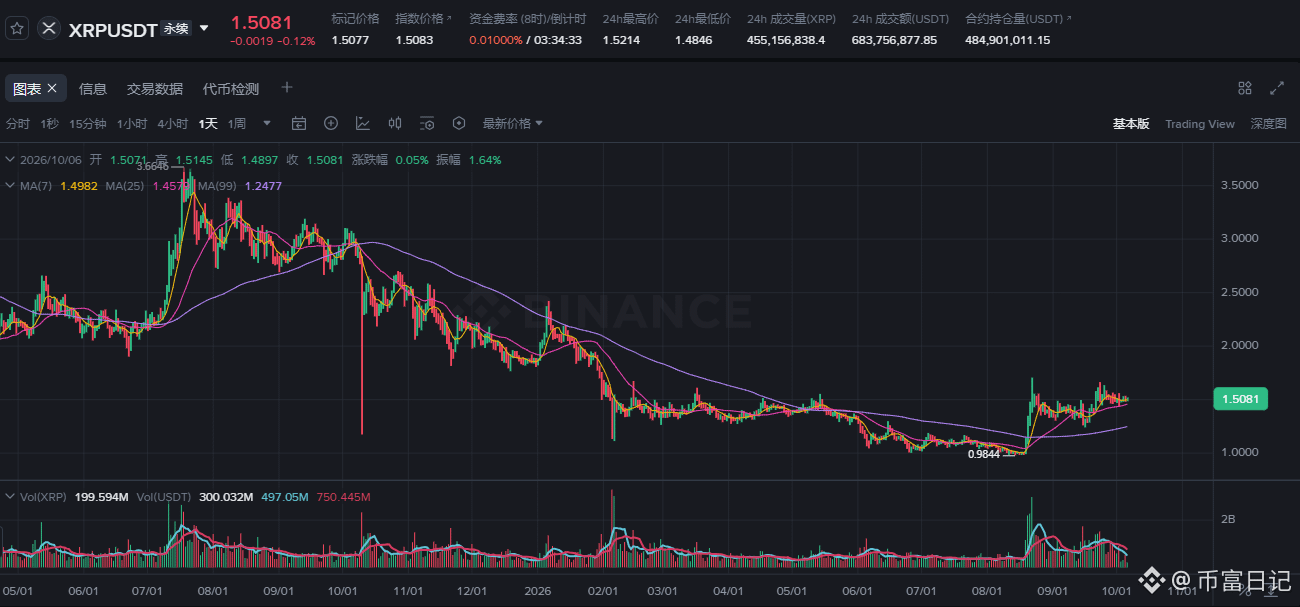
#xrp Date: 10.6 Long-term strategy
Ticker: XRP
Recommended entry prices: 1.5 (5 tranches), 1.8 (3 tranches), 2 (2 tranches)
Reasons: Regulatory uncertainty has largely cleared
The lawsuit with the SEC has concluded completely, and XRP has been explicitly classified as a non-security in the context of programmatic sales. This was the biggest factor weighing on it over the past few years. Institutions can now allocate to it with relatively greater confidence. Spot ETFs are live and continue to attract inflows.
Several spot XRP ETFs in the United States have launched, with cumulative inflows reaching the billion-dollar level, providing sustained institutional buying support for the price. This is a source of incremental capital that did not exist before. Strong utility and clear payment use cases
XRP’s core role is as a bridge asset for cross-border payments and settlements, offering fast speeds and low fees. Ripple continues to expand its partnerships with banks and financial institutions, while its RLUSD stablecoin is also growing. Relatively reasonable cost basis
Around 1.5 is near a short-term support zone. Compared with buying in at higher levels, the risk-reward profile is more favorable. If it can hold above this level and break through key resistance, further upside could open up.
Institutional narrative continues to strengthen
Progress toward a trust bank charter, expansion of custody and clearing businesses, and XRPL upgrades (such as private transfers and batch transactions) are all bringing it closer to institution-grade infrastructure.
Summary:
Entering near 1.5 is a relatively rational position. XRP’s key strengths are that regulatory issues have largely been resolved, institutional access through ETFs is now available, and it has real-world payment utility. Over the medium to long term, these fundamentals support its value. In the short term, it will still move with the broader market.
Ticker: XRP
Recommended entry prices: 1.5 (5 tranches), 1.8 (3 tranches), 2 (2 tranches)
Reasons: Regulatory uncertainty has largely cleared
The lawsuit with the SEC has concluded completely, and XRP has been explicitly classified as a non-security in the context of programmatic sales. This was the biggest factor weighing on it over the past few years. Institutions can now allocate to it with relatively greater confidence. Spot ETFs are live and continue to attract inflows.
Several spot XRP ETFs in the United States have launched, with cumulative inflows reaching the billion-dollar level, providing sustained institutional buying support for the price. This is a source of incremental capital that did not exist before. Strong utility and clear payment use cases
XRP’s core role is as a bridge asset for cross-border payments and settlements, offering fast speeds and low fees. Ripple continues to expand its partnerships with banks and financial institutions, while its RLUSD stablecoin is also growing. Relatively reasonable cost basis
Around 1.5 is near a short-term support zone. Compared with buying in at higher levels, the risk-reward profile is more favorable. If it can hold above this level and break through key resistance, further upside could open up.
Institutional narrative continues to strengthen
Progress toward a trust bank charter, expansion of custody and clearing businesses, and XRPL upgrades (such as private transfers and batch transactions) are all bringing it closer to institution-grade infrastructure.
Summary:
Entering near 1.5 is a relatively rational position. XRP’s key strengths are that regulatory issues have largely been resolved, institutional access through ETFs is now available, and it has real-world payment utility. Over the medium to long term, these fundamentals support its value. In the short term, it will still move with the broader market.