Today, let’s talk about new opportunities at the intersection of AI × DePIN, and how Acurast is unlocking the potential of smartphone computing power.
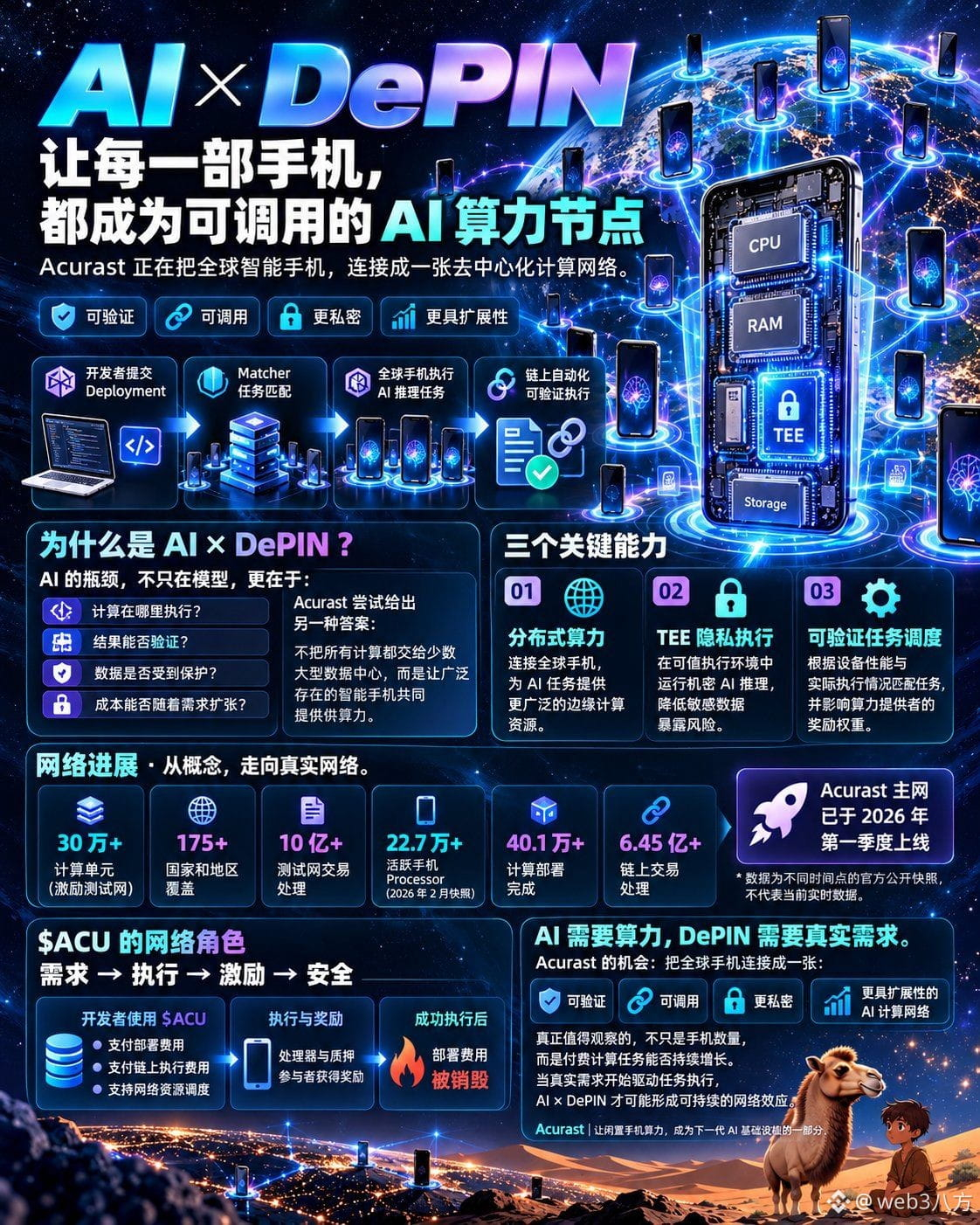
AI’s bottlenecks aren’t just in the models. They’re also about where computation is performed, whether it can be verified, whether data is protected, and whether costs can scale with demand.
Acurast @Acurast aims to turn the smartphones we find everywhere into an accessible, decentralized computing network.
Once a phone runs Processor, it can be matched to suitable tasks based on benchmarks such as CPU, RAM, and storage. Developers submit a Deployment, and the network uses Matcher to schedule available computing power.
This gives AI × DePIN a more tangible use case:
• No need to rely entirely on centralized data centers;
• Confidential AI inference can run in a phone’s trusted execution environment (TEE);
• It can support tasks such as on-chain automation, AI agents, and private LLM inference;
• The performance of compute providers’ devices and the tasks they actually execute affect their reward weights.
This is more than just a concept
Acurast’s mainnet launched in Q1 2026.
According to the project’s current official documentation, its incentivized testnet has connected around 300,000 compute units across 175+ countries and processed more than 1 billion testnet transactions in total.
In a February 2026 announcement on Base, Acurast also disclosed that, at the time, it had 227,000+ active phone Processors across 140+ countries, with 401,000+ compute deployments completed and 645 million+ on-chain transactions. These figures are a snapshot from that time, but they show that the network has moved beyond the “whitepaper-only” stage.
$ACU plays a network-layer role in this system: developers use ACU to pay for deployments and on-chain fees; processors and staking participants receive rewards; and deployment fees are burned after successful execution.
Whether paid compute tasks will grow and gradually form a cycle of demand, execution, incentives, and security remains to be seen.
AI needs computing power, and DePIN needs real demand.
Acurast’s opportunity lies in whether it can connect the two through a verifiable, accessible computing network powered collectively by smartphones.
#Acurast #ACU
This article is for sharing purposes only and does not constitute investment advice. DYOR
AI’s bottlenecks aren’t just in the models. They’re also about where computation is performed, whether it can be verified, whether data is protected, and whether costs can scale with demand.
Acurast @Acurast aims to turn the smartphones we find everywhere into an accessible, decentralized computing network.
Once a phone runs Processor, it can be matched to suitable tasks based on benchmarks such as CPU, RAM, and storage. Developers submit a Deployment, and the network uses Matcher to schedule available computing power.
This gives AI × DePIN a more tangible use case:
• No need to rely entirely on centralized data centers;
• Confidential AI inference can run in a phone’s trusted execution environment (TEE);
• It can support tasks such as on-chain automation, AI agents, and private LLM inference;
• The performance of compute providers’ devices and the tasks they actually execute affect their reward weights.
This is more than just a concept
Acurast’s mainnet launched in Q1 2026.
According to the project’s current official documentation, its incentivized testnet has connected around 300,000 compute units across 175+ countries and processed more than 1 billion testnet transactions in total.
In a February 2026 announcement on Base, Acurast also disclosed that, at the time, it had 227,000+ active phone Processors across 140+ countries, with 401,000+ compute deployments completed and 645 million+ on-chain transactions. These figures are a snapshot from that time, but they show that the network has moved beyond the “whitepaper-only” stage.
$ACU plays a network-layer role in this system: developers use ACU to pay for deployments and on-chain fees; processors and staking participants receive rewards; and deployment fees are burned after successful execution.
Whether paid compute tasks will grow and gradually form a cycle of demand, execution, incentives, and security remains to be seen.
AI needs computing power, and DePIN needs real demand.
Acurast’s opportunity lies in whether it can connect the two through a verifiable, accessible computing network powered collectively by smartphones.
#Acurast #ACU
This article is for sharing purposes only and does not constitute investment advice. DYOR