【API3 surges 27.1% on rising four-hour volume: slips from 2nd to 3rd on rescan】
I’m staying on the sidelines for now; I won’t chase based on leaderboard position or percentage gains.
In the complete USDT perpetual leaderboard as of 16:01, API3USDT briefly ranked 2nd, with a rolling 24-hour gain of 31.541% and a scan price of 0.3866. A rescan at 16:04 showed it had slipped to 3rd, with a gain of 31.133%, a scan price of 0.3854, and about $58.56 million in quote volume. The price had pulled back only about 0.31% in a few minutes; the change in rank shows that competition at the top remains intense, but is not enough to prove that the structure is weakening.
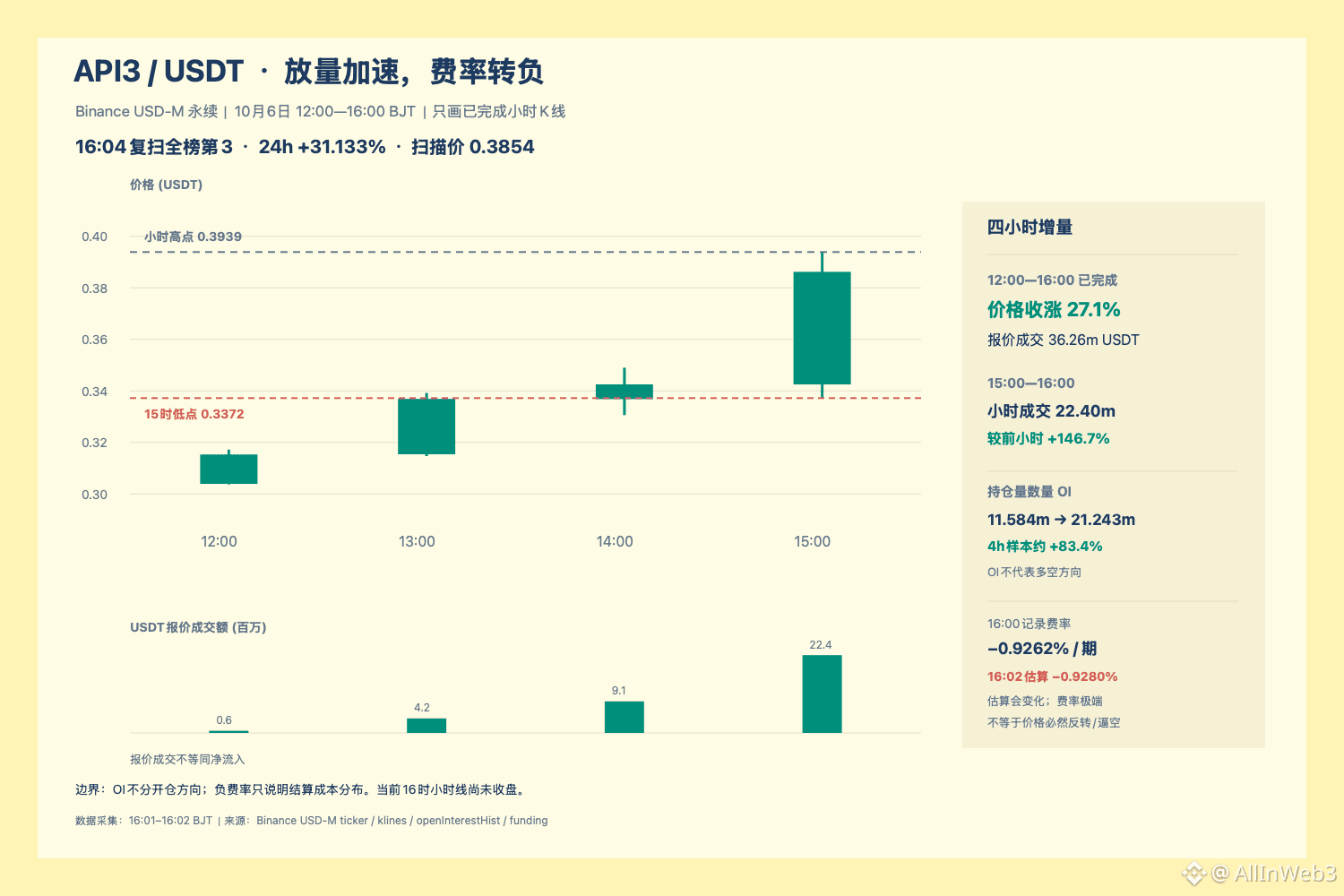
Looking at the candles that have closed: from 12:00 to 16:00 BJT, the four-hour candle rose from 0.3039 to close at 0.3862, up about 27.1%. The final hour gained 12.76%, with $22.4 million in quote volume—about 146.7% more than the $9.08 million in the preceding hour—and an intraday high of 0.3939. This indicates that the advance was concentrated in the latter part of the period and participation expanded notably; however, quote volume is not net inflow and does not prove that buyers were in control.
Positioning and funding rates define the risk boundaries. Binance’s four-hour snapshot of open interest in coin units rose from about 11.58 million at 12:00 to about 21.24 million at 16:00, an increase of about 83.4%. The funding rate recorded at 16:00 was -0.9262%, while the estimate for the current period at 16:02 was -0.9280%. The combination of rising prices, expanding open interest, and deeply negative funding may reflect hedging or crowded shorts, but OI does not distinguish between longs and shorts, and estimated funding rates can change. These figures alone cannot establish a short squeeze or a reversal.
On fundamentals, API3’s official website currently lists AirnodeHub as being in early access; TechFinancials reported the product’s launch on October 5. The official page also says it is still at an early stage and that usage is currently free. This is verifiable recent context, but there is no evidence directly linking the product news to this price move. Actual adoption and revenue remain to be seen.
For the short term, I’m watching only to see whether the structure holds: the 15:00 hourly candle had a low of 0.3372 and a high of 0.3939; the 16:00 hourly candle has not yet closed. Only if subsequent full hourly candles hold above 0.3372 and volume does not contract rapidly would that count as evidence of continuation. If a candle closes below that low, the recent high-volume breakout will need to be reassessed. These are conditions to watch, not a buy signal.
I’m staying on the sidelines for now; I won’t chase based on leaderboard position or percentage gains.
In the complete USDT perpetual leaderboard as of 16:01, API3USDT briefly ranked 2nd, with a rolling 24-hour gain of 31.541% and a scan price of 0.3866. A rescan at 16:04 showed it had slipped to 3rd, with a gain of 31.133%, a scan price of 0.3854, and about $58.56 million in quote volume. The price had pulled back only about 0.31% in a few minutes; the change in rank shows that competition at the top remains intense, but is not enough to prove that the structure is weakening.
Looking at the candles that have closed: from 12:00 to 16:00 BJT, the four-hour candle rose from 0.3039 to close at 0.3862, up about 27.1%. The final hour gained 12.76%, with $22.4 million in quote volume—about 146.7% more than the $9.08 million in the preceding hour—and an intraday high of 0.3939. This indicates that the advance was concentrated in the latter part of the period and participation expanded notably; however, quote volume is not net inflow and does not prove that buyers were in control.
Positioning and funding rates define the risk boundaries. Binance’s four-hour snapshot of open interest in coin units rose from about 11.58 million at 12:00 to about 21.24 million at 16:00, an increase of about 83.4%. The funding rate recorded at 16:00 was -0.9262%, while the estimate for the current period at 16:02 was -0.9280%. The combination of rising prices, expanding open interest, and deeply negative funding may reflect hedging or crowded shorts, but OI does not distinguish between longs and shorts, and estimated funding rates can change. These figures alone cannot establish a short squeeze or a reversal.
On fundamentals, API3’s official website currently lists AirnodeHub as being in early access; TechFinancials reported the product’s launch on October 5. The official page also says it is still at an early stage and that usage is currently free. This is verifiable recent context, but there is no evidence directly linking the product news to this price move. Actual adoption and revenue remain to be seen.
For the short term, I’m watching only to see whether the structure holds: the 15:00 hourly candle had a low of 0.3372 and a high of 0.3939; the 16:00 hourly candle has not yet closed. Only if subsequent full hourly candles hold above 0.3372 and volume does not contract rapidly would that count as evidence of continuation. If a candle closes below that low, the recent high-volume breakout will need to be reassessed. These are conditions to watch, not a buy signal.