

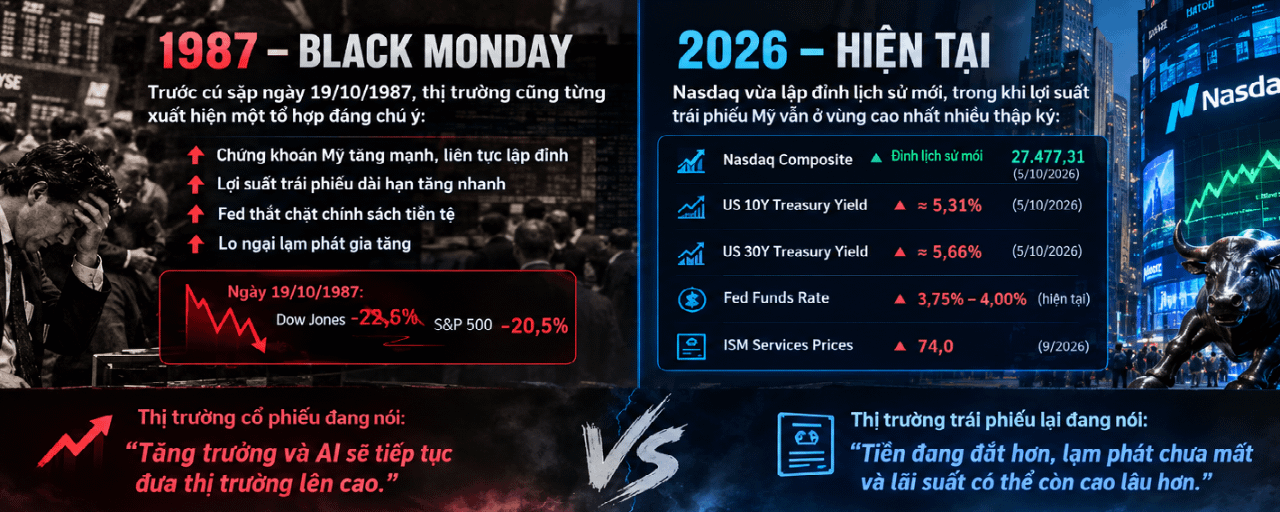


In 1987, before the Black Monday crash, the U.S. stock market had surged while long-term bond yields were also climbing and monetary policy was becoming tighter.
Now, the Nasdaq has just reached a new all-time high, while U.S. Treasury yields remain near their highest levels in decades:
U.S. 10Y: around 5.31%
U.S. 30Y: around 5.66%
Fed Funds Rate: 3.75%–4.00%
ISM Services Prices: 74.0
What stands out is that bond yields are rising while technology stocks keep hitting new highs.
The stock market is betting heavily on growth, AI, and corporate earnings.
Meanwhile, the bond market is telling a different story:
Inflation could prove more persistent, and interest rates may need to stay higher for longer.
In 1987, long-term bond yields also rose sharply ahead of Black Monday. Fed documents show that 30-year bond yields had climbed significantly in the period before the crash, while the Fed was also tightening policy.
But there’s one very important point:
History doesn’t repeat itself exactly.
Black Monday in 1987 didn’t happen simply because yields were rising. Many other factors were at play, including currency volatility, trade deficits, derivatives markets, and trading mechanisms that greatly amplified the sell-off. On October 19, 1987, the Dow Jones fell 22.6%—the biggest one-day drop in the index’s history.
So I’m not saying a 20% crash is about to happen.
What I’m saying is:
Pay attention to the divergence between stocks and bonds.
One side is saying:
“Growth and AI will keep pushing the market higher.”
The other side is saying:
“Money is getting more expensive, inflation hasn’t disappeared, and interest rates could stay higher for longer.”
The two markets are telling different stories.
And if this divergence continues to widen, that’s when I’ll start dialing back the FOMO and managing risk more tightly.