I've been looking at $DIA
from a different angle lately.
Instead of asking whether DIA is just another crypto oracle, I think the more interesting question is:
How well is its infrastructure suited to institutional onchain finance?
There are several reasons I think this deserves attention.
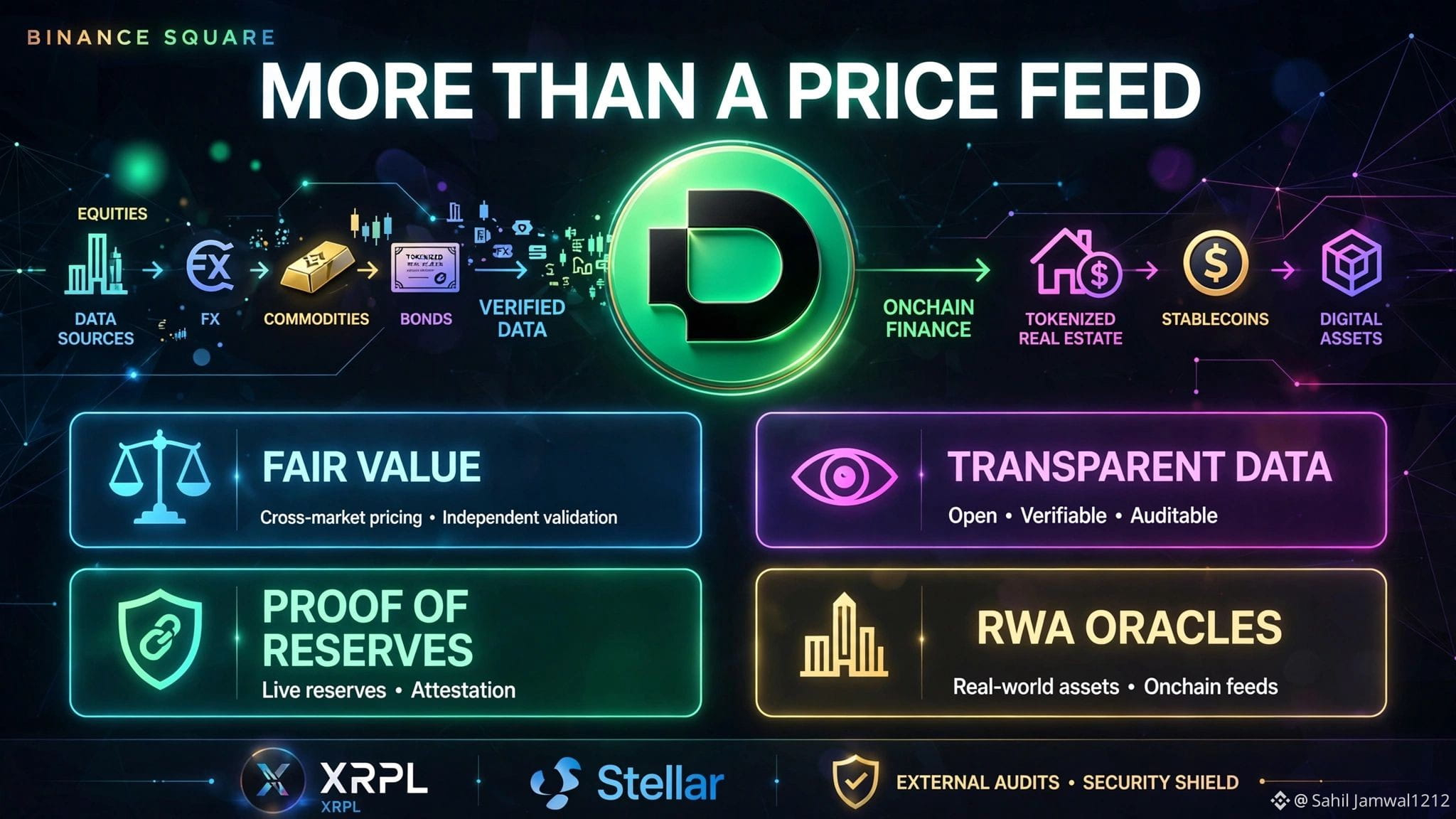
1. Fair-value pricing
DIA Value is built for assets where a simple market price may not be reliable enough.
It supports methodologies such as NAV, Proof of Reserves, Redemption Value and Contract Exchange Rate.
That becomes useful for tokenized funds, stablecoins, yield-bearing assets and illiquid collateral.
2. Data transparency
DIA emphasizes traceability from raw data sources through the methodology used to produce the final feed.
That creates a much clearer audit trail than treating an oracle as a black box.
3. RWA infrastructure
DIA xReal brings traditional financial data onchain, including stocks, ETFs, FX, bonds and commodities.
As tokenized assets expand, reliable external data becomes part of the infrastructure stack.
4. Reserve verification
DIA can use verifiable reserve and collateral information for fair-value pricing rather than depending entirely on secondary-market trading.
5. Broader asset coverage
Institutional finance isn't only BTC and ETH.
It involves equities, currencies, commodities, bonds and increasingly tokenized versions of these assets.
6. XRPL and Stellar
DIA has integrations across both ecosystems, which are actively building infrastructure around tokenized assets and financial applications.
7. Security
DIA's Lumina and staking infrastructure have undergone MixBytes audits, adding another layer of external technical review.
There is an important caveat:
None of this makes DIA automatically “institutionally compliant.”
Institutional adoption depends on jurisdiction, governance, risk controls, custody, legal structure and the specific implementation.
If more traditional financial assets move onchain, oracle infrastructure may need to provide more than a price.
from a different angle lately.
Instead of asking whether DIA is just another crypto oracle, I think the more interesting question is:
How well is its infrastructure suited to institutional onchain finance?
There are several reasons I think this deserves attention.
1. Fair-value pricing
DIA Value is built for assets where a simple market price may not be reliable enough.
It supports methodologies such as NAV, Proof of Reserves, Redemption Value and Contract Exchange Rate.
That becomes useful for tokenized funds, stablecoins, yield-bearing assets and illiquid collateral.
2. Data transparency
DIA emphasizes traceability from raw data sources through the methodology used to produce the final feed.
That creates a much clearer audit trail than treating an oracle as a black box.
3. RWA infrastructure
DIA xReal brings traditional financial data onchain, including stocks, ETFs, FX, bonds and commodities.
As tokenized assets expand, reliable external data becomes part of the infrastructure stack.
4. Reserve verification
DIA can use verifiable reserve and collateral information for fair-value pricing rather than depending entirely on secondary-market trading.
5. Broader asset coverage
Institutional finance isn't only BTC and ETH.
It involves equities, currencies, commodities, bonds and increasingly tokenized versions of these assets.
6. XRPL and Stellar
DIA has integrations across both ecosystems, which are actively building infrastructure around tokenized assets and financial applications.
7. Security
DIA's Lumina and staking infrastructure have undergone MixBytes audits, adding another layer of external technical review.
There is an important caveat:
None of this makes DIA automatically “institutionally compliant.”
Institutional adoption depends on jurisdiction, governance, risk controls, custody, legal structure and the specific implementation.
If more traditional financial assets move onchain, oracle infrastructure may need to provide more than a price.