My biggest loss didn’t come from getting the direction wrong. It came from changing my rules mid-trade.
That day, I’d already set a stop-loss. Then the market plunged, and I couldn’t accept it. In a moment of weakness, I moved my stop-loss lower by $AIN .
At the time, I thought, “I’ll wait a little longer—then it’ll bounce.” But what I got wasn’t a rebound; I just got deeper and deeper in the hole.
It was only when I reviewed the trade later that I realized the problem was never the market. It was me.
The harshest thing about crypto isn’t the volatility—it’s how it amplifies your emotions.
When prices rise, you think they can go even higher, so you keep moving your take-profit target. In the end, you give back all your gains.
When prices fall, you think they’re about to bounce, so you keep pushing your stop-loss further away. In the end, a small loss becomes a big one.
You think you’re adapting flexibly, but really, you’re letting your emotions lead you around.
After taking plenty of wrong turns, I finally forced myself to set one hard-and-fast rule:
All rules must be set after the market closes.
Once I enter a trade, there’s only one thing to do during the session: follow the plan.
No matter what the market does, don’t try to optimize or adjust anything, and don’t try to be “clever in the moment.”
Because when you’re holding a position, you’re at your least rational.
You’re not watching the market—you’re watching your profit-and-loss numbers.
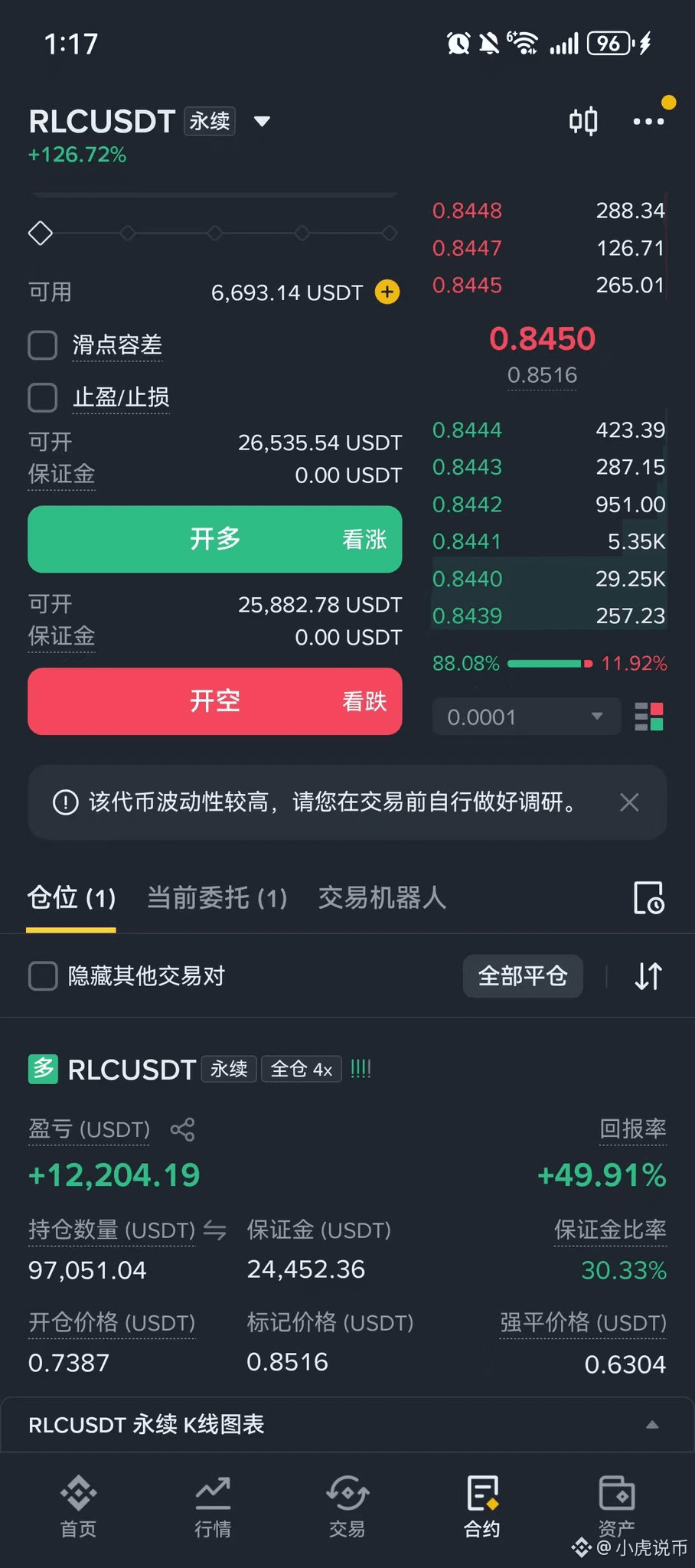
Over time, I started to notice a change $RLC .
It wasn’t that my predictions got more accurate. It was that my losses became manageable, and I learned to hold on to my gains.
When it comes down to it, trading isn’t about who’s smarter.
It’s about who can truly stick to the rules when it’s time to be strict.
A lot of people are still searching for a strategy, but the strategy has been there all along $BTC .
The hard part is whether you can still follow the rules when your emotions kick in.
If you’re still feeling lost, you’re welcome to reach out. I’m always here. As long as you want to improve, I’ll move forward with you.
That day, I’d already set a stop-loss. Then the market plunged, and I couldn’t accept it. In a moment of weakness, I moved my stop-loss lower by $AIN .
At the time, I thought, “I’ll wait a little longer—then it’ll bounce.” But what I got wasn’t a rebound; I just got deeper and deeper in the hole.
It was only when I reviewed the trade later that I realized the problem was never the market. It was me.
The harshest thing about crypto isn’t the volatility—it’s how it amplifies your emotions.
When prices rise, you think they can go even higher, so you keep moving your take-profit target. In the end, you give back all your gains.
When prices fall, you think they’re about to bounce, so you keep pushing your stop-loss further away. In the end, a small loss becomes a big one.
You think you’re adapting flexibly, but really, you’re letting your emotions lead you around.
After taking plenty of wrong turns, I finally forced myself to set one hard-and-fast rule:
All rules must be set after the market closes.
Once I enter a trade, there’s only one thing to do during the session: follow the plan.
No matter what the market does, don’t try to optimize or adjust anything, and don’t try to be “clever in the moment.”
Because when you’re holding a position, you’re at your least rational.
You’re not watching the market—you’re watching your profit-and-loss numbers.
Over time, I started to notice a change $RLC .
It wasn’t that my predictions got more accurate. It was that my losses became manageable, and I learned to hold on to my gains.
When it comes down to it, trading isn’t about who’s smarter.
It’s about who can truly stick to the rules when it’s time to be strict.
A lot of people are still searching for a strategy, but the strategy has been there all along $BTC .
The hard part is whether you can still follow the rules when your emotions kick in.
If you’re still feeling lost, you’re welcome to reach out. I’m always here. As long as you want to improve, I’ll move forward with you.