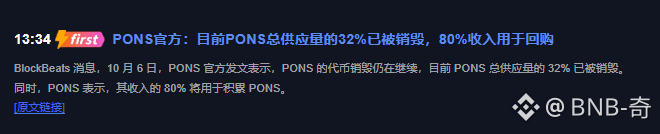
32% of the total supply of $PONS is burned through buybacks. Do buybacks actually matter? Just look at these four points:
1. Where does the money come from? Buying with actual protocol revenue (USDT, ETH, etc.) counts as a buyback. Using your own token to buy your own token is just moving funds from one pocket to another.
2. Whose tokens are being bought? Only buying tokens in circulation, held by retail investors, reduces actual selling pressure. Buying tokens that haven't been unlocked by the project team, or tokens in the team's own wallets, is just moving eggs from one basket to another.
3. Where do the bought-back tokens go? Supply is only truly reduced when they're sent to a burn address and permanently destroyed. If they're put in a separate wallet, that's just one more whale, who could still sell them later.
4. Is it hard-coded? Only if it's automated, written into the contract, and continuously executed according to set rules does it have binding force. Manual operations can be stopped at any time. When the project is doing well, it's marketing; when things go badly, who knows? Pons currently falls into this category.
Even if all four conditions are met, that doesn't mean the price will necessarily rise. The scale of buybacks depends on how much the protocol earns. If daily fees are only $1,000 and 1% of that is used for buybacks, it will have almost no impact on the market. Genuine buybacks require substantial revenue, purchases from the circulating supply, and token burns—otherwise, it's just a narrative.
$PONS
1. Where does the money come from? Buying with actual protocol revenue (USDT, ETH, etc.) counts as a buyback. Using your own token to buy your own token is just moving funds from one pocket to another.
2. Whose tokens are being bought? Only buying tokens in circulation, held by retail investors, reduces actual selling pressure. Buying tokens that haven't been unlocked by the project team, or tokens in the team's own wallets, is just moving eggs from one basket to another.
3. Where do the bought-back tokens go? Supply is only truly reduced when they're sent to a burn address and permanently destroyed. If they're put in a separate wallet, that's just one more whale, who could still sell them later.
4. Is it hard-coded? Only if it's automated, written into the contract, and continuously executed according to set rules does it have binding force. Manual operations can be stopped at any time. When the project is doing well, it's marketing; when things go badly, who knows? Pons currently falls into this category.
Even if all four conditions are met, that doesn't mean the price will necessarily rise. The scale of buybacks depends on how much the protocol earns. If daily fees are only $1,000 and 1% of that is used for buybacks, it will have almost no impact on the market. Genuine buybacks require substantial revenue, purchases from the circulating supply, and token burns—otherwise, it's just a narrative.
$PONS