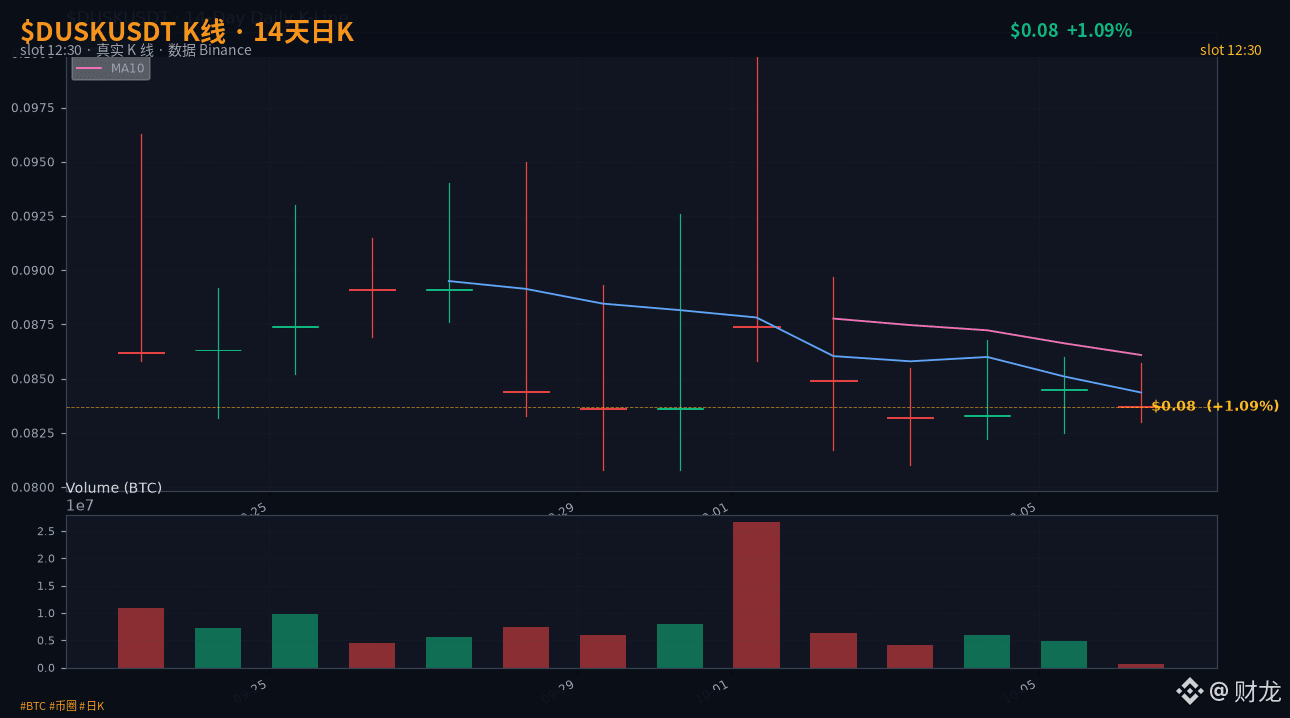

$DUSK is currently trading at $0.0839, up a modest 0.72% over 24 hours. Nothing exciting on the price front. But last week, @Dusk tucked something into its docs that was easy to overlook—the kind of pitfall developers hit the first time they write a contract.
The contract environment has a 4-step lifecycle: submit, enter an L2 block, send the data to the settlement layer, and get finality from the settlement layer. The problem is step 4: getting on-chain and settling are not the same thing. A contract can land on an L2 chain in seconds, but finalizing back on the settlement layer takes a rollback window. During that window, the state may look correct, then a rollback can invalidate everything.
For real-world assets, those few seconds can mean an incident. Incorrect entries on the asset side, mismatched regulatory reports, misaligned compliance-audit timestamps—all happen in that gap. The official guidance is clear: verify against protocol state or wallet state; don’t use time to determine finality.
@Dusk has given developers a rule of thumb: don’t use time to determine finality; verify against the protocol layer or wallet state. The first is for the Ethereum crowd; the second is for the clearing banks in that €300 million pool at a Dutch-licensed exchange.
Two things to remember today: the contract environment runs on testnet, while settlement back to the settlement layer runs on mainnet; the two-stage route has only been in the docs for six months. The privacy vault further tightens the L2 part, combining homomorphic encryption with zero-knowledge proofs in an isomorphic design, so the data layer obscures the on-chain and settlement steps of private contracts from the outset. @Dusk has laid out this playbook, and the people it’s aimed at are already changing how they write contracts.
#dusk #合约环境 #L2Finality
The contract environment has a 4-step lifecycle: submit, enter an L2 block, send the data to the settlement layer, and get finality from the settlement layer. The problem is step 4: getting on-chain and settling are not the same thing. A contract can land on an L2 chain in seconds, but finalizing back on the settlement layer takes a rollback window. During that window, the state may look correct, then a rollback can invalidate everything.
For real-world assets, those few seconds can mean an incident. Incorrect entries on the asset side, mismatched regulatory reports, misaligned compliance-audit timestamps—all happen in that gap. The official guidance is clear: verify against protocol state or wallet state; don’t use time to determine finality.
@Dusk has given developers a rule of thumb: don’t use time to determine finality; verify against the protocol layer or wallet state. The first is for the Ethereum crowd; the second is for the clearing banks in that €300 million pool at a Dutch-licensed exchange.
Two things to remember today: the contract environment runs on testnet, while settlement back to the settlement layer runs on mainnet; the two-stage route has only been in the docs for six months. The privacy vault further tightens the L2 part, combining homomorphic encryption with zero-knowledge proofs in an isomorphic design, so the data layer obscures the on-chain and settlement steps of private contracts from the outset. @Dusk has laid out this playbook, and the people it’s aimed at are already changing how they write contracts.
#dusk #合约环境 #L2Finality