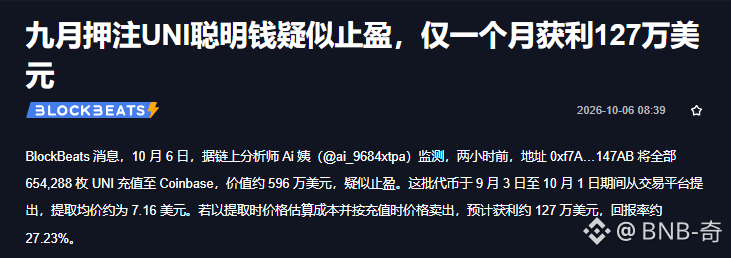
$UNI The smart money that bet in September appears to have taken profits, making $1.27 million in a month. As for UNI, I’ve been bullish on it for a long time, and it’s one of the coins I’ve consistently had confidence in. I entered spot positions around $6 and also made a few short-term long trades on futures, but I won’t go into futures trading in detail.
I’ll focus on why UNI is my top choice for spot. For UNI, the tokenization of on-chain stocks is moving from concept to actual trading. Once trading volume picks up, whoever handles those orders can continue to capture growth in the sector.
Uniswap holds a key position here. OKX has announced a partnership between its stock tokenization service and Uniswap v4 Hooks, effectively connecting the trading logic for stock tokens to v4’s customizable liquidity layer.
Expanding to multiple chains doesn’t require building a separate market from scratch; existing routing, liquidity, and Hook mechanisms can be reused. This isn’t just a one-off partnership—it embeds stock token trading into Uniswap’s infrastructure.
The logic can be summed up as a flywheel: stock token trading volume rises, protocol fees increase, UNI burns increase in turn, and the resulting supply contraction then helps support the token price.
The more active trading becomes, the more consistent the burns—and the harder it is for new protocols to replace these network effects all at once. So, if you’re bullish on the tokenization of on-chain stocks, UNI is currently the most direct beneficiary.
It already has a multi-chain liquidity base, and v4 Hooks connect it to a new trading use case. A measurable positive relationship between volume and burns is already taking shape.
$UNI
I’ll focus on why UNI is my top choice for spot. For UNI, the tokenization of on-chain stocks is moving from concept to actual trading. Once trading volume picks up, whoever handles those orders can continue to capture growth in the sector.
Uniswap holds a key position here. OKX has announced a partnership between its stock tokenization service and Uniswap v4 Hooks, effectively connecting the trading logic for stock tokens to v4’s customizable liquidity layer.
Expanding to multiple chains doesn’t require building a separate market from scratch; existing routing, liquidity, and Hook mechanisms can be reused. This isn’t just a one-off partnership—it embeds stock token trading into Uniswap’s infrastructure.
The logic can be summed up as a flywheel: stock token trading volume rises, protocol fees increase, UNI burns increase in turn, and the resulting supply contraction then helps support the token price.
The more active trading becomes, the more consistent the burns—and the harder it is for new protocols to replace these network effects all at once. So, if you’re bullish on the tokenization of on-chain stocks, UNI is currently the most direct beneficiary.
It already has a multi-chain liquidity base, and v4 Hooks connect it to a new trading use case. A measurable positive relationship between volume and burns is already taking shape.
$UNI