Family, hot coffee in hand and a cool eye on the charts. In the trading trenches, we don’t just trade structures, imbalances, and supply/demand blocks; we also have to understand where institutional capital is moving and why.
Today I’m bringing you a straightforward rundown, trader to trader, of two assets that are making waves on the radar and that we should keep a close eye on in our 4H analyses: $AAVE and $LayerZero (ZRO).
1. Aave ($AAVE ) — The DeFi giant that keeps absorbing liquidity
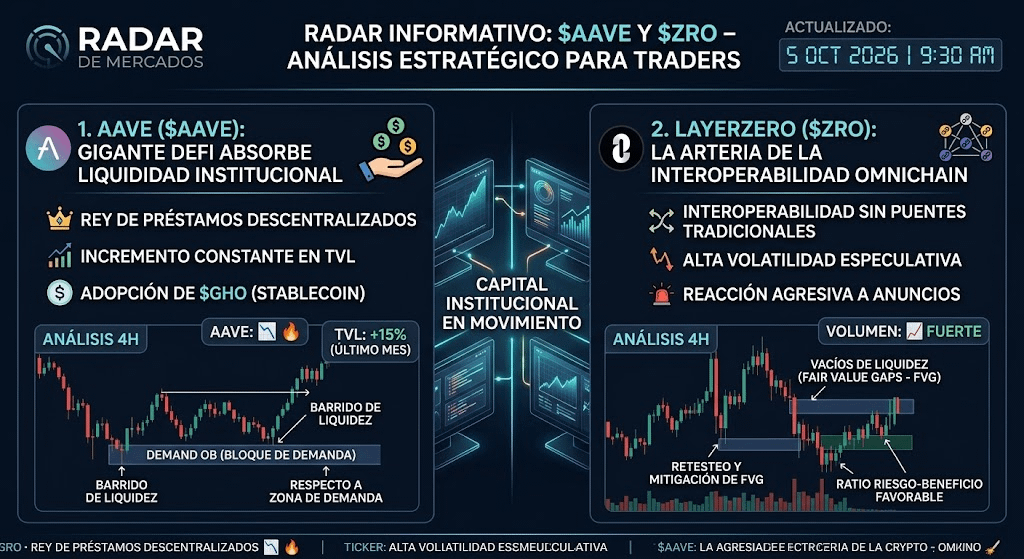
What’s happening: Aave continues to establish itself as the undisputed king of decentralized lending. The protocol is experiencing a steady increase in its Total Value Locked (TVL), driven by demand for stable yield and the adoption of its native stablecoin ($GHO) across multiple networks.
Why it matters to traders: When a protocol of this scale shows a steady influx of institutional capital, the impact on price is not long in coming. On the 4H chart, AAVE often translates this fundamental strength into very clean bullish structures, respecting demand zones (Demand OB) after sweeping liquidity from previous lows.
Tactical approach: Watch for pullbacks toward key support levels. This is an ideal asset for looking for trend-continuation entries when buying flow confirms that the block is holding.
2. LayerZero ($ZRO ) — The artery of multichain interoperability
What’s happening: LayerZero remains at the center of the infrastructure narrative as it expands its Omnichain integrations. The ability to transfer messages, data, and liquidity between dozens of blockchains without traditional bridges is leading more and more major applications to adopt its standard.
Why it matters to traders: Every expansion in the LayerZero ecosystem generates spikes in volatility and speculative volume. ZRO is a token that reacts very aggressively to market swings and announcements of new partnerships.
Tactical approach: ZRO loves to leave liquidity voids (Fair Value Gaps - FVG) during its impulsive moves. The key here is to patiently wait for a retest and mitigation of those imbalances on the 4H chart before pulling the trigger, aiming for a highly favorable risk-reward ratio.