Day 17: Forex Basics - Setting Stop-Loss Levels (ATR + Key Levels)
Stop-losses are one of the most easily overlooked lessons for beginners, yet they can be a lifesaver.
Their purpose is not to “lose less,” but to give your trades a safety net.
📍 Where should you place a stop-loss? Two principles:
Principle 1: Place it beyond a key level
· Going long → Place the stop-loss below the swing low / support
· Going short → Place the stop-loss above the swing high / resistance
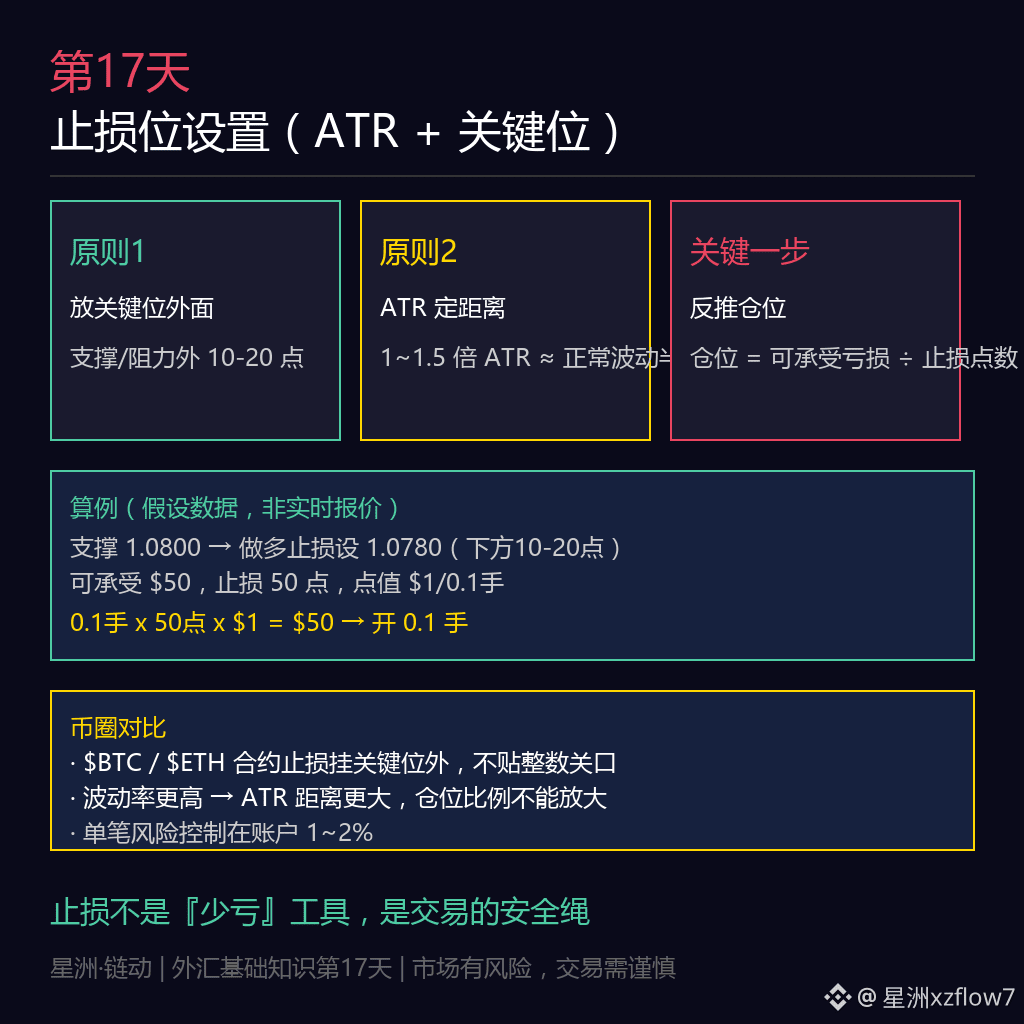
· Suppose support is at 1.0800: place the stop-loss at 1.0780 (10–20 pips below), not at 1.0805
Why: Only a decisive break below a key level shows that your analysis was wrong. Place it too close, and normal market fluctuations may trigger it.
Principle 2: Use ATR (Average True Range) to measure the distance
ATR is the market’s own measure of its “normal range of movement.”
· The daily ATR for EUR/USD is about 50 pips (a general estimate, not real-time data)
· Stop-loss distance = 1–1.5 × ATR (about 50–75 pips)
· Closer than the market’s normal range → More likely to be stopped out by noise
· Much wider than the normal range → Excessive risk; reduce your position size accordingly
💰 A key step: Use the stop-loss distance to work out your position size
Before opening a trade, first calculate “the maximum amount I can lose on this trade”:
· You can afford to lose $50; the stop-loss is 50 pips; each pip is worth $1 per 0.1 lot
· 0.1 lot × 50 pips × $1 = exactly $50 → Open 0.1 lot
Remember: Position size = acceptable loss ÷ (stop-loss distance in pips × pip value)
Set the risk first, then determine the position size. Never reverse the order.
⚡ Three rules to follow
1. Set your stop-loss before opening a trade; don’t add it afterward
2. If your stop-loss is triggered, exit. Don’t chase the trade or stubbornly hold on
3. Keep the risk per trade to 1–2% of your account
₿ Crypto comparison
$BTC / $ETH Perpetual contracts follow the same logic: place stop-losses below key support / above resistance, not right at round-number levels.
Crypto is more volatile, so ATR-based distances are also wider, but that doesn’t mean you should increase your position size proportionally—
High volatility ≠ permission to increase leverage and tough it out. If anything, you should use a smaller position size.
Markets involve risk. Trade with caution. The content above is for educational purposes only and does not constitute investment advice.
Stop-losses are one of the most easily overlooked lessons for beginners, yet they can be a lifesaver.
Their purpose is not to “lose less,” but to give your trades a safety net.
📍 Where should you place a stop-loss? Two principles:
Principle 1: Place it beyond a key level
· Going long → Place the stop-loss below the swing low / support
· Going short → Place the stop-loss above the swing high / resistance
· Suppose support is at 1.0800: place the stop-loss at 1.0780 (10–20 pips below), not at 1.0805
Why: Only a decisive break below a key level shows that your analysis was wrong. Place it too close, and normal market fluctuations may trigger it.
Principle 2: Use ATR (Average True Range) to measure the distance
ATR is the market’s own measure of its “normal range of movement.”
· The daily ATR for EUR/USD is about 50 pips (a general estimate, not real-time data)
· Stop-loss distance = 1–1.5 × ATR (about 50–75 pips)
· Closer than the market’s normal range → More likely to be stopped out by noise
· Much wider than the normal range → Excessive risk; reduce your position size accordingly
💰 A key step: Use the stop-loss distance to work out your position size
Before opening a trade, first calculate “the maximum amount I can lose on this trade”:
· You can afford to lose $50; the stop-loss is 50 pips; each pip is worth $1 per 0.1 lot
· 0.1 lot × 50 pips × $1 = exactly $50 → Open 0.1 lot
Remember: Position size = acceptable loss ÷ (stop-loss distance in pips × pip value)
Set the risk first, then determine the position size. Never reverse the order.
⚡ Three rules to follow
1. Set your stop-loss before opening a trade; don’t add it afterward
2. If your stop-loss is triggered, exit. Don’t chase the trade or stubbornly hold on
3. Keep the risk per trade to 1–2% of your account
₿ Crypto comparison
$BTC / $ETH Perpetual contracts follow the same logic: place stop-losses below key support / above resistance, not right at round-number levels.
Crypto is more volatile, so ATR-based distances are also wider, but that doesn’t mean you should increase your position size proportionally—
High volatility ≠ permission to increase leverage and tough it out. If anything, you should use a smaller position size.
Markets involve risk. Trade with caution. The content above is for educational purposes only and does not constitute investment advice.