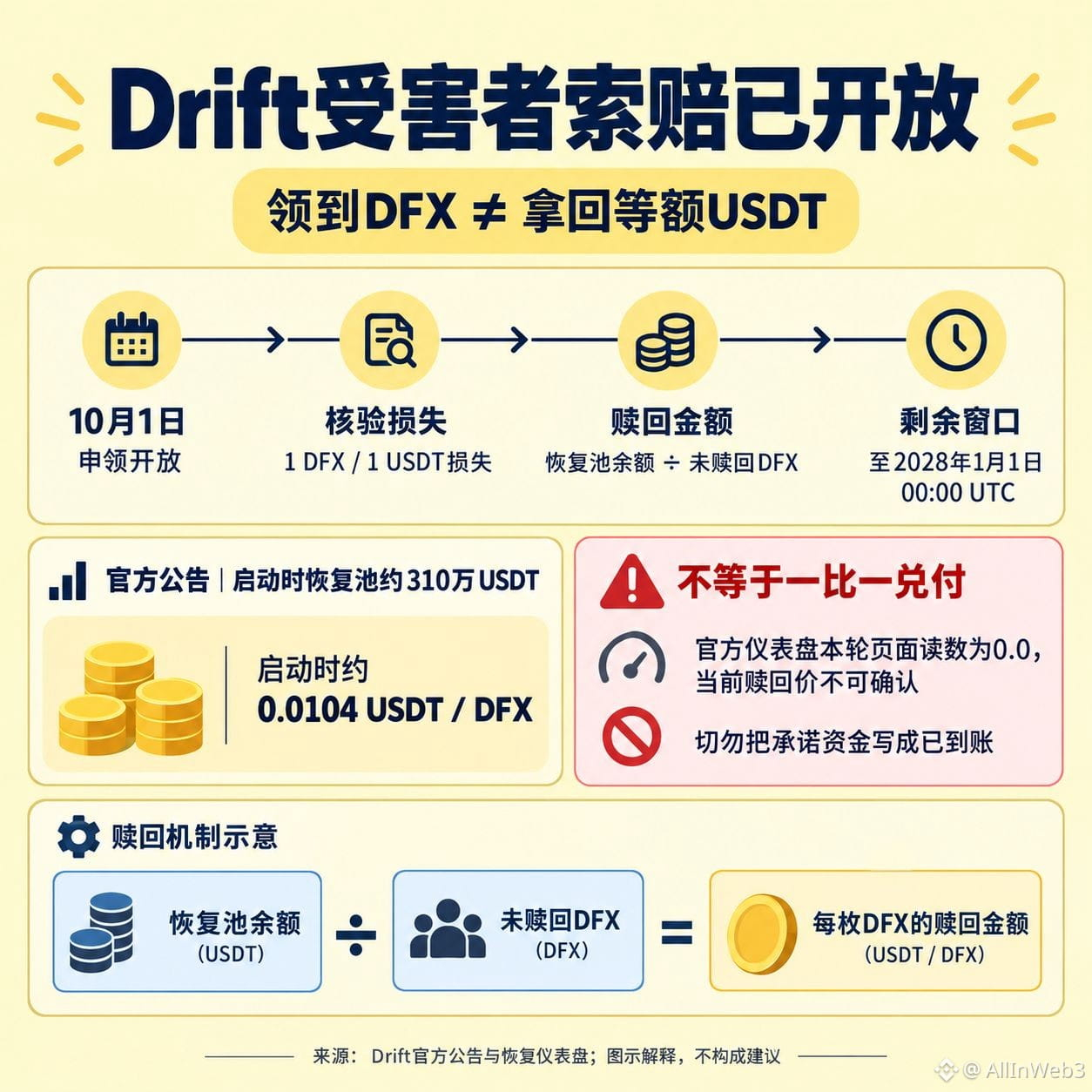
#The Drift claims window is now open, but receiving DFX does not mean recovering dollars at a 1:1 rate. What actually determines how much each token can be redeemed for is the recovery pool balance divided by the amount of DFX that has not yet been redeemed.
Drift’s October 1 announcement said users affected by the April incident whose losses had been verified could receive 1 DFX for every 1 USDT lost. This is only the allocation amount—not a face value of 1 USDT per DFX. At launch, the official announcement said the recovery pool held about 3.1 million USDT, with an initial redemption price of about 0.0104 USDT per token. The pool will be replenished over time with Velocity’s net protocol revenue and recovered funds, and the redemption amount will vary with the pool balance and the unredeemed supply.
So keep three things separate: claiming means verifying eligibility against the snapshot and receiving DFX; redeeming means burning DFX and receiving USDT at the price shown at that time; selling on the secondary market is a separate transaction, and its price is not guaranteed by the official redemption formula. Tether’s “up to $127.5 million” and other partners’ “up to $20 million” are commitment caps, not evidence that all the funds have already arrived.
When I checked Drift’s public recovery dashboard this time, it showed the pool balance and cumulative contributions as 0.0 USDT, 0 redeemed, and the DFX redemption price as unavailable, while “issued” was about 298.96 million and “unredeemed” showed 0. These dashboard readings do not match the launch data in the October 1 announcement, and the fields are internally inconsistent as well. The only conclusion is that the page could not provide a reliable current figure at the time; this does not justify concluding that the pool has been emptied or that users have not claimed. The public page should be checked again before being used.
What is really worth watching next is the daily pool deposits at 00:00 UTC, whether the dashboard can again show consistent figures for the pool balance, unredeemed amount, and redemption price per token, and whether recovered funds have on-chain proof. The change now is that claims have officially opened; the actual pace of recovery still depends on future revenue and recoveries, so the allocation should not be described as cash already recovered. Source: Drift’s October 1 official announcement and public recovery dashboard.
Drift’s October 1 announcement said users affected by the April incident whose losses had been verified could receive 1 DFX for every 1 USDT lost. This is only the allocation amount—not a face value of 1 USDT per DFX. At launch, the official announcement said the recovery pool held about 3.1 million USDT, with an initial redemption price of about 0.0104 USDT per token. The pool will be replenished over time with Velocity’s net protocol revenue and recovered funds, and the redemption amount will vary with the pool balance and the unredeemed supply.
So keep three things separate: claiming means verifying eligibility against the snapshot and receiving DFX; redeeming means burning DFX and receiving USDT at the price shown at that time; selling on the secondary market is a separate transaction, and its price is not guaranteed by the official redemption formula. Tether’s “up to $127.5 million” and other partners’ “up to $20 million” are commitment caps, not evidence that all the funds have already arrived.
When I checked Drift’s public recovery dashboard this time, it showed the pool balance and cumulative contributions as 0.0 USDT, 0 redeemed, and the DFX redemption price as unavailable, while “issued” was about 298.96 million and “unredeemed” showed 0. These dashboard readings do not match the launch data in the October 1 announcement, and the fields are internally inconsistent as well. The only conclusion is that the page could not provide a reliable current figure at the time; this does not justify concluding that the pool has been emptied or that users have not claimed. The public page should be checked again before being used.
What is really worth watching next is the daily pool deposits at 00:00 UTC, whether the dashboard can again show consistent figures for the pool balance, unredeemed amount, and redemption price per token, and whether recovered funds have on-chain proof. The change now is that claims have officially opened; the actual pace of recovery still depends on future revenue and recoveries, so the allocation should not be described as cash already recovered. Source: Drift’s October 1 official announcement and public recovery dashboard.