The Traps of the Human Mind
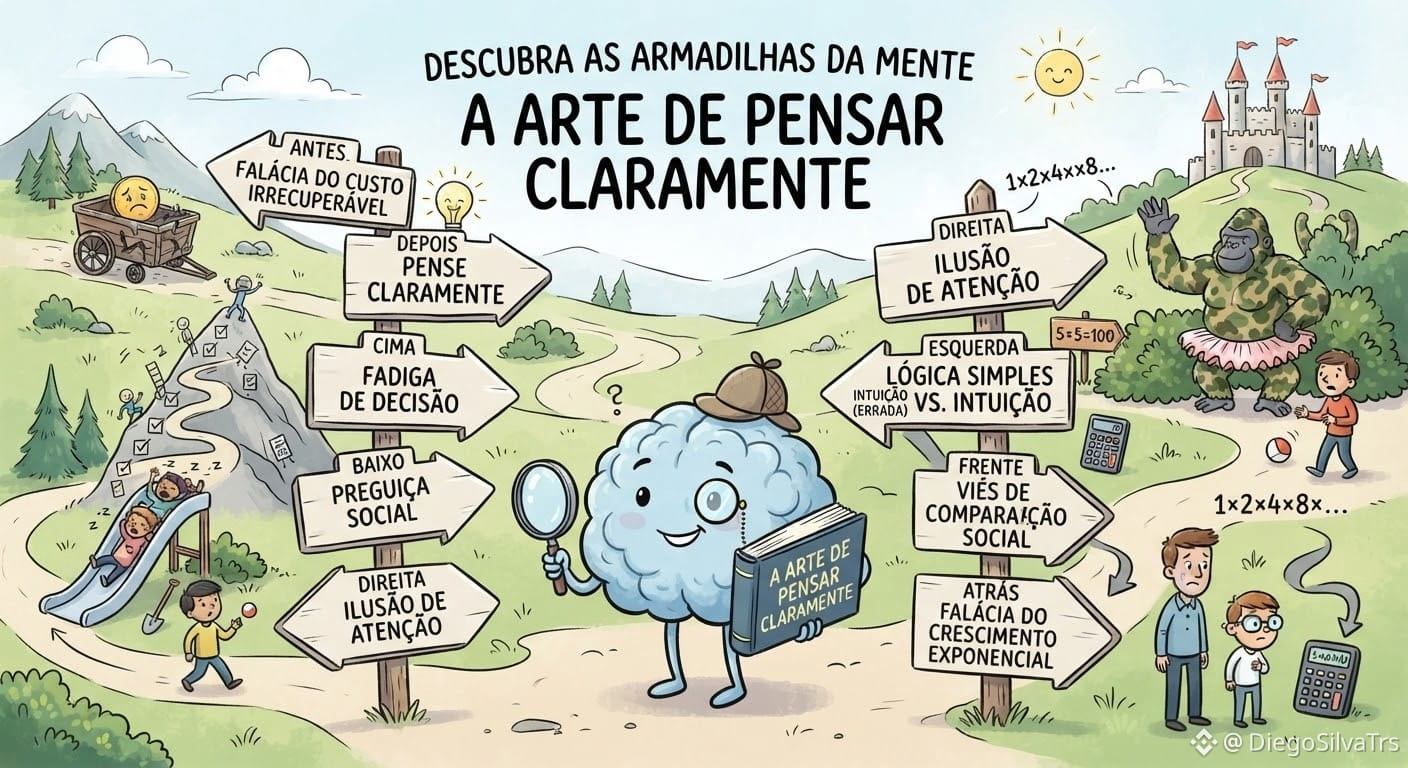
Everyday thinking is often distorted by invisible cognitive biases that affect personal, professional, and financial decisions. Among the main distortions are the exponential growth fallacy, which makes it difficult to intuitively understand interest and inflation; the sunk cost fallacy, which traps people in bad choices because of the past; and the conjunction fallacy, which makes us prefer detailed narratives to actual probabilities. Other recurring errors include the illusion of attention, which hides obvious changes when our focus is directed toward a single task; decision fatigue, which drains mental energy throughout the day and makes impulse purchases more likely; social loafing, which reduces individual effort in group work; simple logic, which gives way to misguided intuitive answers; and social comparison bias, which creates insecurity and reluctance to hire more talented people for teams. Overcoming these traps requires strategic breaks, self-awareness, and replacing emotional intuition with rational, structured analysis. To explore these concepts further and neutralize these cognitive barriers in everyday life, Rolf Dobelli’s book The Art of Thinking Clearly is an indispensable and practical guide. The author brings together dozens of systematic errors in judgment that we make without realizing it, in an exceptionally accessible way, offering valuable insights to improve discernment, avoid external manipulation, and gain greater intellectual autonomy, mental clarity, and soundness in decision-making in any circumstance of modern life, whether in business or relationships.
$PAXG $SOL $ADA
Everyday thinking is often distorted by invisible cognitive biases that affect personal, professional, and financial decisions. Among the main distortions are the exponential growth fallacy, which makes it difficult to intuitively understand interest and inflation; the sunk cost fallacy, which traps people in bad choices because of the past; and the conjunction fallacy, which makes us prefer detailed narratives to actual probabilities. Other recurring errors include the illusion of attention, which hides obvious changes when our focus is directed toward a single task; decision fatigue, which drains mental energy throughout the day and makes impulse purchases more likely; social loafing, which reduces individual effort in group work; simple logic, which gives way to misguided intuitive answers; and social comparison bias, which creates insecurity and reluctance to hire more talented people for teams. Overcoming these traps requires strategic breaks, self-awareness, and replacing emotional intuition with rational, structured analysis. To explore these concepts further and neutralize these cognitive barriers in everyday life, Rolf Dobelli’s book The Art of Thinking Clearly is an indispensable and practical guide. The author brings together dozens of systematic errors in judgment that we make without realizing it, in an exceptionally accessible way, offering valuable insights to improve discernment, avoid external manipulation, and gain greater intellectual autonomy, mental clarity, and soundness in decision-making in any circumstance of modern life, whether in business or relationships.
$PAXG $SOL $ADA