


I recently came across a really interesting DePIN data chart:
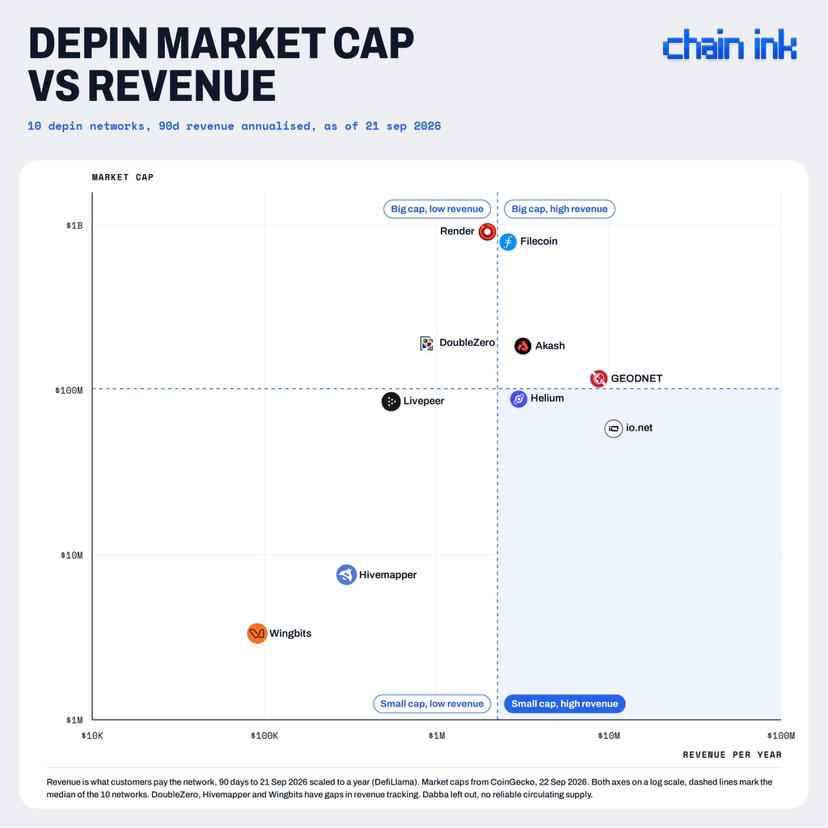
Market Cap vs Revenue
It compares 10 DePIN networks side by side:
👉 Market cap
👉 Annualized revenue
👉 Real demand
👉 Market valuation
And what’s most noteworthy isn’t the projects with the largest market caps.
But tucked away in the corner—
$IO / io.net
🔥 $IO’s biggest problem may not be a lack of revenue
Instead:
The market’s valuation of it is simply too low.
According to the chart:
📌 Revenue is annualized based on the 90 days before 2026/9/21
📌 Market cap data as of 2026/9/22
📌 $IO is in the “low market cap × high revenue” quadrant
In other words:
Its revenue-generating ability may already be running ahead of its market valuation.
This is why I’ve started taking another look at $IO.
💰 Just how cheap is $IO right now?
According to CoinGecko, $IO’s market cap on 2026/10/5 was around:
$71.3M.
So let’s run a very simple valuation exercise:
Assuming $IO currently has a $70M market cap:
🔹 $100M → 1.4X
🔹 $300M → 4.3X
🔹 $500M → 7.1X
🔹 $1B → 14.3X
🔹 $2B → 28.6X
🔹 $3B → 42.9X
🔹 $5B → 71.4X
🔹 $7B → 100X
By this point, you’ll see:
For $IO to 100X, it doesn’t need to become a $100B giant.
It only needs to grow from a small DePIN project worth around $70M to a market cap of around $7B.
Of course—
This is neither a prediction nor a guarantee.
The real question is:
Could io.net grow revenue, AI usage, and token value capture all together?
🧠 This is the flywheel that really got me interested in $IO
I think the most compelling thing about $IO to research isn’t just “lots of GPUs.”
Instead:
AI compute demand → io.net usage → network revenue → $IO buybacks → Burn → lower circulating supply
That’s the complete economic model.
io.net’s official IDE (Incentive Dynamic Engine) has shifted from purely inflationary incentives to a demand-driven model.
The official description currently says:
After paying GPU providers, at least 50% of the remaining revenue will be used for Burn.
with a goal of removing more than 150 million $IO from circulation.
This is extremely important.
Because:
Revenue ≠ Token value
There’s still a bridge to build.
And $IO is now trying to build that bridge.
🚀 So why hasn’t the market given it a higher valuation yet?
This is actually what I find most interesting.
The market still has a few questions:
❌ How high is actual GPU utilization?
❌ Can the number of enterprise customers keep growing?
❌ Can AI inference become a long-term source of revenue?
❌ Can revenue continue growing beyond the tens-of-millions-of-dollars range?
❌ Can Burn continue to scale up?
❌ Can $IO truly move beyond the DePIN narrative and become AI Infrastructure?
So, right now, $IO is:
It is not a “guaranteed 100X gem.”
Instead:
A project with 100X potential, but one the market still expects to prove itself.
👀 The 6 metrics I’d really keep an eye on
If you really want to study $IO through a “100X gem” lens, I wouldn’t recommend looking at the price every day.
Here are the 6 things to watch next:
1️⃣ Network Revenue
Can revenue continue to grow?
2️⃣ GPU Utilization
It’s not the number of GPUs, but:
How many GPUs are actually earning money?
3️⃣ AI Inference
Can AI Agents, LLMs, and inference workloads take off?
4️⃣ Enterprise Customers
Are enterprise customers continuing to grow?
5️⃣ $IO Burn
As revenue grows, does Burn increase alongside it?
6️⃣ Market Cap / Revenue
Has the market started to reprice it?
🐂 What if all these things really happen at the same time?
Assuming over the next few years:
AI compute demand continues to surge
⬇️
DePIN GPUs become an important supplement to cloud computing
⬇️
io.net revenue continues to grow
⬇️
Inference / Agent / Training workloads increase
⬇️
Network Revenue expands
⬇️
$IO Buyback & Burn increases
⬇️
The market starts reassessing $IO’s valuation
So:
$70M → $1B
This may only be the first phase.
$1B → $3B
That’s when it would truly start entering the mainstream DePIN / AI Infrastructure valuation range.
But:
$7B
That’s the mathematical endpoint of “100X” we’re discussing today.
⚠️ But I want to emphasize one thing
This chart is great for spotting:
“Projects the market may be mispricing”
But it can’t directly prove:
“$IO is definitely going to 100X.”
Because revenue isn’t net profit.
More importantly:
How much of the revenue generated by the network can actually be captured by the $IO token?
This is the key.
DePIN revenue figures also vary depending on how the data is measured, so looking at P/S or a single chart alone isn’t enough to make an investment decision.
🔥 My final thoughts on $IO for now
When I used to look at DePIN, I’d first check:
Narrative, community, and token price gains.
When I look at $IO now, I’m more interested in:
Revenue → Usage → Burn → Valuation
Because projects with a real chance of making a major run are often not the ones where:
“Everyone is saying it’ll go up.”
Instead, look at:
Fundamentals are beginning to improve, but the market hasn’t fully repriced it yet.
So I wouldn’t say:
“$IO is the next 100X gem.”
I’d rather put it this way:
“$IO now has the qualities that make it worth studying through a 100X-gem lens.”
What’s really worth watching next isn’t whether it’s up 10% or down 10% today.
Instead:
Can it turn massive AI compute demand into sustained revenue growth, and ultimately into value captured by $IO?
If this flywheel gets going—
That’s what’s truly worth fearing you’ll miss out on. 🚀
What do you think of $IO?
Which do you think it’s closer to:
🟢 Undervalued AI × DePIN infrastructure
Or
🔴 A high-risk project that the market discounts for good reason?
#IO #ioNet #DePIN #AI #GPU #AIInfrastructure #Solana #Crypto #100X #BinanceSquare #Cryptocurrency