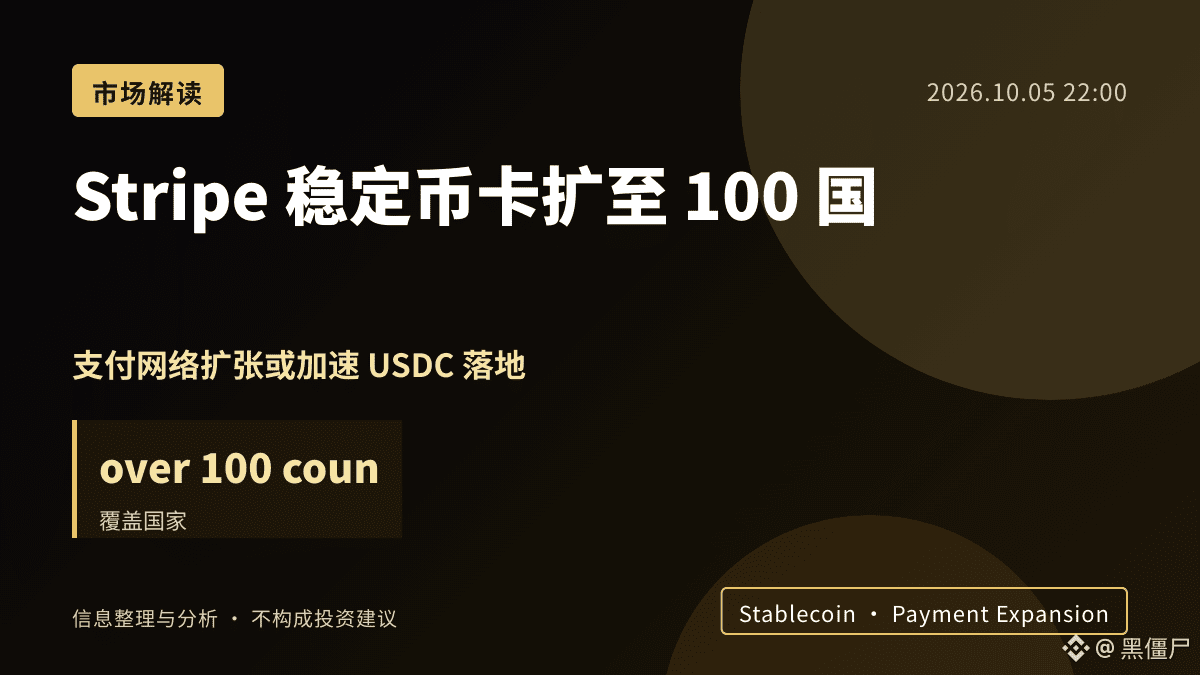
Stripe’s Stablecoin Card to Reach 100 Countries by Year-End as USDC Payments Gain Momentum
According to CoinDesk, Stripe plans to expand its stablecoin card business to more than 100 countries by the end of this year, while also exploring solutions related to tokenized deposits. The significance of this move lies not in the launch of a single product, but in the growing direct link between the expansion of payment networks and stablecoin settlement capabilities.
From a market-structure perspective, Stripe’s distribution reach has long been a key bottleneck for bringing crypto payments into real-world use. Stablecoins have so far been used primarily for on-chain transfers and institutional settlements, while access to card networks and acquiring networks determines whether everyday merchants and consumers can use them for routine purchases. If the goal of reaching 100 countries by year-end stays on track, the adoption path for USDC in cross-border payments, merchant settlements, and consumer spending may become clearer. Competition among stablecoins could also shift from “who issues them” to “who connects to more payment nodes.”
However, the information disclosed so far remains more of a roadmap: the specific countries covered, merchant numbers, payment volumes, and compliance timelines have yet to be clarified. Requirements for stablecoin cards, tokenized deposits, and payment licenses vary widely across jurisdictions, making the timeline uncertain. If the expansion remains limited to partnership announcements, actual fund flows and transaction volumes may fall short of expectations.
What will be more important to watch next is whether Stripe discloses launches in specific countries, merchant onboarding figures, or transaction volumes. For those following USDC, the key near-term question is whether the payment network’s expansion leads to confirmed real-world usage—not simply what the roadmap suggests.
#Stablecoin #USDC #CryptoMarket
The above is a summary of information and personal analysis, and does not constitute investment advice.
Follow me for ongoing coverage of key market developments and data.
According to CoinDesk, Stripe plans to expand its stablecoin card business to more than 100 countries by the end of this year, while also exploring solutions related to tokenized deposits. The significance of this move lies not in the launch of a single product, but in the growing direct link between the expansion of payment networks and stablecoin settlement capabilities.
From a market-structure perspective, Stripe’s distribution reach has long been a key bottleneck for bringing crypto payments into real-world use. Stablecoins have so far been used primarily for on-chain transfers and institutional settlements, while access to card networks and acquiring networks determines whether everyday merchants and consumers can use them for routine purchases. If the goal of reaching 100 countries by year-end stays on track, the adoption path for USDC in cross-border payments, merchant settlements, and consumer spending may become clearer. Competition among stablecoins could also shift from “who issues them” to “who connects to more payment nodes.”
However, the information disclosed so far remains more of a roadmap: the specific countries covered, merchant numbers, payment volumes, and compliance timelines have yet to be clarified. Requirements for stablecoin cards, tokenized deposits, and payment licenses vary widely across jurisdictions, making the timeline uncertain. If the expansion remains limited to partnership announcements, actual fund flows and transaction volumes may fall short of expectations.
What will be more important to watch next is whether Stripe discloses launches in specific countries, merchant onboarding figures, or transaction volumes. For those following USDC, the key near-term question is whether the payment network’s expansion leads to confirmed real-world usage—not simply what the roadmap suggests.
#Stablecoin #USDC #CryptoMarket
The above is a summary of information and personal analysis, and does not constitute investment advice.
Follow me for ongoing coverage of key market developments and data.