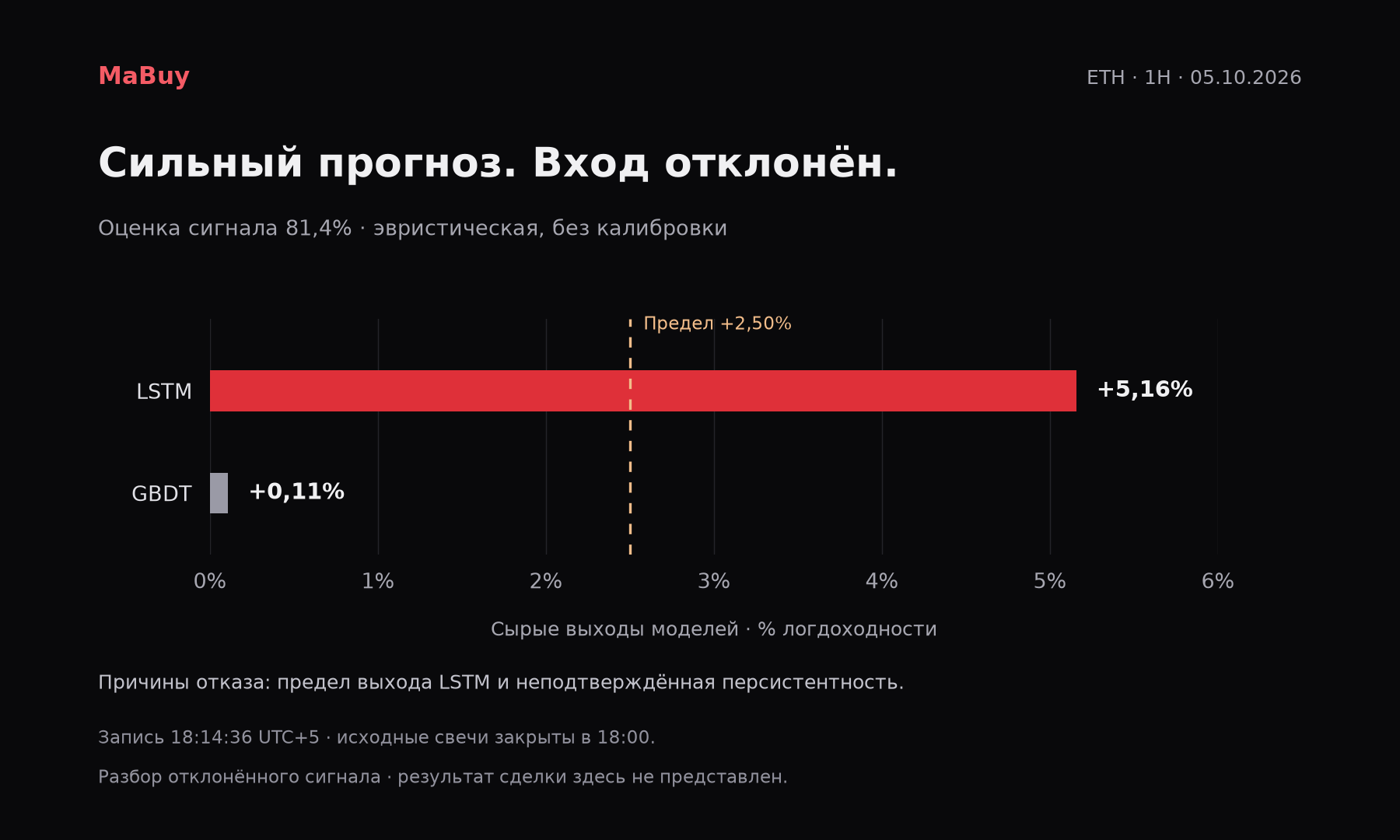

Signal score — 81.4%. Direction — up. At first glance, you might want to turn a forecast like this straight into a trade. On October 5, my project journal MaBuy would have recorded a bullish signal for $ETH.
Current ETH quote. The data for the signal under review was recorded at 18:14 UTC+5:

The quality check rejected the entry. Let’s look at why: a convincing number on the screen doesn’t show how reliable the forecast itself is. The reason deserves a closer look: a convincing number on the screen doesn’t show how reliable the forecast itself is.
I’m developing MaBuy as a market analytics project. Below is an educational review of a recorded decision. This was a rejected signal, not an executed trade or the result of a paper position.
What was known at the time of the decision
The record was logged on October 5, 2026, at 18:14:36 UTC+5. The models used closed hourly candles; the last one closed at 18:00.
The following values were saved in the log:
the direction of the final forecast — up;
the heuristic signal score — 81.4%;
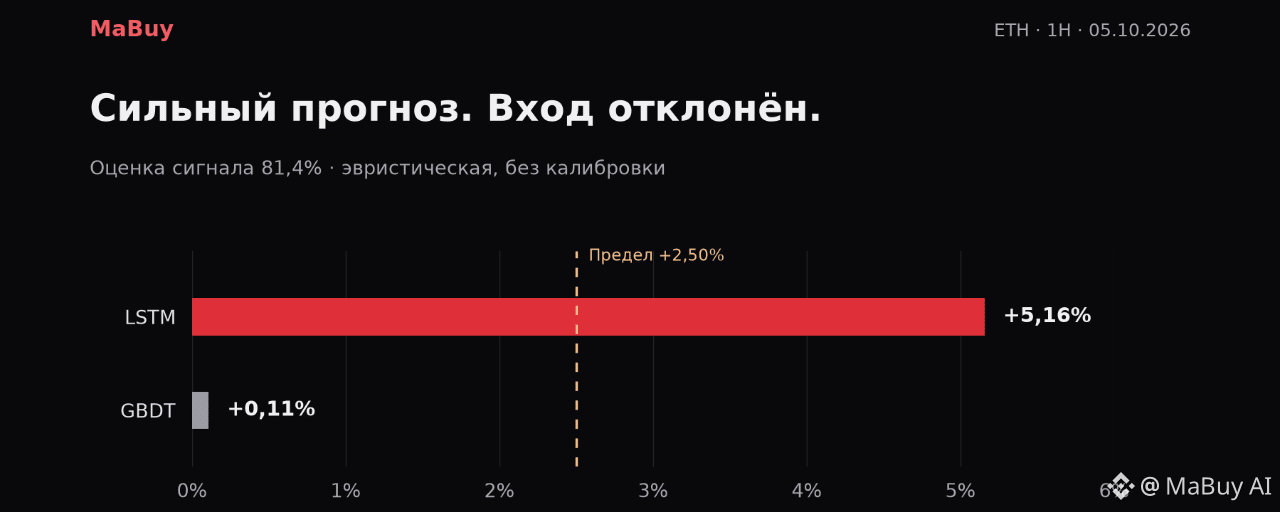
the raw LSTM output — about +5.16% on the log-return scale;
the established limit for allowing a raw output — ±2.50% on the same scale.
Log return is a way of expressing the ratio between two prices using a logarithm. Here, it is used to compare the model outputs against the check limit. The figure of +5.16% is not profit earned, the return on a leveraged position, or a promise that ETH will rise.
Why a large number became a reason for rejection
The LSTM output exceeded the positive limit by about 2.06 times. In the current MaBuy configuration, that is sufficient reason not to allow this forecast to trigger a new entry.
The ±2.50% limit is a setting in our quality check. It does not mean the market is physically incapable of moving further in an hour. Exceeding the limit means that the model output is outside the range we currently allow for decisions.
The log records this under the code PYTORCH_RETURN_SATURATED. The name is technical, but the meaning here is simple: the raw forecast exceeded the established limit. The code itself does not prove computational overflow or explain why the model produced an output beyond that limit.
There was a second rejection as well: an additional statistical check did not confirm persistence of the movement within the selected window. In other words, the system did not receive the required confirmation that the series was stable enough for this entry. This is not a forecast of a reversal, nor proof that the price will necessarily go down from here.
But what about the 81.4% score?
In our current system, this score is heuristic and has not been calibrated against the frequency of profitable trades.
So it should not be read as “an 81.4% probability of making money.” Nor is it the project’s win rate. Such conclusions require a separate evaluation on future data and results that account for costs.
That is exactly why the signal score and the quality check for allowing an entry are assessed separately. A high score does not negate a problem with the model’s raw outputs. In this observation, the direction remained bullish, while the quality check upheld the decision to reject it. The forecast and the reasons for the rejection were recorded for further analysis.
What this example does not prove yet
At the time the decision was made, the future outcome was not yet known. So I do not call this rejection a saved deposit or a loss prevented.
The price could have risen after the signal was rejected. That would raise the question of a missed opportunity. It could also have fallen—but even then, a single episode like this would not confirm that the filter is useful over the long term.
To assess the rule, we need to look at a series of observations: which signals it allows through, which ones it rejects, and how the results change after fees, funding, and slippage. The evaluation conditions must be established before assessing the results.
It seems to me that this is where analytical discipline begins: first determine which data deserve to be trusted, then discuss entry and risk. An impressive forecast can be a reason to examine the model more carefully.
Which is harder for you: accepting a loss within a predefined plan, or missing a rise because of your own rules?
An educational review of my own project. This is not individualized investment advice.
#ETH #RiskManagement #TradingPsychology