
NVDA’s chips that have already been sold can keep getting faster
This week, I’m more inclined to think NVDA will keep climbing. Closing prices were moving higher in the second half of last week, and OpenAI is continuing to optimize Blackwell, giving customers one more reason to stick with NVIDIA.
In a blog post on October 1, NVIDIA said GPT-6 Astra Ultrafast runs on Blackwell, and that OpenAI is still using its models to optimize GPU inference software. Machines already deployed can continue to improve their response speeds, and the same equipment can be reused for both training and inference. Customers who have already paid for the machines can keep benefiting from software improvements; when switching suppliers, they would also have to account for software and migration costs.
Even if a competitor’s chips are somewhat cheaper, customers may not be willing to immediately abandon software they’re already comfortable using. But OpenAI hasn’t chosen NVIDIA exclusively. AMD disclosed in July that OpenAI expects to begin bringing Helios online in the fourth quarter of this year. This is still a partnership plan, not something that can be treated as fully deployed. Blackwell getting faster hasn’t taken away AMD’s opportunity to win customers.
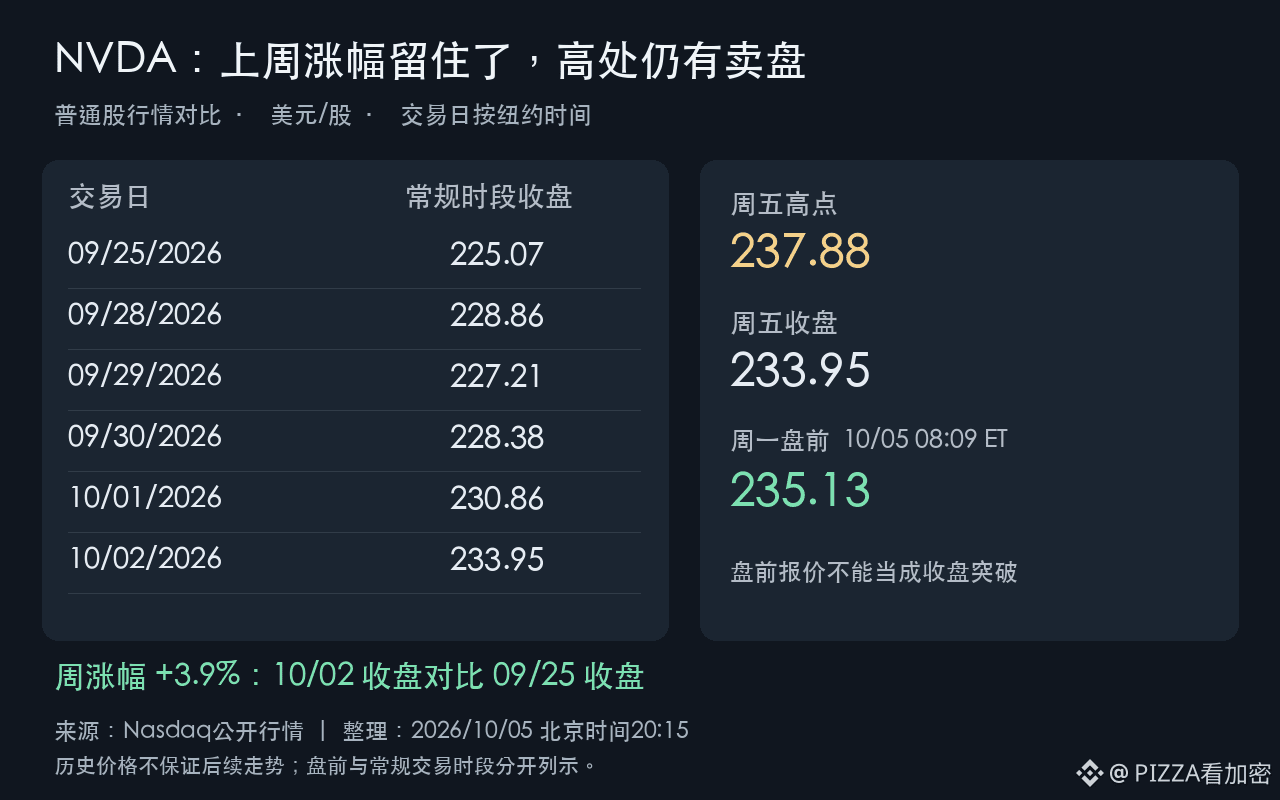
As for the stock, it closed at $233.95 last Friday, about 3.9% higher than the Friday before last. However, it reached $237.88 intraday on Friday before falling back to near that day’s low by the close. The premarket quote at 20:09 Beijing time today was $235.13, still below Friday’s high. This modest premarket gain doesn’t amount to a breakout, and Friday’s pullback also shows that there was selling at higher levels.
If the stock can move above the area around $237.88 and hold onto its gains through the close, there will be stronger grounds for expecting it to keep moving higher this week. If it fails to hold onto gains after several attempts to move higher, then falls back to last week’s early closing range of about $227 to $229, the stock is more likely to consolidate for a few days first, and there’s no need to expect the rally to continue uninterrupted for now.
ISM services data is also due at 10 p.m. tonight. If the price component adds to inflation concerns and pushes rate expectations higher, investors may mark down their valuations of future profits, which would also affect NVDA. The results aren’t out yet, so we can’t count the data as a positive in advance.
Software optimization may make customers more inclined to keep using NVIDIA, but it could also mean they need to buy fewer GPUs for the same workload. Whether NVIDIA ultimately sells more chips will depend on how quickly new demand grows. Making GPUs easier to use is a good thing, but how much more NVDA can earn from it is a separate question.
#NVDA #美股 #AI
This week, I’m more inclined to think NVDA will keep climbing. Closing prices were moving higher in the second half of last week, and OpenAI is continuing to optimize Blackwell, giving customers one more reason to stick with NVIDIA.
In a blog post on October 1, NVIDIA said GPT-6 Astra Ultrafast runs on Blackwell, and that OpenAI is still using its models to optimize GPU inference software. Machines already deployed can continue to improve their response speeds, and the same equipment can be reused for both training and inference. Customers who have already paid for the machines can keep benefiting from software improvements; when switching suppliers, they would also have to account for software and migration costs.
Even if a competitor’s chips are somewhat cheaper, customers may not be willing to immediately abandon software they’re already comfortable using. But OpenAI hasn’t chosen NVIDIA exclusively. AMD disclosed in July that OpenAI expects to begin bringing Helios online in the fourth quarter of this year. This is still a partnership plan, not something that can be treated as fully deployed. Blackwell getting faster hasn’t taken away AMD’s opportunity to win customers.
As for the stock, it closed at $233.95 last Friday, about 3.9% higher than the Friday before last. However, it reached $237.88 intraday on Friday before falling back to near that day’s low by the close. The premarket quote at 20:09 Beijing time today was $235.13, still below Friday’s high. This modest premarket gain doesn’t amount to a breakout, and Friday’s pullback also shows that there was selling at higher levels.
If the stock can move above the area around $237.88 and hold onto its gains through the close, there will be stronger grounds for expecting it to keep moving higher this week. If it fails to hold onto gains after several attempts to move higher, then falls back to last week’s early closing range of about $227 to $229, the stock is more likely to consolidate for a few days first, and there’s no need to expect the rally to continue uninterrupted for now.
ISM services data is also due at 10 p.m. tonight. If the price component adds to inflation concerns and pushes rate expectations higher, investors may mark down their valuations of future profits, which would also affect NVDA. The results aren’t out yet, so we can’t count the data as a positive in advance.
Software optimization may make customers more inclined to keep using NVIDIA, but it could also mean they need to buy fewer GPUs for the same workload. Whether NVIDIA ultimately sells more chips will depend on how quickly new demand grows. Making GPUs easier to use is a good thing, but how much more NVDA can earn from it is a separate question.
#NVDA #美股 #AI