


Key Takeaways
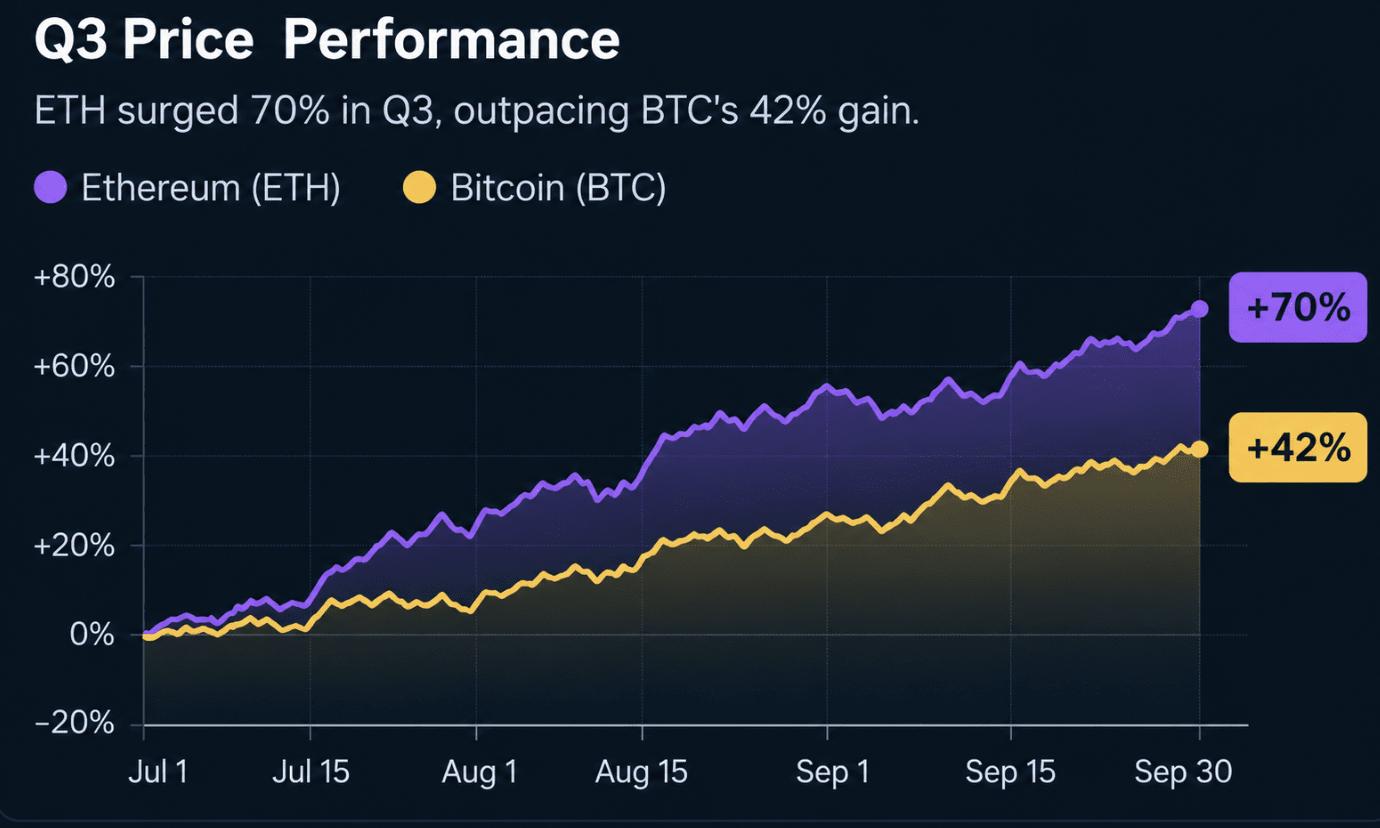
Ether gained approximately 70% in Q3, significantly outperforming Bitcoin's 42% increase.
Despite the rally, ETH's median daily market depth was only 35%–45% of Bitcoin's between July 6 and September 30, according to CoinGecko.
During the same period last year, Ether's market depth was at least 60% of Bitcoin's, pointing to a substantial deterioration in relative liquidity.
ETH maintained around $13 million–$14 million of market depth within 0.15% of its price, suggesting the asset remains relatively liquid for regular trading despite the decline.
Solana liquidity has also deteriorated, while XRP's overall market depth remained comparatively stable.
Ethereum significantly outperformed Bitcoin during the third quarter, but the rally came with an unusual development: ETH market liquidity became thinner rather than deeper.
Ether gained approximately 70% during Q3, compared with Bitcoin's 42% increase.
Despite the stronger price performance, ETH's median daily market depth between July 6 and September 30 stood at only 35% to 45% of Bitcoin's, according to CoinGecko.
During the comparable period last year, Ether's market depth was at least 60% of Bitcoin's.
CoinGecko described the decline as a "stark drop" from last year's levels.
Ethereum Rallies 70% as Market Depth Declines
Market depth measures the total value of buy and sell orders available on exchanges within a specified range of an asset's current market price.
Deeper order books allow larger trades to be executed with less impact on price.
Thinner liquidity means large buy or sell orders can consume available orders more quickly, potentially producing greater price movements and slippage.
For Ether, approximately $13 million to $14 million of liquidity was available within 0.15% of its market price during the period analyzed by CoinGecko.
In practical terms, this represents the amount of nearby liquidity available to absorb trades before ETH's price moves approximately 0.15%.
ETH Liquidity Falls Relative to Bitcoin
The decline is particularly notable because Ether's price was rising rapidly at the same time.
A common market assumption is that strong price performance attracts additional traders, increasing trading activity and ultimately deepening order books.
That relationship did not materialize for Ether during Q3.
Instead, ETH gained approximately 70% while its liquidity remained substantially weaker relative to Bitcoin than a year earlier.
Its median daily market depth fell to 35%–45% of Bitcoin's during the July 6 to September 30 period, compared with at least 60% during the corresponding period last year.
The divergence suggests that ETH's strong Q3 price performance was not accompanied by an equivalent improvement in the market's ability to absorb large trades.
Ether Remains Relatively Liquid Despite Decline
The reduction in market depth does not mean Ether has become illiquid.
CoinGecko said ETH remains "fairly liquid" within 0.15% of its market price, with most exchanges maintaining more than $1 million of depth on each side of their order books.
That means there remains meaningful liquidity available close to the prevailing ETH price.
However, the year-over-year deterioration could make market depth increasingly important during periods of elevated volatility.
Thinner order books generally require less buying or selling pressure to produce larger price movements.
Solana Liquidity Also Falls
Ethereum is not the only major cryptocurrency experiencing thinner market liquidity.
CoinGecko found that overall liquidity for Solana has also declined considerably compared with 2025.
SOL's market depth within 2% of its market price fell from approximately $28 million on each side of the order book last year to around $20 million this year.
Unlike the ETH measurement, which focuses on liquidity immediately surrounding the market price, the 2% SOL measure provides a broader indication of how much buying or selling pressure the market can absorb during larger price moves.
The decline therefore suggests Solana's order books have also become less capable of absorbing significant trading flows without greater price impact.
XRP Market Depth Holds Near $30M
XRP showed a different liquidity pattern.
Its total market depth remained around $30 million, with order books tilted toward buyers during the period analyzed.
CoinGecko recorded approximately $18 million in bids compared with $14 million in asks.
XRP's market capitalization is around 40% larger than Solana's, yet its market depth within 2% of the prevailing price remains lower.
CoinGecko attributed the difference partly to trading activity, noting that SOL generates approximately 25% more average daily trading volume than XRP.
What Thinner Liquidity Means for Ethereum
Ether's Q3 performance highlights an important distinction between price momentum and market liquidity.
ETH's 70% quarterly rally demonstrated strong price performance, but declining market depth means that the underlying order books did not strengthen alongside the rally.
That does not necessarily signal that ETH prices will decline. However, thinner liquidity can amplify moves in either direction because less capital is required to push through available buy or sell orders.
For Ethereum traders, the key takeaway from Q3 is therefore not simply that ETH outperformed Bitcoin by a wide margin, but that it did so while the market became less liquid relative to BTC.