Nikkei Reclaims 70,000, but Half of Stocks Fell That Day—Look Beneath the Surface of This “Bull”
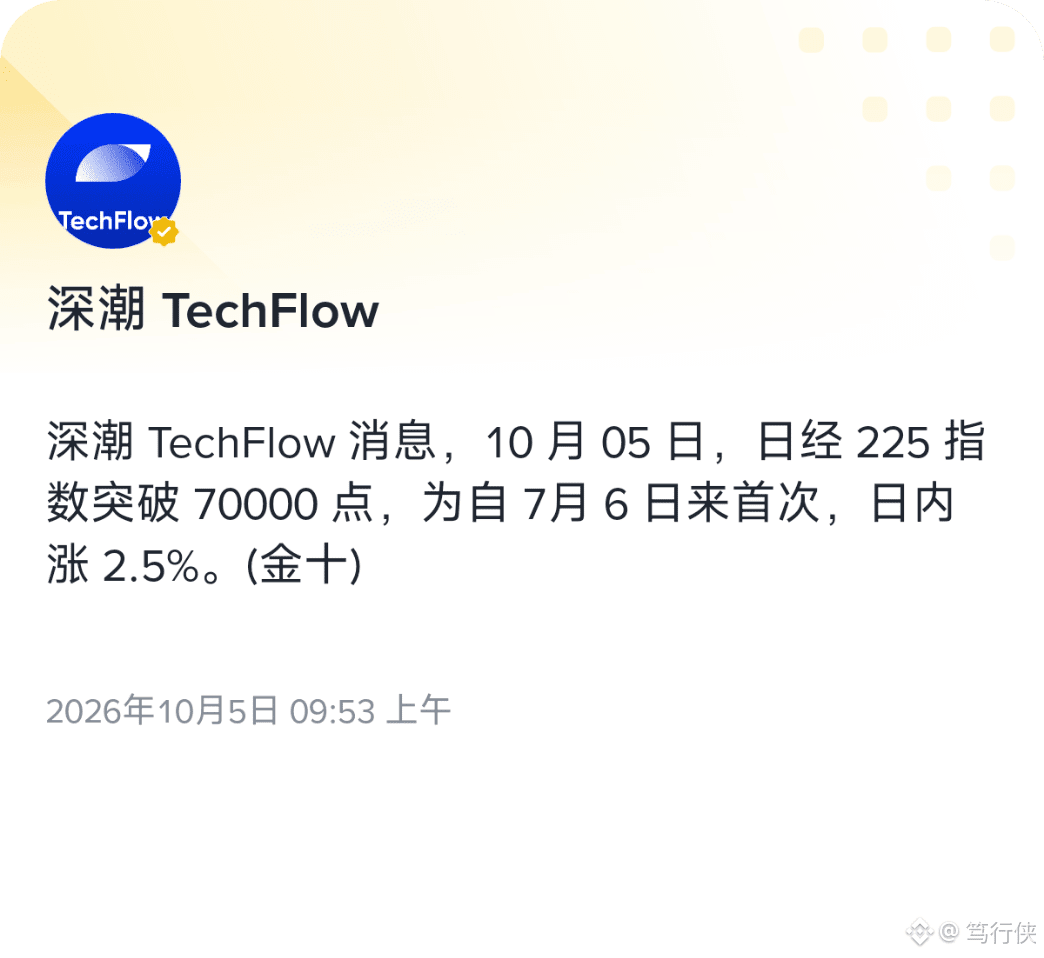
On October 5, the Nikkei 225 broke above 70,000 intraday for the first time since July 6, and closed up 2.40% at 69,946.86. The TOPIX rose 1.33%.
Two details are more worth discussing than the “new high”: First, among the more than 1,500 stocks on the Tokyo Stock Exchange Prime Market, 53% rose and 42% fell. This is an “index bull market,” with gains driven almost entirely by a handful of heavyweight stocks: Advantest (+4.5%, a record high for the second day in a row), Tokyo Electron (+5.7%), SoftBank (+3.68%) and Renesas (+7%). Second, Micron’s earnings beat expectations, but memory giant Kioxia opened higher before plunging, and is still nearly 50% below its June peak. In the words of Resona’s chief strategist: “The AI rally will continue, but the market has become more selective.”
Three drivers: A surprisingly weak US nonfarm payrolls report sent the odds of a rate hike in October down to around 20%, while the Nasdaq hit a record high overnight; South Korea’s markets were closed, funneling Asia-Pacific funds into Tokyo; and Japan is planning a $140 billion AI data center initiative (JERA, Dell and Rhaelm will initially invest $15 billion to build 400 megawatts of capacity). The underlying issue is Japan’s awkward position in computing capacity: 29.2 gigawatts in the US, 8.5 gigawatts in China, and just 1.7 gigawatts in Japan.
Three areas of concern: The 30-year Japanese government bond yield is at 4.235%; Tokyo’s September core CPI hit 2.7%, exceeding the target and fueling expectations of a December Bank of Japan rate hike; and Mitsubishi Corporation’s CEO warned that this could “jeopardize the record-breaking stock market boom.” The Nikkei surged 3.33% on October 1, only to give back the gains the following day.
Near-term momentum is real (the FOMC minutes are due Wednesday), but this is a “rally in AI leaders,” not a “rally in Japanese stocks”—unless market breadth improves, every push higher will depend on a handful of stocks taking turns leading.
Watch the FOMC minutes, the odds of a December BOJ rate hike, and how concentrated trading volume is in AI leaders. Gold at 4,150 and BTC at 86,000 are both pricing in “no rate hike in October,” but the 10-year US Treasury yield is still pinned at 5.3%—don’t mistake a rebound for a reversal.
Risk warning: US long-term rates nearing 6% are an explicit source of downside pressure; if the BOJ raises rates, the effects will spill over into equities; funds may be diverted when South Korean markets reopen; and Taiwan’s 70% year-to-date gain in its weighted index is a reminder of the risks of overheating.
#日经225涨2.5%创三月新高
On October 5, the Nikkei 225 broke above 70,000 intraday for the first time since July 6, and closed up 2.40% at 69,946.86. The TOPIX rose 1.33%.
Two details are more worth discussing than the “new high”: First, among the more than 1,500 stocks on the Tokyo Stock Exchange Prime Market, 53% rose and 42% fell. This is an “index bull market,” with gains driven almost entirely by a handful of heavyweight stocks: Advantest (+4.5%, a record high for the second day in a row), Tokyo Electron (+5.7%), SoftBank (+3.68%) and Renesas (+7%). Second, Micron’s earnings beat expectations, but memory giant Kioxia opened higher before plunging, and is still nearly 50% below its June peak. In the words of Resona’s chief strategist: “The AI rally will continue, but the market has become more selective.”
Three drivers: A surprisingly weak US nonfarm payrolls report sent the odds of a rate hike in October down to around 20%, while the Nasdaq hit a record high overnight; South Korea’s markets were closed, funneling Asia-Pacific funds into Tokyo; and Japan is planning a $140 billion AI data center initiative (JERA, Dell and Rhaelm will initially invest $15 billion to build 400 megawatts of capacity). The underlying issue is Japan’s awkward position in computing capacity: 29.2 gigawatts in the US, 8.5 gigawatts in China, and just 1.7 gigawatts in Japan.
Three areas of concern: The 30-year Japanese government bond yield is at 4.235%; Tokyo’s September core CPI hit 2.7%, exceeding the target and fueling expectations of a December Bank of Japan rate hike; and Mitsubishi Corporation’s CEO warned that this could “jeopardize the record-breaking stock market boom.” The Nikkei surged 3.33% on October 1, only to give back the gains the following day.
Near-term momentum is real (the FOMC minutes are due Wednesday), but this is a “rally in AI leaders,” not a “rally in Japanese stocks”—unless market breadth improves, every push higher will depend on a handful of stocks taking turns leading.
Watch the FOMC minutes, the odds of a December BOJ rate hike, and how concentrated trading volume is in AI leaders. Gold at 4,150 and BTC at 86,000 are both pricing in “no rate hike in October,” but the 10-year US Treasury yield is still pinned at 5.3%—don’t mistake a rebound for a reversal.
Risk warning: US long-term rates nearing 6% are an explicit source of downside pressure; if the BOJ raises rates, the effects will spill over into equities; funds may be diverted when South Korean markets reopen; and Taiwan’s 70% year-to-date gain in its weighted index is a reminder of the risks of overheating.
#日经225涨2.5%创三月新高