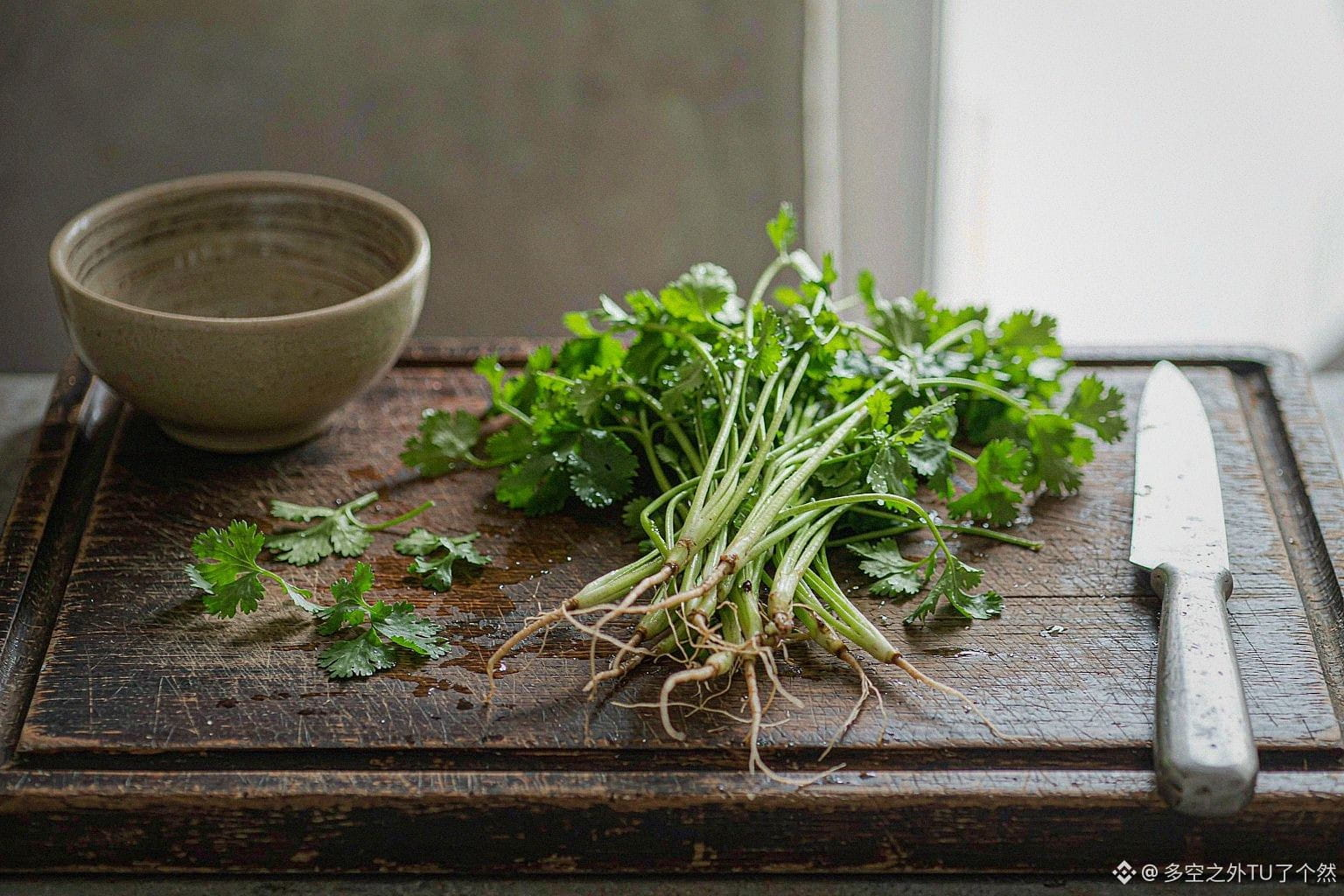
The same plate of cold salad tastes fresh and fragrant to you, but your friend says it tastes like soap?
That’s especially common with cilantro.
In 2012, Nicholas Eriksson’s team at the genetic testing company 23andMe conducted a genome-wide association study of nearly 30,000 people. They found a site in a cluster of olfactory receptor genes on chromosome 11 that was significantly associated with “cilantro tasting like soap” (p = 6.4×10⁻⁹). One gene in that cluster, called OR6A2, encodes a receptor that is particularly sensitive to the aldehydes in cilantro.
Cilantro’s aroma comes mainly from aldehydes. Some have a fruity, green scent; others smell soapy and pungent. Different genotypes shift the balance between the two.
That same year, Mauer and El-Sohemy reported the rates of cilantro aversion among different ethnic groups in the journal *Flavour*: 21% among East Asians, 17% among people of European ancestry, 14% among people of African ancestry, 7% among South Asians, 4% among Latin Americans, and 3% among people from the Middle East.
But it’s not all down to genes. These variants explain less than a tenth of the difference, and heritability is only around 0.087. In other words, repeated exposure—or cooking or chopping the cilantro (enzymes in the leaves gradually convert aldehydes into odorless compounds)—can help you acquire a taste for it.
That cilantro hater you know might just switch sides one day.
That’s especially common with cilantro.
In 2012, Nicholas Eriksson’s team at the genetic testing company 23andMe conducted a genome-wide association study of nearly 30,000 people. They found a site in a cluster of olfactory receptor genes on chromosome 11 that was significantly associated with “cilantro tasting like soap” (p = 6.4×10⁻⁹). One gene in that cluster, called OR6A2, encodes a receptor that is particularly sensitive to the aldehydes in cilantro.
Cilantro’s aroma comes mainly from aldehydes. Some have a fruity, green scent; others smell soapy and pungent. Different genotypes shift the balance between the two.
That same year, Mauer and El-Sohemy reported the rates of cilantro aversion among different ethnic groups in the journal *Flavour*: 21% among East Asians, 17% among people of European ancestry, 14% among people of African ancestry, 7% among South Asians, 4% among Latin Americans, and 3% among people from the Middle East.
But it’s not all down to genes. These variants explain less than a tenth of the difference, and heritability is only around 0.087. In other words, repeated exposure—or cooking or chopping the cilantro (enzymes in the leaves gradually convert aldehydes into odorless compounds)—can help you acquire a taste for it.
That cilantro hater you know might just switch sides one day.