


Key Takeaways
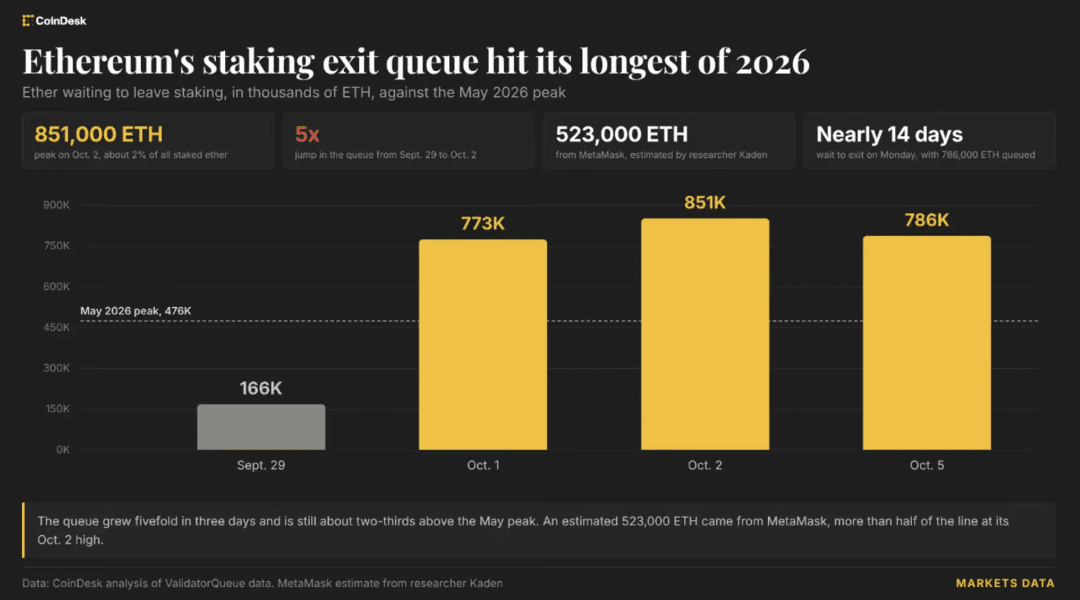
Ethereum's staking exit queue surged from roughly 166,000 ETH on September 29 to 851,000 ETH on October 2, its longest withdrawal wait of 2026.
Around 786,000 ETH worth more than $2 billion remained in the exit queue as of Monday morning in Asia, with an estimated wait of nearly 14 days.
Much of the increase followed MetaMask's precautionary withdrawal of validators after a security incident affecting part of its staking infrastructure.
An Ethereum security researcher estimated the MetaMask-related exits involved around 17,000 validators holding approximately 523,000 ETH, although MetaMask has not confirmed those figures.
Meanwhile, Ethereum's staking entry queue has fallen from around 2 million ETH in early September to 1.5 million ETH, indicating that new staking demand has also cooled.
Ethereum's staking exit queue has climbed to its highest level of 2026, leaving investors facing a wait of nearly two weeks to remove ETH from the network's validator system.
Ether waiting to exit staking increased more than fivefold in just three days last week, rising from approximately 166,000 ETH on September 29 to around 851,000 ETH by October 2.
The spike followed precautionary validator exits by MetaMask after a security incident involving part of its staking infrastructure.
By Monday morning in Asia, approximately 786,000 ETH worth just over $2 billion was still waiting to exit, with the estimated queue time approaching 14 days.
Ethereum Staking Exit Queue Surges Fivefold
The roughly 851,000 ETH waiting to exit on October 2 represented approximately 2% of the 43.6 million ETH currently staked.
It also substantially exceeded the roughly 476,000 ETH recorded during a previous increase in withdrawal demand in May.
Ethereum deliberately limits the number of validators that can enter or leave its staking system at any given time to protect network stability.
At current limits, approximately 57,600 ETH can enter staking and another 57,600 ETH can exit each day.
When demand exceeds those limits, validators are placed into queues. ETH leaving the validator set must also complete a separate withdrawal process before becoming available in its owners' wallets.
MetaMask Validator Exits Drive Much of the Increase
The latest surge does not necessarily indicate that Ethereum holders broadly are rushing to unstake their ETH.
Most of the increase has been linked to MetaMask, which operates validators for liquid staking protocol Lido in addition to its cryptocurrency wallet services.
MetaMask disclosed a security incident on September 30 and subsequently began taking affected validators out of service as a precaution.
An October 1 update said its investigation had found no indication that customer wallets or funds were affected.
Ethereum security researcher Kaden estimated that the precautionary action covered around 17,000 validators holding approximately 523,000 ETH. MetaMask has not confirmed those figures.
If accurate, that amount would account for a substantial portion of the increase in Ethereum's exit queue.
Lido Expects ETH to Return to Staking
The MetaMask-related withdrawals could ultimately prove temporary rather than representing a permanent reduction in staked ETH.
Lido expects the affected Ether to gradually return to staking after the validators exit, their balances are withdrawn and the assets re-enter the staking process.
The entire process could take up to approximately 45 days, during which affected validators will miss staking rewards while they remain out of service.
Lido has said that no action is required from holders of stETH, its liquid staking token.
The protocol expects the final affected MetaMask validators to stop staking by October 7, after which the withdrawn ETH can begin the process of entering staking again.
Ethereum Staking Entry Demand Also Cools
While the exit queue surge is largely linked to the MetaMask incident, Ethereum is simultaneously experiencing a separate slowdown in demand from new validators.
Approximately 1.5 million ETH worth around $4 billion was waiting to enter staking as of Monday morning.
That compares with around 2 million ETH in early September, representing a decline of roughly 25%.
The estimated entry wait has also fallen from around 35 days in early September to approximately 25 days.
The decline suggests that demand to add new ETH to Ethereum's validator set has moderated even as the network continues to maintain a substantial entry backlog.
What Ethereum's Two Staking Queues Signal
The current staking data presents two different trends.
The sharp increase in Ethereum's exit queue is primarily associated with an operational event involving MetaMask validators and could reverse as those assets return to staking.
The decline in the entry queue, however, reflects a broader moderation in the amount of ETH currently waiting to begin earning staking rewards.
For that reason, the record 2026 exit queue should not necessarily be interpreted as evidence of widespread bearish sentiment among ETH holders.
The more significant longer-term indicator may be whether the 1.5 million ETH entry queue continues to decline after the MetaMask-related validators complete their exit and begin returning to Ethereum's staking system.