【CJ Advanced Series, Part 03/30 · No. 31 overall】
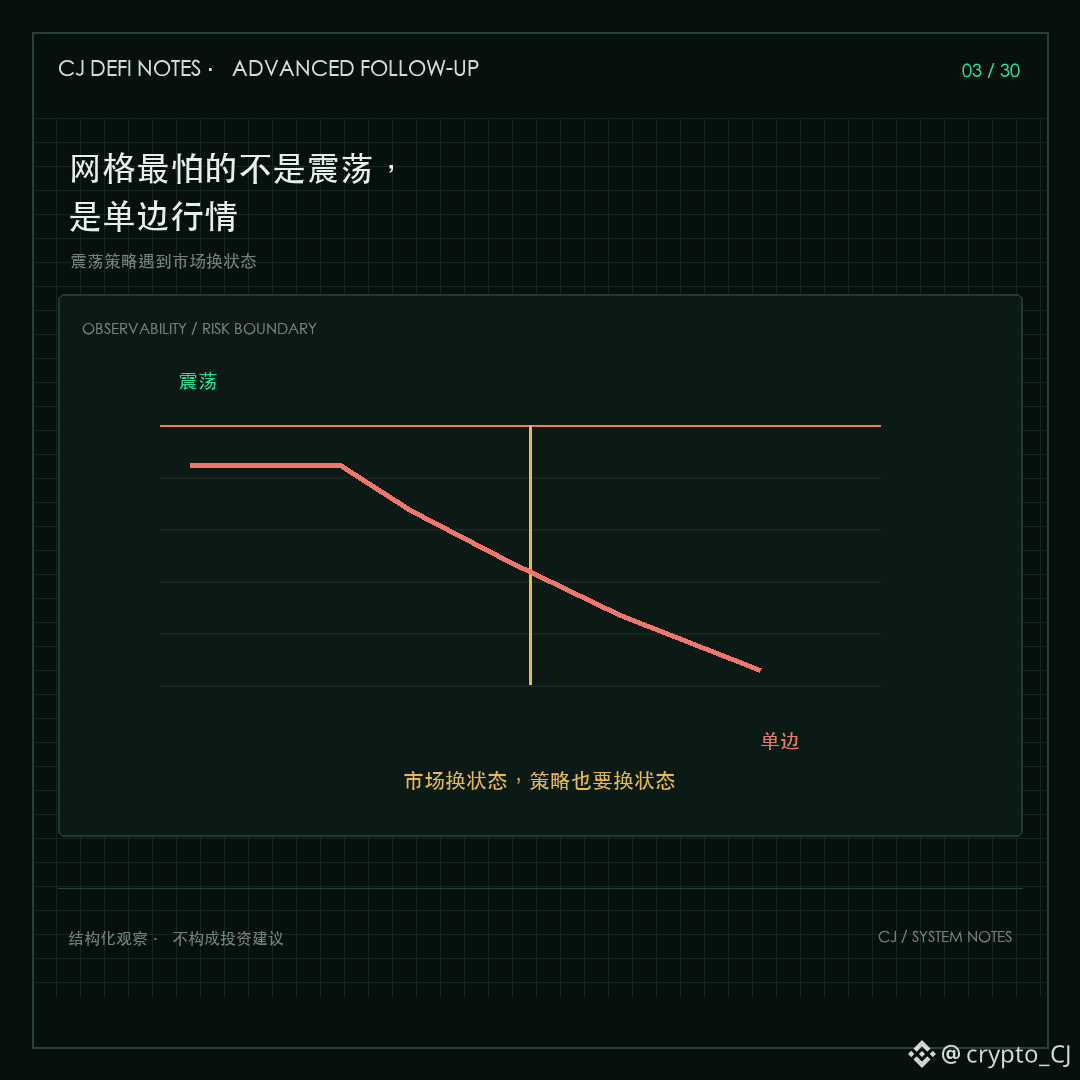
Grid trading is very active in a choppy market. But once the market moves in only one direction, that activity can turn into continuously accumulating inventory.
Grid profits come from prices moving back and forth across adjacent levels. The problem is that a range prices have crossed repeatedly in the past is not guaranteed to be revisited next time. In a one-way decline, buy orders fill level by level, while the corresponding sell orders keep waiting. What accumulates in the account is not “a chance to buy at a bargain,” but an ever-larger position in the same direction.
Many people interpret “buy more as the price falls” as lowering their cost basis, but forget that as the cost basis falls, their directional exposure increases too. If the market keeps moving that way, the grid stops trading volatility and becomes a passive holding strategy.
For example, even if buy orders keep filling in both cases, a back-and-forth move within a range creates a different inventory profile from a sustained decline. The former may have corresponding sell orders; the latter may leave you with nothing but buys. When reviewing performance, separate realized grid profits from the unrealized changes in inventory still held, so local gains don’t obscure the overall risk.
So you can’t assess a grid strategy by its backtest curve alone. You also need to consider one-way market scenarios: how far inventory could accumulate, when to stop placing additional orders, which orders need to be canceled, and how to exit in the end. The most important parameter in a range-bound strategy often isn’t how tight the grid is, but when it recognizes that the market has shifted regimes.
Next: Why is margin already getting tight when the price hasn’t fallen much?
#网格策略 #MarketStructure
Grid trading is very active in a choppy market. But once the market moves in only one direction, that activity can turn into continuously accumulating inventory.
Grid profits come from prices moving back and forth across adjacent levels. The problem is that a range prices have crossed repeatedly in the past is not guaranteed to be revisited next time. In a one-way decline, buy orders fill level by level, while the corresponding sell orders keep waiting. What accumulates in the account is not “a chance to buy at a bargain,” but an ever-larger position in the same direction.
Many people interpret “buy more as the price falls” as lowering their cost basis, but forget that as the cost basis falls, their directional exposure increases too. If the market keeps moving that way, the grid stops trading volatility and becomes a passive holding strategy.
For example, even if buy orders keep filling in both cases, a back-and-forth move within a range creates a different inventory profile from a sustained decline. The former may have corresponding sell orders; the latter may leave you with nothing but buys. When reviewing performance, separate realized grid profits from the unrealized changes in inventory still held, so local gains don’t obscure the overall risk.
So you can’t assess a grid strategy by its backtest curve alone. You also need to consider one-way market scenarios: how far inventory could accumulate, when to stop placing additional orders, which orders need to be canceled, and how to exit in the end. The most important parameter in a range-bound strategy often isn’t how tight the grid is, but when it recognizes that the market has shifted regimes.
Next: Why is margin already getting tight when the price hasn’t fallen much?
#网格策略 #MarketStructure