SAND at $0.072—are you chasing it?
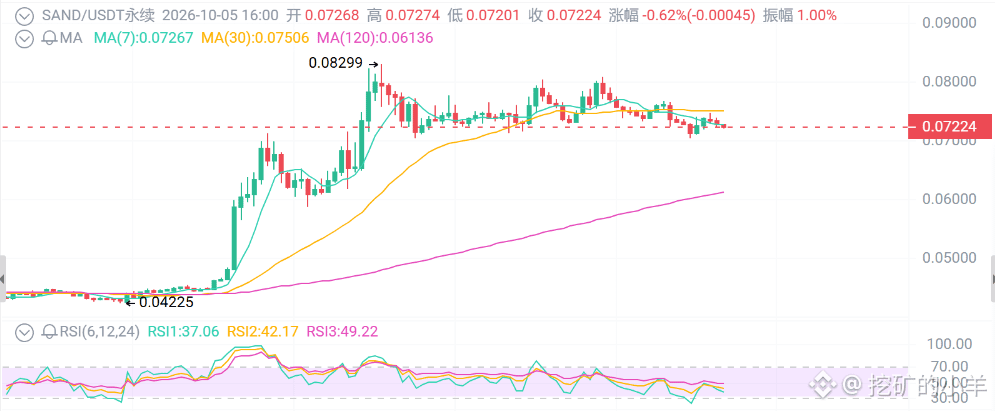
First, the surface-level picture: SAND was at $0.044 on October 1, surged to $0.074 on October 2, touched $0.084 on October 3, then pulled back steadily to $0.072. Trading volume briefly exploded to around $900 million—dozens of times its usual level. The candlesticks tell you that $0.070–$0.071 is today's low zone, while $0.064–$0.066 is the breakout retest zone. The RSI has retreated from overbought territory, and the 4-hour chart looks weak. The spike has been sold off as traders take profits. Don't try to catch a falling knife halfway down.
First: The real reason behind this rally isn't the metaverse's comeback
A lot of people see SAND double in three days and immediately think, “The metaverse is coming back to life.” Let me tell you: wake up.
The real reason is that South Korean exchanges lifted their trading warnings.
In August, SAND's cross-chain bridge was hacked. The attacker minted a massive amount of fake tokens out of thin air on Base and drained 14.75 million genuine ETH. Upbit, Bithumb, and Coinone all issued trading warnings, leaving South Korean retail traders unable to buy or sell.
The warnings were lifted on October 2, and liquidity from Korean markets instantly bounced back. SAND rose as much as 79% in a single day.
Second: The Studio launch is a narrative, but it hasn't delivered yet
The project says the closed beta ran for 3.5 months, with more than 100 creators making over 100 games. It integrated AI asset-generation tools such as Meshy and Scenario, and aims to launch the public version this month, with distribution across the web, mobile, and Telegram.
But it hasn't launched publicly yet, and it hasn't proved that it can bring in sustained buying. The narrative is about the medium term; the price is about today.
Third: The fundamentals haven't improved—the warning label has simply been removed
There are 3 billion tokens in total, with 2.94 billion in circulation—almost the entire supply—so there's virtually no scarcity premium. Its uses are still in-game payments, governance, staking, and creator incentives.
It's down about 73% over the past year. The narrative has shifted from the metaverse to AI gaming tools, but it hasn't generated revenue yet.
It's only been a little over a month since the bridge security incident, and cross-chain trust hasn't fully recovered.
Nearly the entire supply is already circulating. The rally is driven by leverage and Korean-market trading, not by tokens being locked up.
The fundamentals haven't improved. The price improved because the selling-pressure warning label was removed.
Trading strategies
Aggressive:
Around $0.072, consider only a small long position, with a stop-loss at $0.0695. First target: $0.077; second target: $0.080. Take half off at $0.077.
Conservative:
Wait for $0.064–$0.066 before considering an entry, with a stop-loss at $0.058. A better entry zone would be $0.055–$0.060.
Breakout strategy:
Only consider chasing if price breaks above and holds $0.084 on strong volume, then retests $0.077 without breaking below it. Targets: $0.095–$0.10. Skip it if the breakout is fake.
Short side:
If SAND struggles to push higher in the $0.078–$0.082 range, consider a small short on a pullback, with a stop-loss at $0.086 and targets at $0.070 and $0.064.
First, the surface-level picture: SAND was at $0.044 on October 1, surged to $0.074 on October 2, touched $0.084 on October 3, then pulled back steadily to $0.072. Trading volume briefly exploded to around $900 million—dozens of times its usual level. The candlesticks tell you that $0.070–$0.071 is today's low zone, while $0.064–$0.066 is the breakout retest zone. The RSI has retreated from overbought territory, and the 4-hour chart looks weak. The spike has been sold off as traders take profits. Don't try to catch a falling knife halfway down.
First: The real reason behind this rally isn't the metaverse's comeback
A lot of people see SAND double in three days and immediately think, “The metaverse is coming back to life.” Let me tell you: wake up.
The real reason is that South Korean exchanges lifted their trading warnings.
In August, SAND's cross-chain bridge was hacked. The attacker minted a massive amount of fake tokens out of thin air on Base and drained 14.75 million genuine ETH. Upbit, Bithumb, and Coinone all issued trading warnings, leaving South Korean retail traders unable to buy or sell.
The warnings were lifted on October 2, and liquidity from Korean markets instantly bounced back. SAND rose as much as 79% in a single day.
Second: The Studio launch is a narrative, but it hasn't delivered yet
The project says the closed beta ran for 3.5 months, with more than 100 creators making over 100 games. It integrated AI asset-generation tools such as Meshy and Scenario, and aims to launch the public version this month, with distribution across the web, mobile, and Telegram.
But it hasn't launched publicly yet, and it hasn't proved that it can bring in sustained buying. The narrative is about the medium term; the price is about today.
Third: The fundamentals haven't improved—the warning label has simply been removed
There are 3 billion tokens in total, with 2.94 billion in circulation—almost the entire supply—so there's virtually no scarcity premium. Its uses are still in-game payments, governance, staking, and creator incentives.
It's down about 73% over the past year. The narrative has shifted from the metaverse to AI gaming tools, but it hasn't generated revenue yet.
It's only been a little over a month since the bridge security incident, and cross-chain trust hasn't fully recovered.
Nearly the entire supply is already circulating. The rally is driven by leverage and Korean-market trading, not by tokens being locked up.
The fundamentals haven't improved. The price improved because the selling-pressure warning label was removed.
Trading strategies
Aggressive:
Around $0.072, consider only a small long position, with a stop-loss at $0.0695. First target: $0.077; second target: $0.080. Take half off at $0.077.
Conservative:
Wait for $0.064–$0.066 before considering an entry, with a stop-loss at $0.058. A better entry zone would be $0.055–$0.060.
Breakout strategy:
Only consider chasing if price breaks above and holds $0.084 on strong volume, then retests $0.077 without breaking below it. Targets: $0.095–$0.10. Skip it if the breakout is fake.
Short side:
If SAND struggles to push higher in the $0.078–$0.082 range, consider a small short on a pullback, with a stop-loss at $0.086 and targets at $0.070 and $0.064.