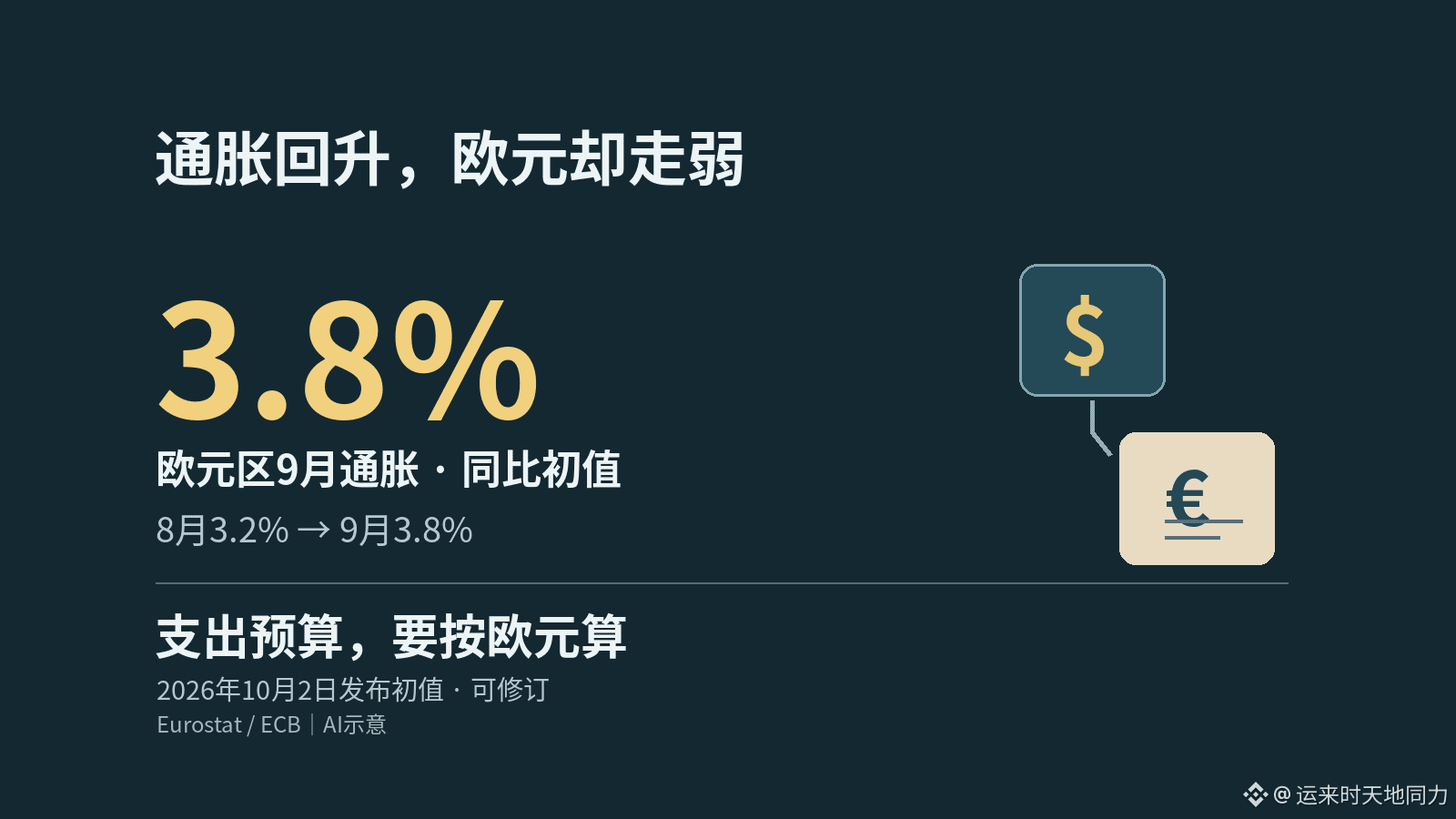
The Eurozone’s inflation preliminary reading for September rose to 3.8%. On October 2—the day the preliminary data was released—the euro reference rate against the U.S. dollar was still moving lower. For people holding U.S.-dollar stablecoins and also spending in euros, you should look separately at the face value of the dollars in your account and the bills you can actually pay.
On October 2, the EU’s statistical office (Eurostat) reported that the year-on-year price increase in September was higher than in August, rising to 3.2%. Energy price increases were especially notable, and service prices also saw a wider year-on-year rise. But this kind of pressure does not necessarily mean business is getting better: when energy costs become more expensive, it may raise companies’ costs, and after households pay their bills, the money left over could also shrink.
The European Central Bank (ECB) has already raised interest rates in September, but it still needs to judge how long this round of cost increases will last, and whether it will continue to feed through into wages and other prices. Higher interest rates may support the euro; however, economic growth pressure, changes on the U.S. dollar side, and shifts in capital flows will also affect the exchange rate. You can’t just look at the inflation numbers and jump to the conclusion that the euro will rise.
As of 13:58 Beijing time on October 5, the ECB’s most recently released figure is still the reference exchange rate from October 2. It shows another side: using the ECB’s same day-based methodology, the dollar per euro on October 2 fell by about 0.65% compared with the previous trading day, and the previous day also fell by about 0.50%. This is the change in the reference rate, not a tradable quote. Those concurrent facts also cannot prove that inflation is the cause of the euro’s decline.
Zooming in on existing positions: if a U.S.-dollar stablecoin continues to hold its dollar value, when the euro weakens, the same amount of dollars can be exchanged for more euros; when the euro strengthens, it’s the opposite. But bills themselves may also be subject to price increases—getting more euros doesn’t necessarily mean you can buy more things. Therefore, for anyone paying euro rent or procurement costs, when budgeting you need to look at the final euro amount, not just the stablecoin quantity. Conversion fees and de-anchoring (loss of peg) risk must be considered separately.
What can be confirmed for now is that rising price pressures and a weakening euro are occurring at the same time. If the euro strengthens later, your spending budget will need to be recalculated accordingly. If revisions to the official inflation data change the rebound magnitude, you must also update your assessment of policy pressure. This period’s downside move cannot be directly extrapolated into the direction of the next step.
Source: Eurostat preliminary reading on October 2; ECB policy statement and daily reference exchange rate
#宏观经济分析 #稳定币
On October 2, the EU’s statistical office (Eurostat) reported that the year-on-year price increase in September was higher than in August, rising to 3.2%. Energy price increases were especially notable, and service prices also saw a wider year-on-year rise. But this kind of pressure does not necessarily mean business is getting better: when energy costs become more expensive, it may raise companies’ costs, and after households pay their bills, the money left over could also shrink.
The European Central Bank (ECB) has already raised interest rates in September, but it still needs to judge how long this round of cost increases will last, and whether it will continue to feed through into wages and other prices. Higher interest rates may support the euro; however, economic growth pressure, changes on the U.S. dollar side, and shifts in capital flows will also affect the exchange rate. You can’t just look at the inflation numbers and jump to the conclusion that the euro will rise.
As of 13:58 Beijing time on October 5, the ECB’s most recently released figure is still the reference exchange rate from October 2. It shows another side: using the ECB’s same day-based methodology, the dollar per euro on October 2 fell by about 0.65% compared with the previous trading day, and the previous day also fell by about 0.50%. This is the change in the reference rate, not a tradable quote. Those concurrent facts also cannot prove that inflation is the cause of the euro’s decline.
Zooming in on existing positions: if a U.S.-dollar stablecoin continues to hold its dollar value, when the euro weakens, the same amount of dollars can be exchanged for more euros; when the euro strengthens, it’s the opposite. But bills themselves may also be subject to price increases—getting more euros doesn’t necessarily mean you can buy more things. Therefore, for anyone paying euro rent or procurement costs, when budgeting you need to look at the final euro amount, not just the stablecoin quantity. Conversion fees and de-anchoring (loss of peg) risk must be considered separately.
What can be confirmed for now is that rising price pressures and a weakening euro are occurring at the same time. If the euro strengthens later, your spending budget will need to be recalculated accordingly. If revisions to the official inflation data change the rebound magnitude, you must also update your assessment of policy pressure. This period’s downside move cannot be directly extrapolated into the direction of the next step.
Source: Eurostat preliminary reading on October 2; ECB policy statement and daily reference exchange rate
#宏观经济分析 #稳定币