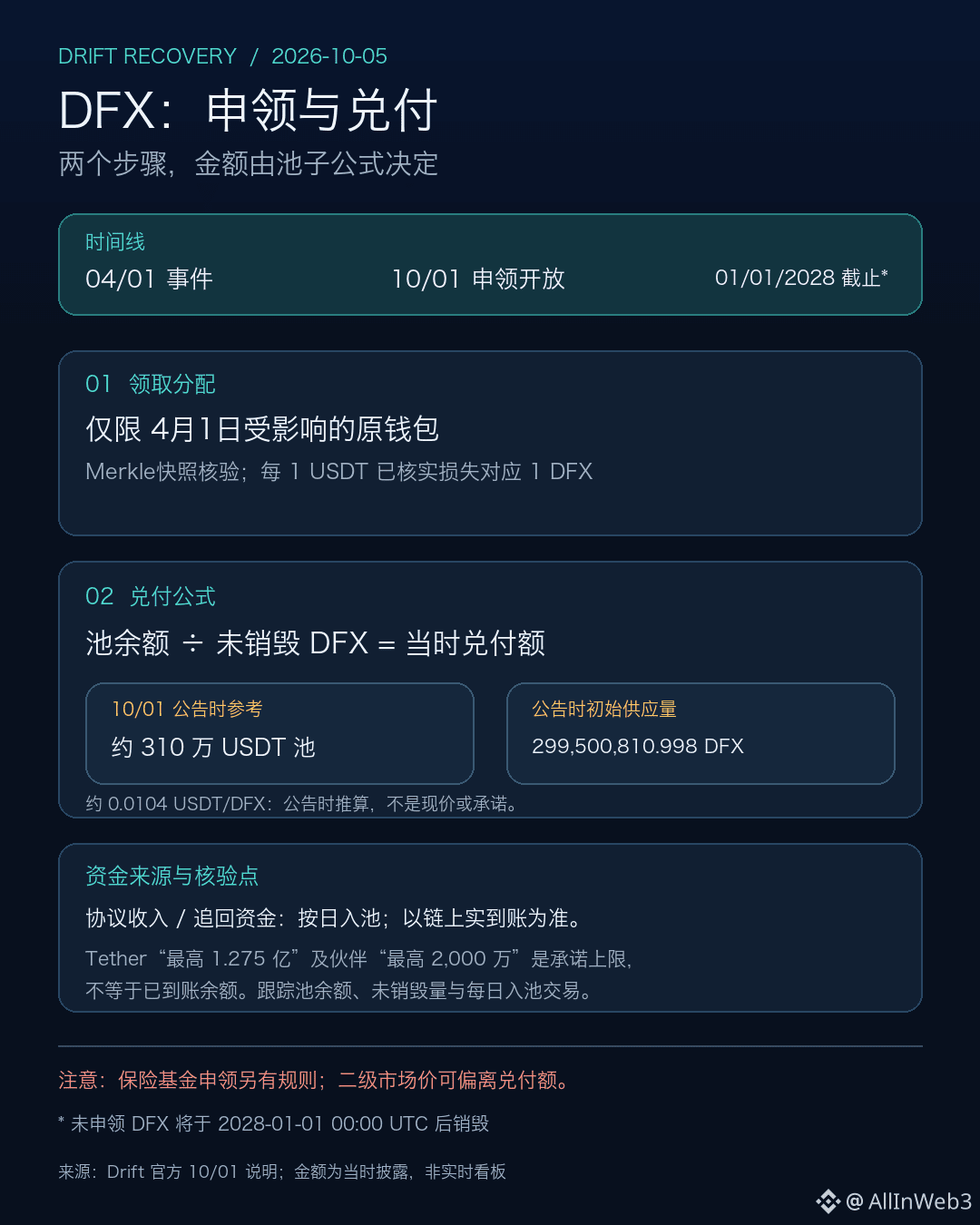
Users affected by Drift have started to claim, but “getting the DFX” does not mean you are receiving an equal amount of USDT back. What truly determines payouts is the Recovery Pool balance divided by the number of DFX that has not yet been destroyed.
Be clear on the timeline: the event occurred on April 1. On October 1, Drift officially announced that the DFX claim and redemption window would open, with the deadline being January 1, 2028 at 00:00 UTC. Eligibility is based on a loss snapshot of affected wallets at the time of the event and a Merkle proof. For each verified $1 USDT of loss, there is 1 DFX. Other wallets that can’t show an allocation doesn’t mean the loss wasn’t recorded.
Claiming and redeeming are two separate steps. First, wallets that qualify under the snapshot receive DFX. After that, you can exchange the DFX for USDT at the redemption amount at the time and then destroy the DFX. Drift disclosed in its opening announcement that the pool contains approximately 3.1 million USDT, with an initial supply of roughly 299.5 million DFX, translating to about 0.0104 USDT per DFX. This is the reference figure from the October 1 announcement—not today’s real-time amount, and not a guarantee of any particular recovery ratio. The public page does not display current personal allocations or real-time redemption figures, and we do not have access to verify wallets.
You also need to read the future fund flow accurately: net protocol revenue is injected on a daily basis, and recovered funds enter the pool. Tether’s “up to 127.5 million USDT” and the strategic partner’s “up to 20 million USDT” are commitment caps and cannot be treated as already received. You should observe the pool-entering transactions on the public chain, the pool balance, and the amount of DFX supply that has not yet been destroyed. After DFX is destroyed due to claims or redemptions, the share of DFX remaining that will be distributed from future pool inflows will change. However, the secondary market price may still deviate from the redemption value.
Another easy-to-confuse point: the insurance fund has its own independent claim rules and is not a DFX loss token. Finally, look at the pool balance from the public dashboard together with the time of collection—historical disclosed values cannot be mistaken for the current balance. Third-party screenshots also can’t prove that a given address already has an allocation. The core of this topic isn’t to add up committed amounts; it’s to verify the actual pool inflows and redemption formulas entry by entry. #Drift
Be clear on the timeline: the event occurred on April 1. On October 1, Drift officially announced that the DFX claim and redemption window would open, with the deadline being January 1, 2028 at 00:00 UTC. Eligibility is based on a loss snapshot of affected wallets at the time of the event and a Merkle proof. For each verified $1 USDT of loss, there is 1 DFX. Other wallets that can’t show an allocation doesn’t mean the loss wasn’t recorded.
Claiming and redeeming are two separate steps. First, wallets that qualify under the snapshot receive DFX. After that, you can exchange the DFX for USDT at the redemption amount at the time and then destroy the DFX. Drift disclosed in its opening announcement that the pool contains approximately 3.1 million USDT, with an initial supply of roughly 299.5 million DFX, translating to about 0.0104 USDT per DFX. This is the reference figure from the October 1 announcement—not today’s real-time amount, and not a guarantee of any particular recovery ratio. The public page does not display current personal allocations or real-time redemption figures, and we do not have access to verify wallets.
You also need to read the future fund flow accurately: net protocol revenue is injected on a daily basis, and recovered funds enter the pool. Tether’s “up to 127.5 million USDT” and the strategic partner’s “up to 20 million USDT” are commitment caps and cannot be treated as already received. You should observe the pool-entering transactions on the public chain, the pool balance, and the amount of DFX supply that has not yet been destroyed. After DFX is destroyed due to claims or redemptions, the share of DFX remaining that will be distributed from future pool inflows will change. However, the secondary market price may still deviate from the redemption value.
Another easy-to-confuse point: the insurance fund has its own independent claim rules and is not a DFX loss token. Finally, look at the pool balance from the public dashboard together with the time of collection—historical disclosed values cannot be mistaken for the current balance. Third-party screenshots also can’t prove that a given address already has an allocation. The core of this topic isn’t to add up committed amounts; it’s to verify the actual pool inflows and redemption formulas entry by entry. #Drift