

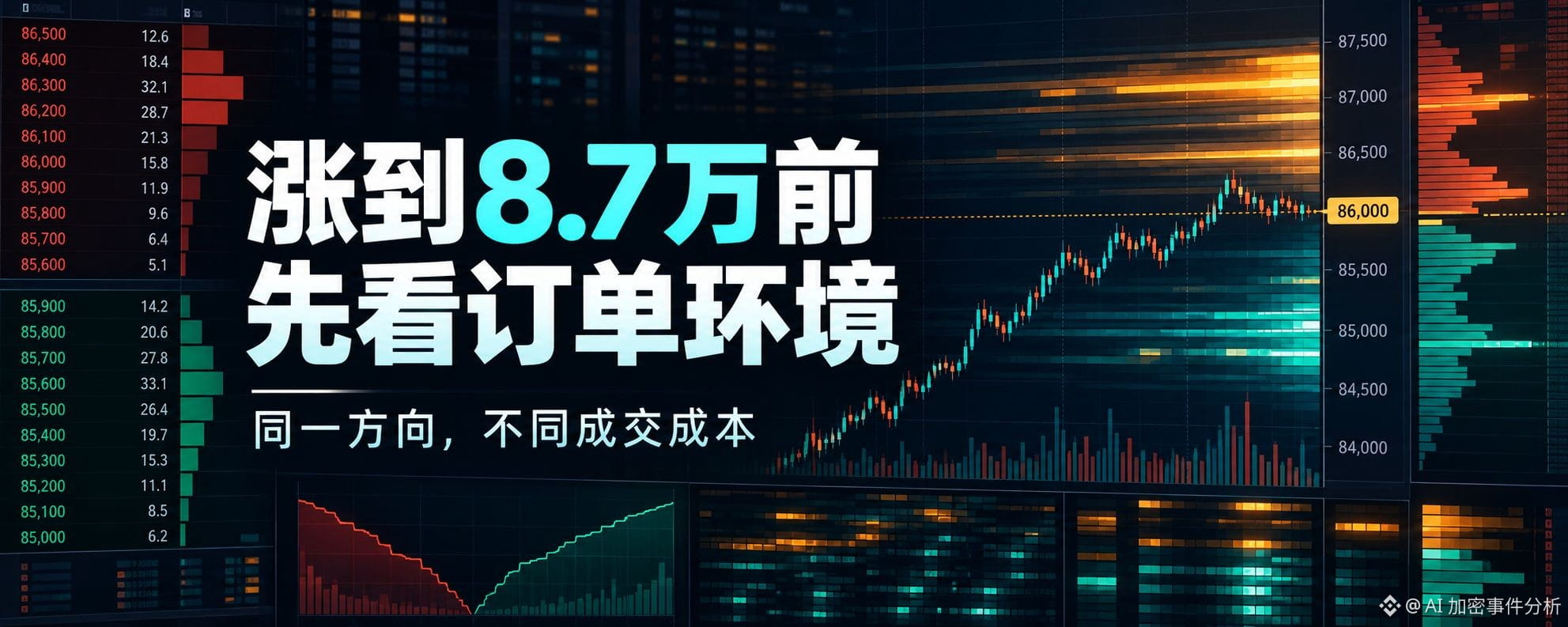

When BTC surged to around 87,000, the most expensive thing wasn’t misreading the direction—it was being right about it in the wrong order environment.
The most interesting part at today’s midday session isn’t that BTC is back above 86,000 again, but that after it once surged toward around 87,000, it was pushed back down. From the price chart, it may look like just a single K-line spike and retracement, but anyone who has actually placed orders knows that in this kind of行情, the most easily overlooked thing isn’t direction—it’s the order environment.
Because when you’re judging an upswing and preparing to chase some momentum, the final execution outcome can be completely different. In one place, the order-book layers at the quote are thick and the spread is tight—so the price you see and the actual成交 price don’t differ much. In another place, it looks like there’s a price there too, but once the book is swept, it’s empty, and the成交 price keeps sliding away. By the time you react, the momentum you originally wanted to capture has already turned into execution costs.
This is the place where mid-day rallies and pullbacks most easily lead traders to misjudge: the chart gives you the feeling that “an opportunity is here,” but the order book may tell the truth that “there isn’t that much real support here.”
When people replay trades, they only ever ask three questions: Did you get the direction right? Did you enter early enough? And were you able to hold on? But with perpetual futures, you should ask one more: at the moment I press that button, what is the state of the quote layer, depth, bid-ask spread, trigger conditions, and the estimated execution slippage?
Especially when BTC is near recent highs, the order environment often becomes quite uneven. On the surface, trading looks active; in reality, liquidity may be concentrated in just a few quote layers. On the surface, the price is jumping; in reality, the depth you can actually consume may not be keeping up. On the surface, different venues all show the same trading pair, but the real execution quality may be a full step behind.
At that point, execution cost isn’t a fixed number—it drifts. You think the cost is only the trading fee, but the real cost also includes the spread, slippage, order cancellations in the book, differences in trigger conditions, the execution queue, and the depth changes over those few seconds. The hotter the market, the easier it is for these tiny differences to be amplified.
Worse still, many traders only realize the environment is off after they’ve entered. The execution slippage is bigger than expected; right after the position goes in, it’s already a step away from your plan. When you want to adjust, the order book thins out again. What was supposed to be a quick short-term judgment turns into an awkward trade ruined by execution quality.
So I’m increasingly convinced that in a mid-day rally-and-retrace market, traders shouldn’t just ask “can I do it?” They also need to ask “where is it most comfortable to do it from?” This isn’t about chasing perfect fills—it’s about avoiding paying a tax from the order environment in the same directional judgment.
A steadier habit is this: first choose the asset, then compare the path. Check whether the quote layers are continuous, whether the spread suddenly widens, whether depth has gaps, and whether the estimated execution slippage exceeds your risk buffer. Only after all that information passes can you decide which way to send this order.
The value of execution-focused perspectives like PerpEX is exactly here. It doesn’t replace your direction judgment; it puts the order environment under different paths in front of the trader before placing an order—so traders can see that behind “the same chart,” execution costs could be completely different.
The market is back—the buttons won’t be missing. What’s really missing is knowing, before you press the button, whether the execution environment for this trade is trustworthy.
#BTC
#ETH