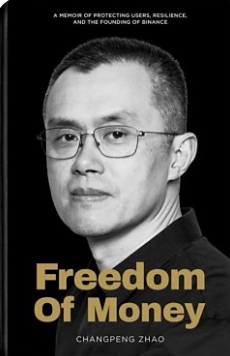

I just finished reading CZ’s autobiography (Binance Life). This book is really special. Most of it was written during the four months he spent serving his sentence in the United States—366 pages, not a dull investment textbook, but a memoir about growth, entrepreneurship, crises, and reflection.
What moved me most about this book isn’t how big CZ once became, nor how close Binance came to the global power center. It’s that in the four months when he experienced the biggest gap in his life, he re-examined his entire life again and again.
The story starts with CZ’s childhood. Raised in rural Jiangsu, he moved to Canada with his family in his teens. He worked a variety of odd jobs, and after graduating, worked on trading systems at Bloomberg and the Tokyo Stock Exchange—getting into finance very early. In 2013, he encountered Bitcoin, directly sold his house to buy in, and bet on this new track. In 2017, he founded Binance. With a small team, the company took off quickly: the whitepaper was written in three days, and within half a year it became the exchange with the highest global trading volume, with BNB being born right alongside it. The book also reveals a lot of inside stories from the industry: timely relocation before the 94 debacle, refusing to pay exorbitant coin-listing fees, his power play with SBF, and his first-person recap of the FTX collapse—writing out, in plain terms, his internal thoughts during that major industry earthquake at the time.
The book’s central theme is captured in its title, Freedom of Money: sovereignty and freedom over your money. CZ believes crypto’s original purpose wasn’t to make people rich through speculation, but to let ordinary people truly control their own assets, break through the barriers of traditional finance, help users in emerging markets withstand local currency depreciation, and solve cross-border payment challenges. But he also candidly acknowledges that Binance’s rapid expansion left major compliance gaps that ultimately came back to haunt him. At its peak, the platform had 300 million users; later, it faced regulatory lawsuits and paid enormous fines. Having experienced both the highs and the lows firsthand, he brings to life one of the book’s most striking aspects.
Many people treat this book as a success manual, but I came away feeling it was more of a firsthand account of survival in the industry. Everyone can make money in a bull market; the real challenge is making it through both bull and bear markets, avoiding black swan events, and holding on to your principles. When markets are euphoric, all people see are rags-to-riches stories. It’s only when a bear market hits that they understand the importance of risk management and respecting market cycles.
The book’s most clear-eyed passages aren’t about victory, but about the price of victory.
When a platform has tens of millions, or even hundreds of millions, of users, and its liquidity is enough to affect global markets, it’s no longer just a “technology product”—it’s public financial infrastructure. Many people can’t grasp this in a bull market. Only when regulation, lawsuits, fines, and restrictions actually arrive do they suddenly understand: freedom has boundaries, and expansion doesn’t automatically mean safety.
My biggest takeaway is this: crypto has never lacked for people willing to take big risks. What it lacks are people who live long enough to finish telling their stories.
Many people see only that CZ sold his home to buy Bitcoin, that Binance grew from nothing to become the world’s largest, and that BNB went from an early-stage asset to the core of the platform’s ecosystem. Few stop to consider how much luck was involved along the way—and how much risk he took on. The window of opportunity in crypto is very narrow. Some people seize it; some seize it only to lose it again; and some are swallowed by the market before they’ve even figured out the rules.
This book made me rethink three things:
1. “Freedom” doesn’t mean escaping the rules; it means understanding them first
Early on, CZ championed crypto freedom and truly helped advance asset sovereignty. But he later realized that genuine freedom can’t be built on gray areas. When the user base is small, innovation can involve rapid trial and error. But once the user base reaches a certain scale, any vulnerability, black swan event, or regulatory action can become a systemic risk.
So freedom doesn’t mean doing whatever you want. It means knowing what you shouldn’t do—and still choosing to move forward.
2. Luck and ability are two different things
The book repeatedly mentions “luck and resilience.” I think those five characters capture something very real. Many successful people in crypto weren’t the most talented when they started. They just happened to make the right choices at the right time and in the right place. But what ultimately determines the outcome is often not that moment of luck—it’s whether you can hold on, correct your mistakes, and keep going after the luck runs out.
In a bull market, everyone’s a genius. It’s in a bear market that you find out who knows how to manage risk. After FTX collapsed, many thought the industry would be reshuffled. But the platforms that survived weren’t the ones with the loudest slogans—they were the ones with stronger liquidity, compliance, and safeguards for user assets.
3. Crypto’s original purpose shouldn’t be just speculation
CZ makes an important point in the book: many people enter crypto just to make money, but crypto’s original ideal was to give ordinary people greater control over their assets. It’s easy to forget that purpose in a bull market. When everyone is chasing hundredfold coins, shitcoins, and meme coins, few people stop to ask: What value does this actually create? What problem does it solve? Why does it deserve to exist in the long term?
That’s not to say you shouldn’t trade in the short term. But if speculation is all the industry has left—without real demand, a compliance framework, or long-term development—then all its prosperity is just a castle built on sand.
CZ says in the book that luck and resilience are the two most important things that carried him through his journey. The industry has never lacked opportunities; what it lacks are people who can survive for the long haul. This book doesn’t teach us how to get rich quick by trading coins. Instead, it records the highs and depths of the crypto industry’s breakneck-growth era. If you’re interested in trading or building a career in Web3, this book is worth taking the time to read. When you finish, you’ll see the opportunities and costs of this industry in a whole new light.
This isn’t a book about how to get rich quick trading crypto. It’s more like a survivor’s memoir of an industry’s breakneck-growth era.
For ordinary participants, there’s just one thing worth remembering: opportunities will always come, but you only have one pot of capital. Don’t mistake luck for skill, or stories for returns.