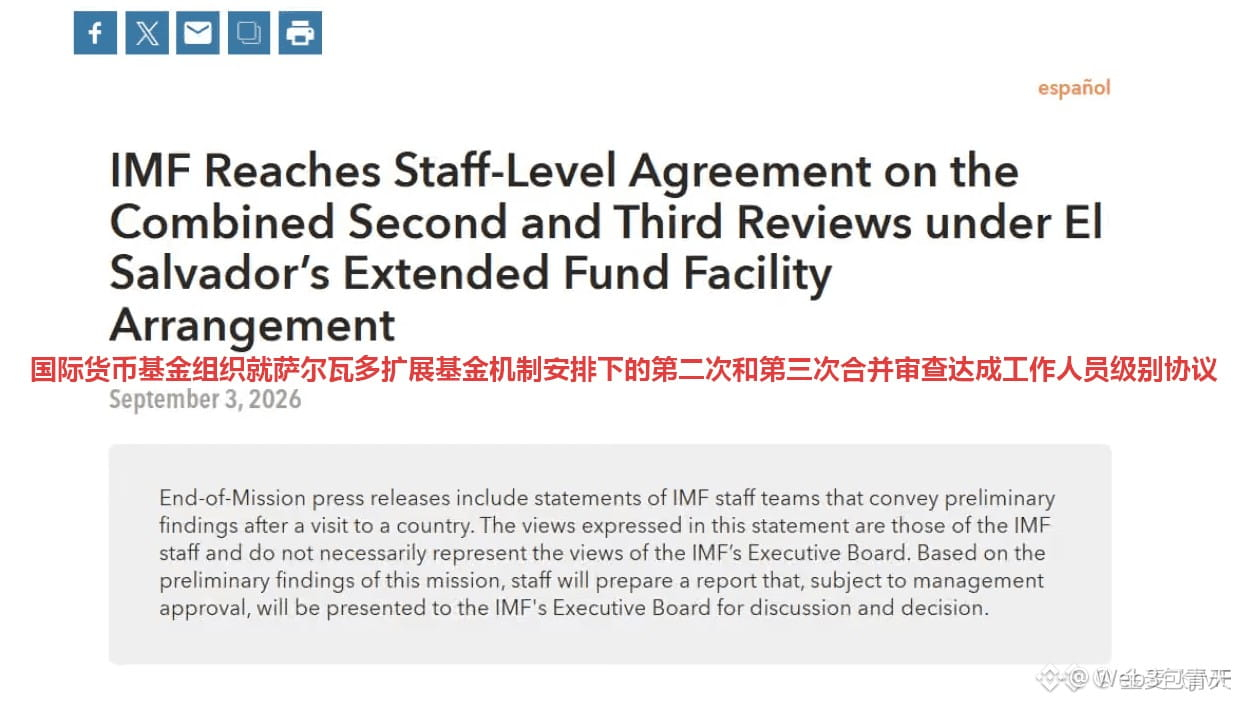
#imf拨款萨尔瓦多并豁免超额购btc
👉 主权持仓怎么看,币安聊天室跟进
The IMF provided a payment to El Salvador.
There was one detail that was overlooked in the accompanying terms.
The pace at which the country buys Bitcoin has exceeded the original cap.
This time, it wasn’t chased and penalized.
You should know that a few years ago, the IMF even used Bitcoin as a bargaining chip.
It demanded that El Salvador shrink the related business before it would release the funds.
Now its stance has become slightly more relaxed.
The reason for the change is very straightforward.
El Salvador’s reserves are profitable on paper.
Its ability to service its debt hasn’t run into problems.
The money is intended for fiscal spending and people’s livelihoods.
It’s separate from the Bitcoin reserves—two different lines.
One line is for paying debts, and the other is for betting on the future.
Sometimes the two lines clash.
Holdings at the sovereign level are always a slow-moving variable.
Buy slowly when buying; sell even more slowly when selling.
They have almost no impact on short-term prices.
What they change is the narrative.
Once a country puts BTC on its balance sheet,
other countries will use it as a point of comparison.
For crypto, sovereign buying is one of the hardest-to-reverse kinds of leverage.
Things written into the treasury rarely flow back into the market.
Do you think other countries will follow suit? Let’s chat in the comments section
👉 主权持仓怎么看,币安聊天室跟进
The IMF provided a payment to El Salvador.
There was one detail that was overlooked in the accompanying terms.
The pace at which the country buys Bitcoin has exceeded the original cap.
This time, it wasn’t chased and penalized.
You should know that a few years ago, the IMF even used Bitcoin as a bargaining chip.
It demanded that El Salvador shrink the related business before it would release the funds.
Now its stance has become slightly more relaxed.
The reason for the change is very straightforward.
El Salvador’s reserves are profitable on paper.
Its ability to service its debt hasn’t run into problems.
The money is intended for fiscal spending and people’s livelihoods.
It’s separate from the Bitcoin reserves—two different lines.
One line is for paying debts, and the other is for betting on the future.
Sometimes the two lines clash.
Holdings at the sovereign level are always a slow-moving variable.
Buy slowly when buying; sell even more slowly when selling.
They have almost no impact on short-term prices.
What they change is the narrative.
Once a country puts BTC on its balance sheet,
other countries will use it as a point of comparison.
For crypto, sovereign buying is one of the hardest-to-reverse kinds of leverage.
Things written into the treasury rarely flow back into the market.
Do you think other countries will follow suit? Let’s chat in the comments section