

Welcome to the OpenSea newsletter. Let’s look back at this week’s biggest NFT and web3 news.
Centre Pompidou launches Digital Art Committee to support on-chain and generative art
According to a press release from the Centre Pompidou (the Paris museum), it has announced the creation of a “Digital Art Committee,” a five-year sponsorship program running from 2026 to 2031 that aims to bring together French and international patrons to support the institution’s work in digital art.
The committee will fund acquisitions for the collections of the Centre Pompidou – Musée national d’Art Moderne, support publications, research projects and exhibitions, and finance conservation work. The museum said the committee will focus in particular on works created and registered on the blockchain (so-called “on-chain art”), as well as new forms of generative art.
Ismail Tazi and Benjamin Gross are the founding patrons of the committee. The museum said it became the first museum of modern and contemporary art to collect blockchain-related works in 2023, and has since added works by Robert Alice, Rhea Myers, and Anna Ridler to its collection.
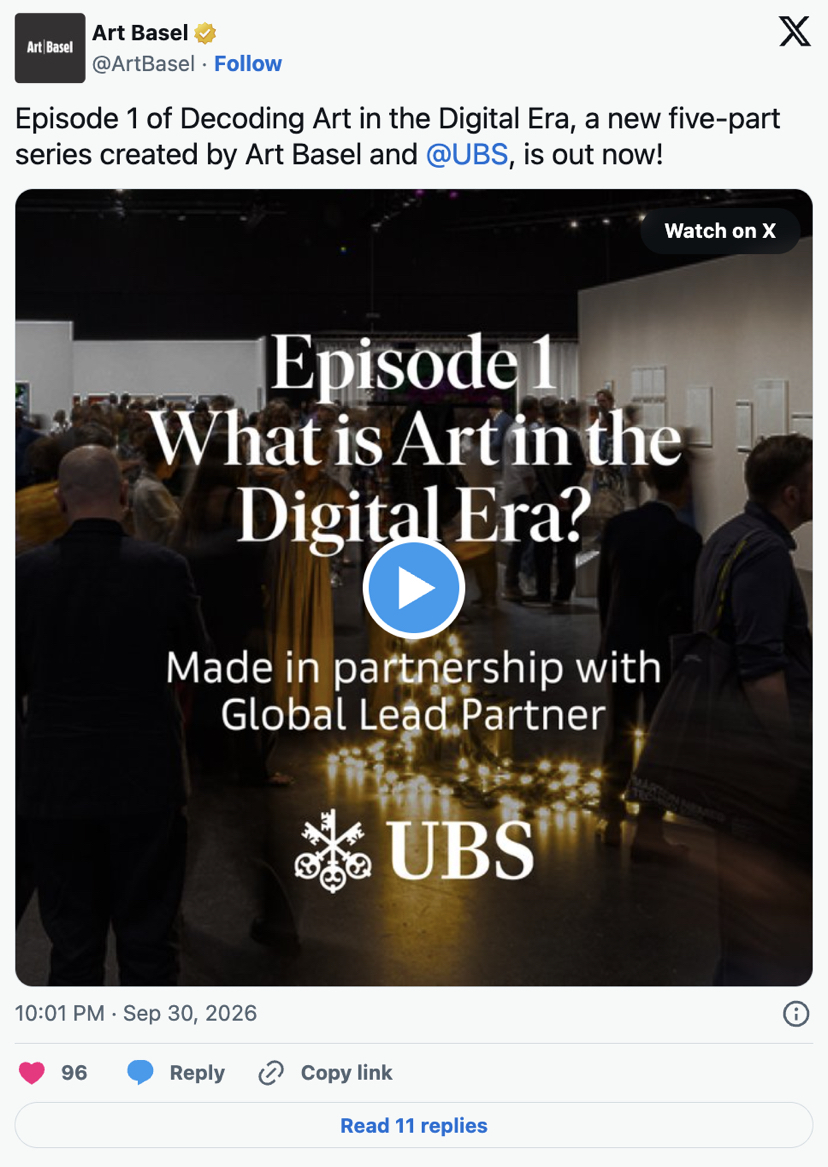
Art Basel and UBS launch a five-part film series exploring art in the digital age
Art Basel and its global lead partner UBS released the first episode of a five-part film series, “Art Decoded in the Digital Age,” on September 30. The series explores how technology is reshaping art.
The first episode, “What Is Art in the Digital Age?,” situates digital art within a 60-year history of artists experimenting with computers and code. According to Art Basel, this practice dates back to the 1960s.
This episode features artists Beeple, Manfred Mohr, Holly Herndon and Mat Dryhurst, and Sougwen Chung, as well as curator Christiane Paul, gallerist Sofia Garcia, critic Shumon Basar, and UBS art advisers Matthew Newton and Carola Wiese.
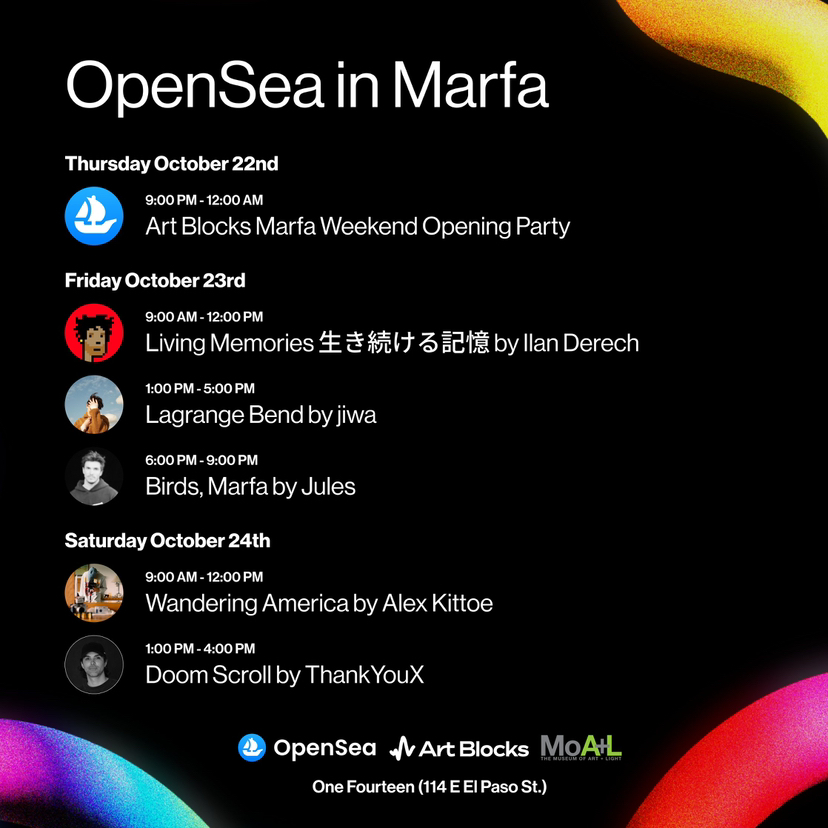
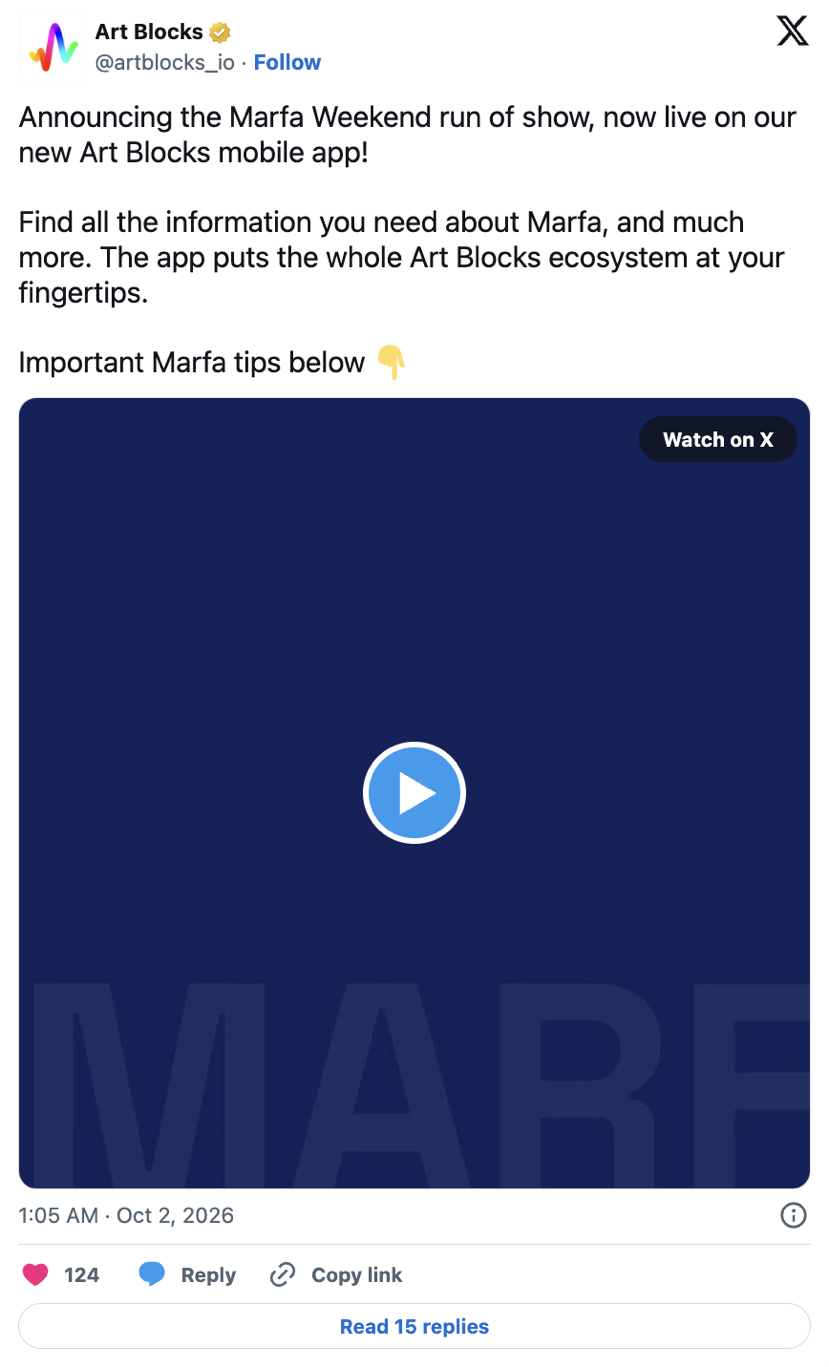
The Art Blocks Marfa Weekend art festival returns to West Texas from October 22 to 25
According to the event registration page, Art Blocks is a digital platform where generative artists can publish artworks created with creative code. The platform will hold its sixth annual Marfa Weekend from October 22 to 25 in Marfa, Texas, bringing together artists, collectors, and the broader generative art community.
The event is free and open to the public, but each attendee must register separately. Art Blocks has announced the full schedule, which includes an artists’ fair at St. George Hall on Friday and Saturday, along with talks, screenings, and panel discussions at the Crowley Theater.
Exhibitions at the Art Blocks Gallery include “Simulacra: Art Blocks 500 Selections,” curated by the Museum of Art and Light, and “Synthetic Terrain,” curated by the Los Angeles County Museum of Art. A Friday workshop on how art institutions are adapting to a changing landscape will feature participants from the Los Angeles County Museum of Art, the Museum of Art and Light, NODE Art Space, and the Centre Pompidou.
Artist 0xfff presents their first solo exhibition in New York at Nguyen Wahed Gallery
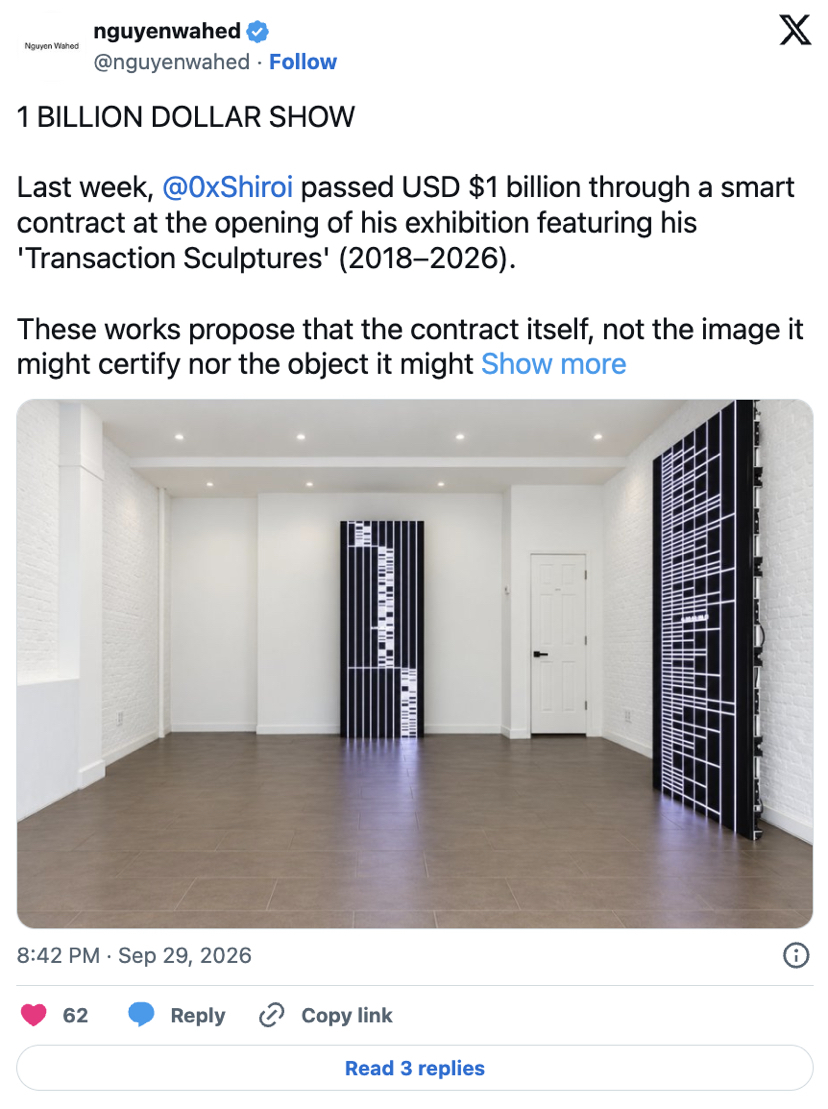
Nguyen Wahed Gallery, which has spaces in New York and London, is presenting “1 BILLION DOLLAR SHOW,” artist 0xfff’s first solo exhibition in New York, on view through October 19.
The exhibition centers on 0xfff’s “Transaction Sculptures” (2018–2026), a series of works made up of smart contracts that can receive and pass value between one another. The gallery describes the contracts themselves—not the images or objects they certify—as the material from which the works are made.
The gallery places this practice within an artistic lineage that includes works such as Sol LeWitt’s wall drawings, Yves Klein’s “Zones of Immaterial Pictorial Sensibility,” and Hans Haacke’s “Condensation Cube.” At the September 25 opening, the artist gave a performance lecture co-hosted by the gallery and Rhizome to celebrate Rhizome’s 30th anniversary. Kim Asendorf was also working on a residency in the basement.
Ethereum Foundation launches zkAPI, letting users pay for AI services without revealing their identities
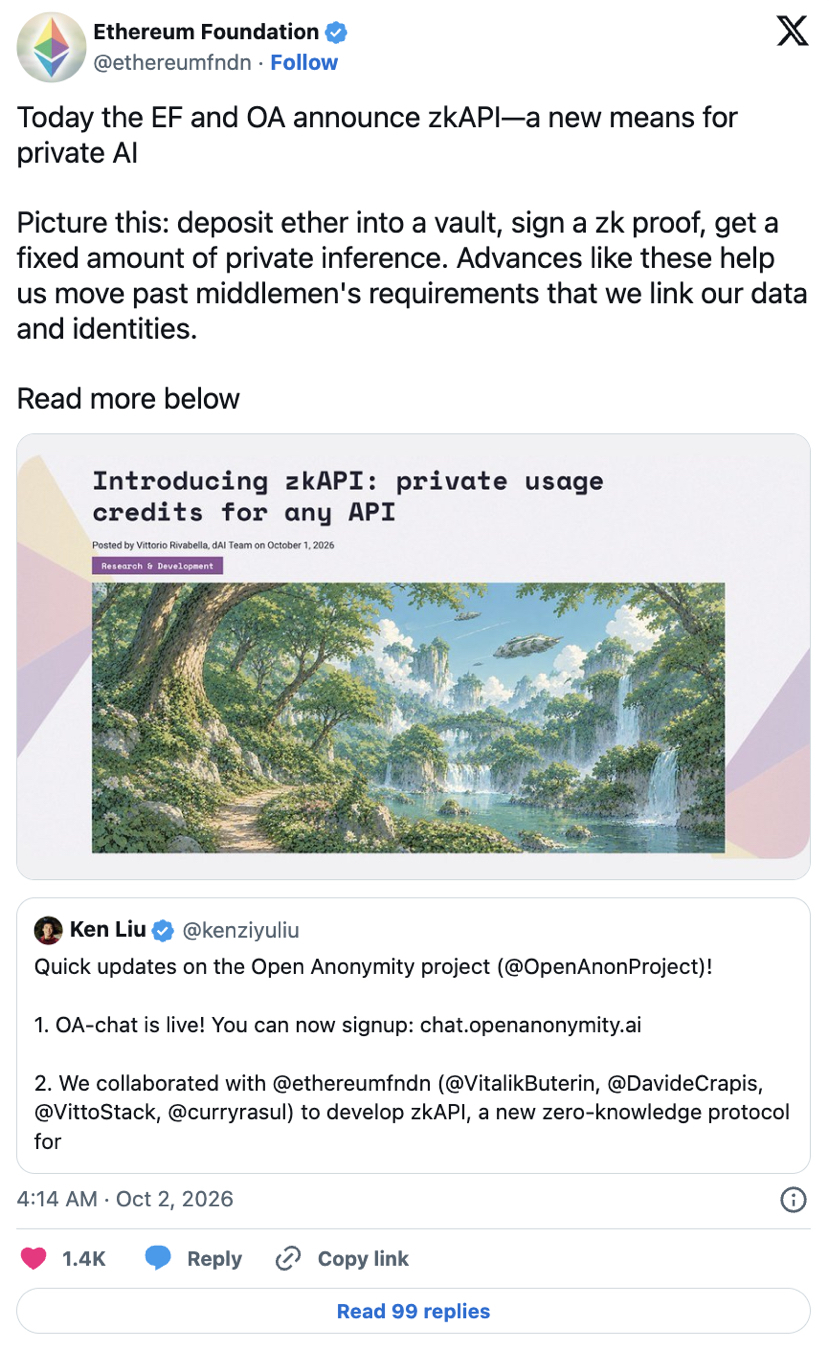
According to a blog post published by the Ethereum Foundation on October 1, the Ethereum Foundation and the Open Anonymous project have launched zkAPI, a system that allows users to pay for AI models and other pay-as-you-go services without linking their identities to their usage. The system is now live on Ethereum mainnet.
Users deposit funds such as ETH or USDC into a vault contract on the Ethereum blockchain. Software on their devices then generates a zero-knowledge proof showing that a request is funded without revealing which specific deposit paid for it. According to the post, the client can work with existing applications that use the standard OpenAI and Ollama APIs.
The foundation noted two limitations: zkAPI does not provide network anonymity, and sessions can be linked back to users through the content of their prompts. The system implements a design co-published by Ethereum co-founder Vitalik Buterin and Davide Crapis, head of the foundation’s dAI team.
Ethereum layer-2 network Blast is winding down, with withdrawals due by October 26
Blast, a layer-2 network built on Ethereum, announced on October 2 that it would wind down because the cost of operating the network exceeded the revenue it generated, and it could see no reliable path to making the chain economically sustainable.
Blast requires users to withdraw their assets to Ethereum mainnet. It will first withdraw assets from Lido, a liquid staking protocol—a process expected to take about a week. Withdrawals will be temporarily unavailable during this period. Once the process is complete, withdrawals will resume, subject to a 24-hour delay.
According to Decrypt, users can withdraw through Blast’s interface until October 26. After October 26, users will only be able to withdraw funds by interacting directly with Blast’s bridge contract on Ethereum. Blast said it will publish instructions ahead of that date.
Blast was launched in November 2023 by the team behind the NFT marketplace Blur, and its mainnet went live in February 2024. Data from DeFiLlama cited by The Block shows that the network had more than $2 billion in total value locked before launch. Its current total value locked is about $32 million.
Disclaimer: This content is for informational purposes only and should not be considered financial or trading advice. Mention of any specific project, product, service, or token does not constitute an endorsement, sponsorship, or recommendation by OpenSea. OpenSea does not guarantee the accuracy or completeness of the information provided. Readers should independently verify any claims in this article before taking action and are responsible for conducting their own due diligence before making any decisions.